Phone Guys: Presentation

The television show Superman and Lois has recently finished its first season. It’s not often I try to keep up with a piece of live-action superhero media as it comes out, but this show, and its cousin Supergirl, are obviously things I feel required to keep up on. But that’s okay, because it’s been mostly decent.
But one thing this show does that I’ve seen in too many adaptations of stuff from comics: it uses names from the source material in ways of which I do not approve.
Here’s what they did wrong (Full of Spoilers):
For the first couple episodes there is a man identified to the audience as Captain Luthor, whom we’re led to believe is the Lex Luthor of an alternate universe. Eventually, this is revealed to be false. He’s actually the John Henry Irons (aka Steel) from an alternate universe.
This is the most forgivable misuse of a name on this list, in part because I genuinely think the show’s creators named the character without knowing where the show was doing. I genuinely believe they did some rewriting and that Luthor was original what he appeared to be. I can understand wanting to change if you think something will work better, but I think they missed a storytelling opportunity here. As far as I can remember, none of the characters are ever led to believe that Irons is Lex. It’s fully a trick played on the audience, never used within the story.
Even so, the reason I find it so easy to forgive is that the Steel reveal was just great. One of the high points of the season.
The use of Morgan Edge as a name on this show is another trick played on the audience, because the character began as he’d appear in comics and went WILDLY different places.
In a way I was pleased, because I was worried that Morgan’s presence meant that they’d be bringing in Darkseid, and as I’ve said, I don’t care for Darkseid in my Superman stuff. But, as I’ve also said before, I prefer Morgan Edge when he’s just a supporting cast member who happens to be a jerk businessman, not a supervillain. That’s not what they did here either.
In the show, there’s an alternate universe in which John Irons and Lois Lane had a daughter named Natalie (I don’t remember catching her surname). In the comics, John Irons has a niece named Natasha. Both go by Nat.
The thing is, I love Natasha. The existence of Natalie on this show almost certainly guarantees that Natasha will not appear. And that’s a dang shame.
And then the worst of all these nominative crimes! They gave the name Dabney Donovan to a normal run-of-the-mill superscientist who was perfectly pleasant, cooperated with authority, and was utterly normal.
Dabney Donovan in the comics is the kind of unhinged loose cannon of science that he created a miniature planet! That had horns! And he hid it in a cemetery! And created life on it that he raised with horror movies! AND THAT IS JUST HIS FIRST APPEARANCE!
At no point should anyone involved in this show have said “We have a scientist here, we could throw in a name from the comics” and landed on Dabney Donovan. Call him Emil Hamilton if you want to phone it in. Call him Harold Vekko if you want to be more obscure. Call him Bernard Klein maybe. Call him Professor Pepperwinkle if you need to. But don’t waste Dabney Donovan on this minor character.
Look, television people. I can promise you that an appropriate name exists within the Superman franchise for anything you’ve got cooked up. I can name those characters for you. Just ask me before you cast Dabney Donovan as the kind of scientist who WOULDN’T create a horned horror planet.
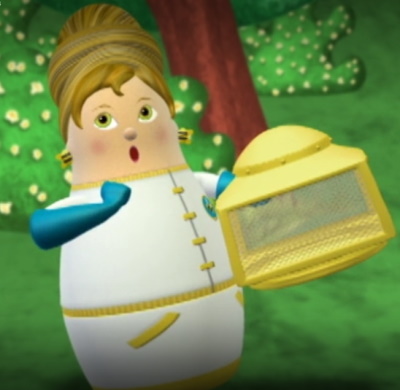
As near as I can tell, Higglytown Heroes was a show about all the different occupations people have in Higglytown. It must have been made by people with good taste, because there’s an episode about a Beekeeper. Kids need to learn. The episode, called “Two Bees or Not Two Bees” naturally, features some kids and some old people and a squirrel (presumably the main cast) who are saddened to learn that the bushes that should be full of higglyberries are not. They summon the Beekeeper to help them figure out what happened.
When she arrives, the Beekeeper Hero investigates a beehive near the bushes and finds it is abandoned (what happened to the bees is unknown), so she has her own bees pollinate the area. She does all this while giving educational lessons to the children. A month later the berries have grown, so the Beekeeper Hero treats the kids to delicious treats of berries and honey. But when the kids hail her as a hero, she makes sure to deflect that thanks to the bees, who are the real heroes. That’s a classy move.
Apart from impeccably-trained bees, does she have any supernatural powers that seem to be different than all the other toy-people of her world? Not that we see. But she has bee-shaped earrings, which is nice.

Three Honeycombs out of Five.
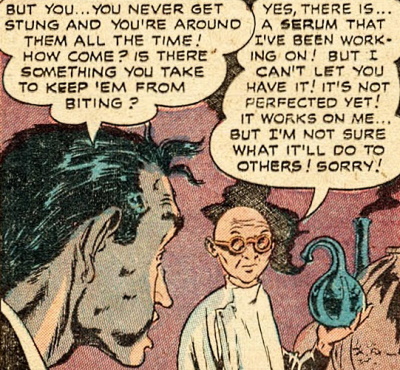
Walter Blane is a Beekeeper who appeared in Mystic #7, a horror comic from 1952. As I’ve noted before, science and beekeeping go together well, and Blane is indeed a scientist doing “special work on bees!” Although we don’t see Blane participating in the actual beekeeping side of the operation, he’s identified as a beekeeper in the text, he clearly loves the bees (they are his “sweet little friends”), and his hives seem to be thriving. The actual beekeeping done in the story is done by a greedy man named Casper who is paid well to take care of Blane’s bees while the scientist is stuck in his laboratory doing research and experimentation. When Casper, the protagonist, learns that Blane has a serum that prevents him from being stung, though Blane notes that it is designed to work with his own physiognomy and any other person who took it would be at risk, Casper steals the serum and drinks some. This, naturally, results in his head mutating into that of a giant bee.
That serum is interesting. All we know for sure is that it prevents him from being stung. It prevented Casper from being stung as well, though it turned him into a bee/human hybrid. Is it possible that Blane is also becoming a hybrid, but since the serum is specifically attuned to him, the effects are less grotesque and more intentional? And that’s just the one experiment we know about. Honestly, it feels like Blane is on the path toward supervillainy. Either intentionally trying to become a bee-man with plans of world conquest, or destined to accidentally become a monster of some kind. But that doesn’t happen in this story. Here, Walter Blane is just a nice beekeeper.
Three Honeycombs out of Five.
Although stories published by Atlas Comics are not generally considered canon in the Marvel Universe until they are referenced, there is nothing here that I can see that would prevent it. That means we can assume Blane or his research could exist in the same universe as Lucius Farnsworth.
