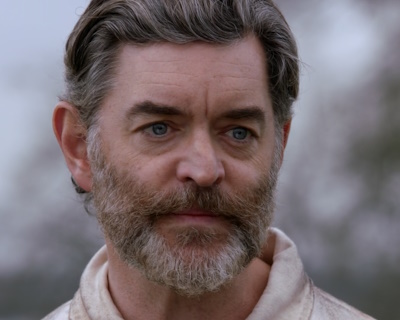
It’s Cain! From the Bible! The show Supernatural kinda plays fast and loose with the stories it takes from the Bible, but the basics of the story of Cain and Abel are there. Cain killed his brother. The reasons may be different and the results may be different, but the core is still that. And, in the world of Supernatural, after Cain killed his brother, he was marked with his eponymous Mark and it kept him alive (even when he tried to kill himself) and drove him to kill more. He went from being a human to being a demon, and even served as the most powerful of the Knights of Hell. He didn’t like it, but he spent thousands of years. But he eventually got out. He fell in love with a human woman and, though it didn’t end well, he swore he’d never pick up his blade again. He retired and went off the grid. And what did he do next? He kept bees!
With the Mark of Cain functioning in a way not unlike Beekeeper Rage, it makes sense he’d find the occupation to his liking. He refers to keeping bees as “very relaxing” and expresses admiration for the animals themselves. It keeps him on the right path for more than a century, he seems to be good at it.Sadly, when he does, because of the plot of the show, take up killing again (specifically going after killers), we don’t see him keeping bees again.
In most ways Cain is as powerful as, say, Beorn was, and maybe moreso. He’s got all kinds of magic abilities. We’re told Cain is one of the most powerful demons in this show’s mythology. He could have rated very high, if he’d just not given up on the beekeeping so easily.

Four Honeycomb out of Five.
I have to note that, like Friar Tuck, Cain exists in the space of legend. Could the popular image of Cain grew so that him being a beekeeper became a well known facet of the tale? Well, it seems less likely to stick than it could for Tuck.

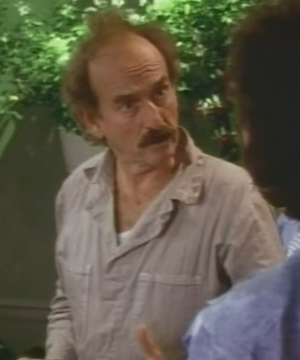
Today I have to grapple with something I should have done before now: the line between entomologist and beekeeper. I might as well do it in the form of a review of Professor Benedict O. Fields, who appeared in the Outer Limits episode called “ZZZZZ“.
Fields has bees that he keeps. There doesn’t seem to be a lot of time and they don’t have a traditional hive that we get to see, but they’re in his lab. And he isn’t harvesting their honey or anything, what Fields takes gathers is information. I’ve said before that science and beekeeping go together well, so keeping the bees to study them works fine for my purposes. Fields is an award-winning scientist with a reputation for perfectionism who has written books about medieval stories of bees and developed a machine that allows translation of bee language into English and vice versa. The man is devoted to bees. He doesn’t seem especially warm to them, and he never gives a speech about how great they are or anything, but comparing to his relationship with his wife I think it may just be because he’s an Early 1960s American Man than anything.
One other thing he did was to “accelerate” his bees to make his bees more intelligent. I don’t know if this was selective breeding or genetic tampering or exposing them to beetronic rays or whatever sci-fi method they could make up, but that doesn’t matter. What does matter is that through this uplifting of the species, he caused his own doom. The Queen of his smart bees fell in love with him and the hive were intelligent enough that they had her take human form to seduce him. They were smart enough to have their queen take human form! The acceleration that Fields did to these bees is frankly miraculous.
Ben falls for the queen’s lies and allows her to become his lab assistant. He’s not interested in her in a romantic sense (completely monogamous this guy), but he’s an idiot if he didn’t understand that she was trying and he should have done something more about it. I get that he lost a child and wanted to fill that hole, but she’s not so clever as she seems to think she is. But then again, I guess what’s obvious to the audience isn’t always obvious to the characters. I guess I can give Fields the benefit of the doubt that he’s not a complete idiot. Anyway, after the Queen kills his wife as part of her plan, he finally rejects her forcefully enough to put an end to it.
So, yes. I’m going to say that Fields “keeps bees” enough to count as a Fictional Beekeeper. He cares enough about them to devote his life to them and invent sci-fi stuff for them. He’d rank higher if he cared enough to KEEP more, but he still keeps.

Three Honeycomb out of Five. Though, honestly, after the events of the episode I have to assume he probably gave it up.

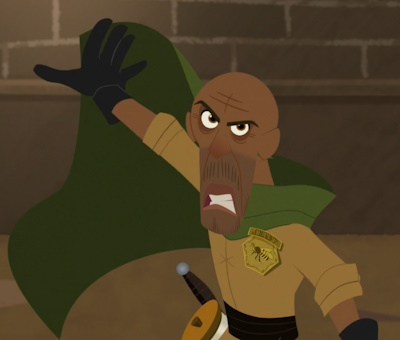
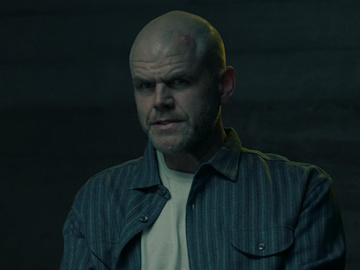
Brother Ellis Kane is formerly Sgt. Ellis Kane, part of a unit of American Marines. When his former Captain was killed, Kane became a suspect in an episode of NCIS: Hawaii. He served multiple tours with the Marines, but it didn’t end well. He got caught up in a whole thing with a corrupt superior and helping protect a friend who was testifying against that superior and all that stuff. The exact details aren’t important, but Kane was drummed out, seemingly haunted by things he’d done and witnessed, and turned to religion. He joined a monastery at which he… you may have guessed it, became a beekeeper. And I’ll cut to the chase, he didn’t do the murder.
Kane is a highly-trained ex-military type, and was depicted as a man who had a lot of anger, though that could very well be understandable anger given he was caught up in wars and corruption. Unlike sufferers of Beekeeper Rage, this guy found peace when he kept his bees. He’s also very willing to put himself in harms way to protect an innocent friend. And I don’t know if this is typical of this kind of show, but he wound up in the climactic showdown alongside the protagonists, which shows he can still be involved in the action if needed. He’s pretty good for a Beekeeper with no supernatural abilities depicted.

Three Honeycomb out of Five. For the record, there are other monks around the monastery too. They never get any lines or are shown doing anything, though. Probably they also help keep the bees, but for all I know the whole thing is Kane’s idea.
“But I had never met Sir John, had never visited Tremoth Hall, till the time of those happenings which formed the final tragedy. My father had taken me from England to Canada when I was a small infant; he had prospered in Manitoba as an apiarist; and after his death the bee ranch had kept me too busy for years to execute a long-cherished dream of visiting my natal land and exploring its rural by-ways.”
Today’s Beekeepers are from a short story from 1933 called “The Unnamed Offspring” by Clark Ashton Smith and it is part of the “Cthulhu Mythos” of stories, which means it shares a lineage with the unnamed Greek Beekeeper I have reviewed before. In that story the Beekeeper was offhandedly mentioned and never showed up. In this one of the Beekeepers is the protagonist, though his beekeeping is only offhandedly mentioned. Well, still better than nothing.
Henry Chaldane is our protagonist. His father, Arthur Chaldane, was the one who originally “prospered in Manitoba as an apiarist” but his father is dead by the time our story begins. Henry took over the “bee ranch” after that and, while it kept him busy for years, he eventually got to a point where either he had enough help running the place he could take some time off, or he just sold it. In either case, Henry is not actively keeping bees at this time, but it is theoretically possible that he has people doing it for him back in Canada while he travels. We know that Arthur was good at beekeeping and Henry seems to have followed in his footsteps, so that’s all good.
But what of the extras of being a Beekeeper? The Chaldanes have no supernatural abilities. We only spend time with Henry and he seems nice enough. He rides a motorcycle, which is unsafe but undeniably cool. When thrust into a horror story scenario, he understands what is going on around him almost immediately. And he’s not necessarily combat-focused by nature, but when given a gun and asked to help fight off a monstrous Ghoul, he does his best. His best fails, but it’s a brave kind of failure.

Two Honeycombs out of Five. I’d love to be able to give him more, but we’re just not given enough information to work with.

Hey you know how neither Spider-Man nor Goofy are known for beekeeping? Well, imagine they were the same guy. Now he’s a Beekeeper! I don’t know why!
This one caught me by surprise. For some reason when the companies who own Spider-Man and Goofy decided to make a comic about Goofy going through Spider-Man’s origin, they added an apiarist angle that neither of the source characters have. The whole story reads to me (and probably could actually be) like one of those Disney comics from Europe that I read and maybe everything hasn’t been translated just perfectly, so maybe I’m missing something. Maybe this makes sense over there. But I don’t have that information, so I can only go on what I see here.
What I see here is a version of Goofy called Goofy Parker who is a student who lives with his Aunt Tessie. Even before he has a superhero origin, he is a prodigy when it comes to entymology and nothing else. He barely notices that other subjects exist. He loves all insects, but the bees that he and Tessie care for are his favourites to the extent that he has named them all individually and will stop and say hi or bye to each of them on his way to school. They provide wax that he and Tessie use to keep their motorcycle nice and shiny.
Unlike Peter Parker, Goofy Parker actually seems to be liked by his fellow students. They ask him to hang out, but he’s always more interested in his insect studies and whatnot. But his origin does soon come to mirror Peter’s very quickly. Goofy discovers an unknown species of spider, it gets radioactive and bites him, he gets powers and he creates the Spider-Goofy identity to try to solve his family’s financial problems. A point of divergence here is that, where Peter ignores a criminal he could stop because he doesn’t think it matters to him, Spider-Goofy ignores the Beagle Boys as they do some crimes because he doesn’t seem to know what’s going on. While Peter loses an uncle because of his choice, Goofy loses his motorcycle, but then makes money from the whole event. Doesn’t really have the same resonance as Peter’s version of the origin doesn’t it? But anyway, after he solves the family’s money problems he also buys nice new hives for his bees.
So we have a Beekeeper who is an expert at insects (and nothing else), who also has Spider-Man powers. That is a powerful combination, to be sure. The only thing I can dock him for is that the Beekeeping is pretty incidental to the Spider-Manning half of his life. If he’d been a Bee-themed hero or something, he’d rate a five, but as it is…

Four Honeycomb out of Five. I don’t know why he’s a Beekeeper!