Beekeeper Review: The Bee Man of Alcatraz

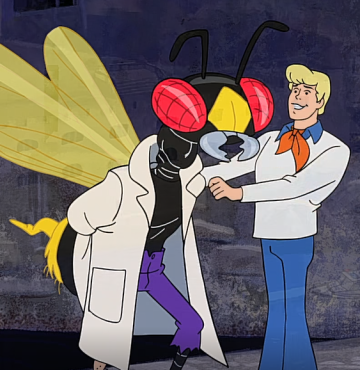
The Bee Man of Alcatraz is a beekeeper and a criminal introduced in an episode of Scooby Doo and Guess Who. Unfortunately, he is only seen at the beginning of an episode, at the end of some off-screen adventure that is being wrapped up in media res. He is unmasked as Bob the Beekeeper.

You might think that this minor appearance would mean I have very little to work with for this review. Not so! We’re talking about a Scooby Doo villain here. I am an expert reviewer of Beekeepers and I have watched an awful lot of Scooby Doo. My knowledge of the abilities of the former and the beloved formulaic nature of the latter mean that I am more than qualified to piece together this tale.

Bob was definitely a beekeeper who worked on or near Alcatraz Island, and he probably had knowledge that there was some manner of secret treasure left behind in the museum that was once the infamous prison there. Perhaps some relative was once a prisoner there and buried it, who can say, but he was definitely looking for something in those walls. He couldn’t very well hunt for treasure with tourists and employees milling about all day, so he did what any criminal would do: he concocted tales of a monster to frighten people away, giving him time to look for his prize. He went with a bee-theme for the monster because that’s what he knows, and it allowed him to use things like wax and bees as part of his ruse. I expect his costume actually allowed him to fly as well.

I think it is a safe bet that when Mystery Inc. showed up Shaggy and Scooby were frightened. There was probably some wax left behind as a clue. It’s quite likely he chased the Mystery Machine around for about the length of a pop song. I figure at some point he tried to sting something and the stinger got caught. And in the end, he was captured in some clever trap.

To review, he’s a beekeeper successful enough as such to be called “Bob the Beekeeper” which means he’s probably at least kind of good at that job. It’s unfortunate he turned to crime, but the fact he has no apparent henchmen means he’s got skills. Those skills aren’t enough to get one over on Scoob and the Gang, but there’s no shame in losing to such an esteemed team of crimefighters.

3 Honeycombs out of Five. It’s worth noting that Bob did not have a speaking role in the episode, so the makers of Scooby Doo definitely need to bring him back, voiced by me.

Beekeeper Review: Jules Beachum

Beekeeping is Jules Beachum’s dream. It started as a mere hobby, but he liked it, so it has become the thing that he yearns to do with his life. Before, he owned a restaurant, but that was just a family business that he’d inherited from his father. When Jules took over, his heart wasn’t in it, and the customers could tell. The business failed.

But Jules’s heart is in beekeeping! Admittedly, he’s off to a rough start. He kept his first two bees in a jar until they died, after which he was surprised to learn that you don’t get honey by mushing up the dead bees. After that failure, he was surprised to learn that you also don’t milk them for honey. Basically, Jules began with an absolute zero in his Beekeeping skills. But unlike the failure with the restaurant, Jules isn’t giving up on Beekeeping. He’s been studying and he’s bought the proper equipment, and it seems like he’s on the path to becoming an professional Beekeeper.

And that heart boosts Jules’s rating in another way as well. As I’ve gone about reviewing Beekeepers there’s one trope I’ve come across far too often: the Apiarist In Distress. If you look back at Holofernus Meiersdorf or Fullan you can see the problem. Those are beekeepers who are just sitting around waiting for a protagonist to come solve their problems. That’s not how high-rating Beekeepers do it. But when Jules appears in an episode of Bob’s Burgers he has a problem: he wants to get back a flat top grill from the failed restaurant so he can keep it in his family. And while the Bob’s cast does get involved, Jules wasn’t waiting for them before he acted. They encountered him in the midst of his scheme. He attempts to steal the grill using disguises and secret passages. Jules is not an Apiarist in Distress, he’s an Apiarist in Action. He may not have supernatural powers or incredible combat skills or more than basic beekeeping talents (yet), but he’s got that extra-special something that can get a Beekeeper an extra point. And all that when he’s got an allergy to bees.

I must include the caveat that there’s always a chance he could reappear on the show and they’d pile on more jokes about his terrible beekeeping and that would hurt his score. But until then: Three Honeycombs out of Five.

Beekeeper Review: Harrison Wilton

Harrison Wilton is a beekeeper that appears on a television show called American Horror Story. The season in which he appears has the subtitle “Cult” and that is appropriate, because Harrison is a cult member. And it seems to me that what drew Harrison to the cult in the first place was a typical case of Beekeeper Rage. In general he was unhappy with his life and his job and that led to Rage that manifested especially as paranoia. He built up a massive gun collection because he was worried the government was going to take away his rights. When the power went out in the area, he immediately assumed it was a terrorist attack. He’s clearly the kind of guy who worried a lot, and a cult leader came along and was able to take advantage of that. It’s a tragedy.

It’s a shame especially because I think he could have been a good beekeeper otherwise. Like the best beekeepers, he would wax poetic about the inspiring insects: “A hive is the perfect natural community because every single member of the hive is completely committed one hundred percent to a singular task. There’s no arguments. There’s no complaints. There’s no ‘me’. I admire them.” In addition to the beekeeping, he was a personal trainer at a gym, which indicates the kind of healthy lifestyle of a good beekeeper and suggests (along with his gun collection) that he may have actually been decent at Beekeeper Combat. And on occasion he seemed nice. He offered candles to his neighbours during a blackout, for example. Granted that may have been part of the cult’s plot, but I expect he would have been capable of such kindness before the cult as well.

But he never got to be the kind of beekeeper he should have been. The cult lifestyle led to his murder by chainsaw. And while that’s a metal way to go, it’s still not ideal. And that’s the true horror story here, America.

Two Honeycombs out of Five.

Beekeeper Review: Dr. Bees

The question I need to tackle in this Beekeeper Review is this: Is Dr. Bees even a beekeeper? Here’s what we know about Dr. Bees: His real name is Dr. Miles Manners and he’s a beelologist and he is the wasp-themed superhero known as the Striped Stinger. But he has a secret identity. He is Dr. Bees! In his own words, Dr. Bees is a “masked vigilante with a load of bees, dedicated to saving mankind.”

Dr. Bees’s costume has a hive built into it, and he keeps bees in jars and briefcases just in case he comes across any problem that he might be able to solve by the judicious application of many bees. His bees seem healthy enough, so perhaps he is capable of beekeeping. But, if anything, he seems less interested in keeping bees than in giving them away.

In a follow-up cartoon we learn that Dr. Bees also has a comic book based on his exploits. When he’s told to tone it down on the bees, he argues that “Bees are my art!” The guy likes bees, I’m saying.

It’s shaky ground, but right now, based on the fact that he’s generally got bees around when he needs them, I’m willing to say, Dr. Bees probably counts as a beekeeper.

Oh right, but even if he is a beekeeper, he’s inept. His use of bees never actually saves the day. In both cartoons he’s dead by the end. Why, I almost suspect that the whole point of these cartoons is what an absurd joke he is. Sorry, Dr. Bees, but we take beekeepers seriously around these parts. I guess I can’t give him more than a minimal rating.

One Honeycombs out of Five. Bee-theming is not enough to count as a good beekeeper.

Beekeeper Review: The Beekeepers of Summersisle

Today’s Beekeepers are from the 2006 movie The Wicker Man. It isn’t a good movie.

Summersisle is an island in the Pacific Northwest which is home to an insular farming community. The big industry on the island is beekeeping. They don’t have a lot of connection to the outside world, but they do sell their honey and other bee-related products online. They make mead for their own use. There are some windows shaped like honeycombs and statues or hives and stuff. They also have “old ways” for treating people allergic to bee stings. In fact, they seem to just generally like nature, as almost everyone seems to be named after after flowers and trees and stuff. On the surface, the place seems absolutely quaint. But they sure are secretive. They just don’t plain like outsiders. So what is up?

It apparently “takes quite a few [beekeepers] to keep order around” Summersisle, but not everyone on the island is an active apiarist. Still, everyone there shares a belief system, so whole don’t intimately get to know any beekeepers, we know that the sort of values they’d have.

Summersisle is a matriarchal society to an extreme. They are, or at least claim, to be descended from Celtic ancestors who “rebelled against suppression of the feminine” and immigrated to America just in time to set up shop around Salem as the whole witch-burning things were going down. Sad to see oppression of women continue, they headed West until they found their current home. But their noble goals of equality have not worked out, because now, in the present, men on Summersisle are the oppressed ones. Male children aren’t educated, they grow up to only be used for manual labour, and they are completely unwilling, perhaps psychologically unable to communicate with outsiders. What does any of that have to do with the beekeeping? Well, it is implied that this is meant to be an evocative the dynamic in a hive, with the queen and all that. The “queen” of Summersisle is one Sister Summersisle, and apparently rulership is a hereditary thing. There’s a level higher than her, though, as they all worship a “great mother goddess” who they feel rules the island. And that’s where things get even worse.

The year before the events of the movie, the island had a failed crop. This is apparently a very rare occurrence, having only happened a few times in the island’s history, but they have a way of dealing with this sort of thing: A bizarre ritual sacrifice they get from a book called “Rituals of the Ancients” which they feel will please their goddess and make everything right again. It’s a dumb ritual. It requires them to find a male stranger who is connected to them by blood. They will call him the drone, for bee-theme reasons. They will run the drone through a dumb obstacle course of confusing scenes and motivations, with the end result that he will be a hunter who they will then hunt and he will come to them willingly. Or something. Outside of the fiction, the confusion is done to keep things mysterious until the end reveal, but within the story, why are they acting like that. It seems to me like it’d be considerably easier to lure the drone in without half the weirdness. How much of their weirdness is legitimate weirdness, and how much is them trying to make him suspicious? And even beyond that, they kill the pilot who brought him to the island because he betrayed them, but they wanted the drone to come to the island, so they totally set that pilot up to be killed. They’re jerks.

Look, I suspect they are decent beekeepers in general, but their belief in this ritual makes me doubt if they actually know what they’re doing.

2 Honeycombs out of Five.