Beekeeper Review: Ghost from Mission Impossible
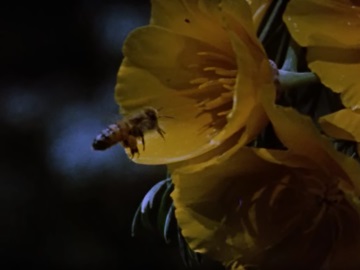
Today’s beekeeper appeared in an episode of Mission Impossible titled “Zubrovnik’s Ghost”. First, let’s have a quick summary of the episode: Some enemy agents are trying to convince someone to defect to their side by telling her that her husband’s ghost wants her to. That’s a lie, though. Her husband, the titular Dr. Zubrovnik, wasn’t even dead for real. For the purposes of this ruse, the bad guys killed a beekeeper and burned his body to pass it off as Zubrovnik. That was a mistake. The beekeeper’s ghost takes its violent revenge on his killers, and the agents that Mission Impossible sent (I’m not going to bother learning which organization stars in the show) get to stand around wondering why this show isn’t about beekeeper ghosts every week.

We never get to see this beekeeper alive, or even learn his name. He’s an unfortunate victim of a murder before the episode even begins, which suggests he may not be the best fighter, but from his position in the afterlife, he displays some real power.
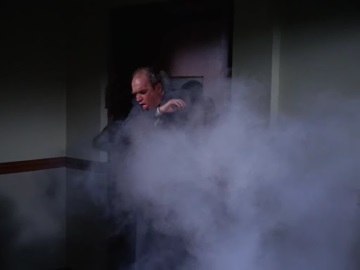
The first suggestion that things are not as they seem is that the bees around Zubrovnik’s mansion are active at night, and even during thunderstorms. Of course, they also wind up swarming the murderers, so it is pretty clear they’re doing the dead beekeeper’s bidding. The ghostly apiarist also displays control over smoke, another standard supernatural beekeeper weapon. Furthermore, his ability to shut and lock doors from beyond the grave should be mentioned. Sure, that’s more Ghost Power than Beekeeper Power, but it is his Beekeeper Rage that brings him back from the grave in the first place.

We do have to address that Beekeeper Rage, though. Now, I’m not going to say getting murdered is something one shouldn’t get a little ticked off about, but as is so often the case, Beekeeper Rage goes above and beyond rational anger. Mission Impossible’s psychic agent tries to contact Zubrovnik’s ghost, but instead find’s the beekeeper, whom she describes as having “unquenchable power”. “It hates,” she says. “It hates!” The beekeeper is using his ghostness to strike out at some bad guys, so I can’t say he isn’t using it in a productive way, but it sure seems to have completely overwhelmed his humanity. Hopefully once the murderers are dead he can find some peace.

It is my understanding, from Internet research, that the Mission Impossible franchise has maintained a continuity that goes all the way to the movies that still come out to this day, rather than having been rebooted like so many franchises. I also understand that the truly supernatural events in this episode are not in keeping with the general tone of Mission Impossible. Since this is supernatural beekeeper exists in a world where that sort of thing is not common, it is actually more impressive that he has these powers.

Three Honeycombs out of Five.
Beekeeper Review: Ulysses Jackson

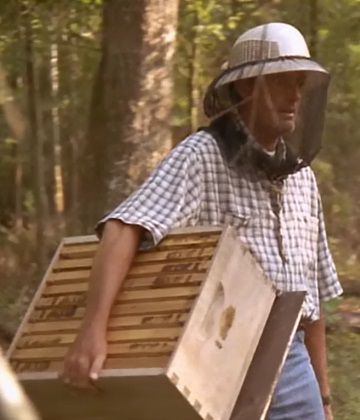
Ulysses Jackson, known as Ulee for short, is a pretty standard beekeeper. Like all the best, he comes from a line of beekeepers (dating back at least to his grandfather). He is just a beekeeper who goes about his business and doesn’t have extraordinary adventures. Most of the time. He is the protagonist of the film Ulee’s Gold.

As of the start of the film, things aren’t going great for Ulee. He’s been working to repair his life after some very bad times, but still things aren’t great. He’s getting old and sore, which makes it hard to do his work. At the beginning of the movie, it is noted that he is working fewer bees than he used to, which means less honey which means less money. Though he does hire part-time assistants, he mostly eschews help as a matter of pride. He’s keeping the business alive, but it is getting harder all the time. His family life is even worse. His son turned out to be a bank robber and wound up in jail. His daughter-in-law has become a junkie and left town. And even after they were recovering from all that, Ulee’s wife died, so now Ulee is raising two granddaughters on his own.

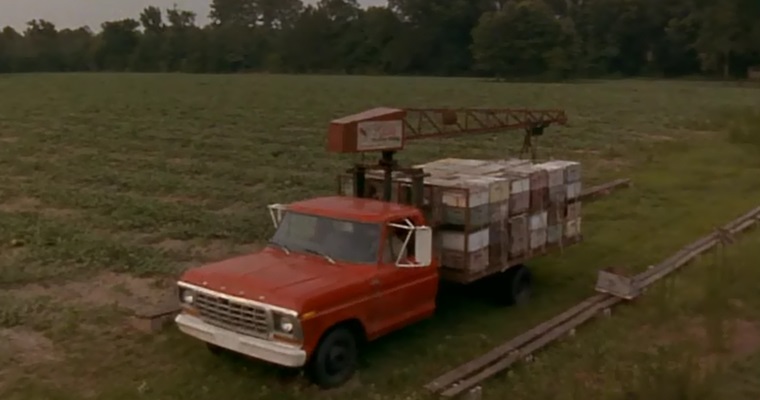
Ulee is not an emotionally healthy person. There’s some PTSD in there. Some Survivor’s Guilt. Many regrets about family stuff. And, naturally, he’s got Beekeeper’s Rage in there too. He’s angry with his son, with his daughter-in-law, with the town Sheriff, with many things. Most of his issues come in the form of trying to avoid showing weakness. He makes his life harder because, as he tells his grand-kids, “we don’t ask outsiders for help”. He tries to do everything on his own, refusing to accept that he can’t. He’s also seems pretty unhappy that his family isn’t likely to keep the business alive, saying “It’s pretty hard work. Most young folks can’t be bothered.” On the upside, he’s got a family dog named “Buckshot” and a truck with a crane for moving hives and stuff. He hasn’t painted it to look like a bee or anything, though. He ought to work on that.

But then, in a “serious drama” movie like this, we aren’t likely to get much in the way of Supernatural Beekeeper Magic, are we? Well, no. But he does note: “The bees and I have an understanding. I take care of them, they take care of me.” And when checking the honeycombs, he does use a smoker, but doesn’t wear gloves. These are minor signs that he has preternatural communication with the bees, but I’ll take what I can get. More significantly though, Ulee is a veteran of the Vietnam war. And it is indicated that his entire unit was killed save Ulee himself. Sounds to me like this Beekeeper can fight.

As the actual plot of the movie unfolds (some of his son’s criminal friends come back to try to find some hidden heist money), Ulee winds up learning that asking for help isn’t a character flaw (in his words “There’s all kinds of weakness in the world. Not all of it is evil. I forget that from time to time.”) and basically everything good that could happen to his family does (the junkie daughter-in-law is brought back and gets cleaned up, the granddaughters get interested in the family business, the son makes peace with Ulee and will probably be out of jail in a year). A happy ending earned by fighting through some tough times, even if it isn’t the punching and kicking kind of fighting.

Three Honeycombs out of Five. I admit I had some doubts about going that high, but then I remembered that’s there’s probably a story in his past about him surviving some real crazy stuff in ‘Nam.

Beekeeper Review: Holofernus Meiersdorf and Sons

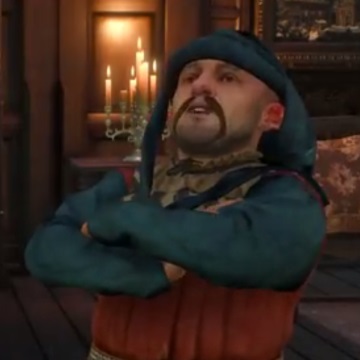
Holofernus Meiersdorf is a halfling beekeeper who lives in the fantasy land in which the Witcher franchise takes place. Previous reviews of Beekeepers in fantasy worlds have provided us glimpses of some very powerful beekeepers. Sadly, Ol’ Holofernus is not another one like that.

Holofernus, with his sons Bernie, Franklin, and Hugo, runs a honey farm called Honeyfill Meadworks. They seem to do a good job of it, so I’m not going to impugn their skills as apiarists. But what they don’t have is that extra something that makes truly special beekeepers. When they think their farm is under attack by a ghost, what do they do about it? They hire the Witcher to solve their problem for them.

These guys live in a world where magic and stuff is all real, but instead of using magic to become Ultimate Level Beekeepers, they’re just ordinary halfling guys who are actually worried about the threat that ghosts could pose. Power to them for being good at beekeeping, but it’s just a shame that they don’t apply themselves and unleash their full potential.

Two Honeycombs out of Five.

Beekeeper Review: Eddie Mapes

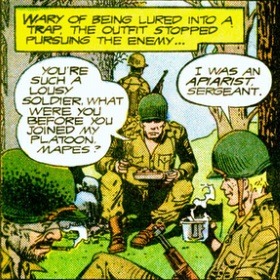
Hey, remember World War Two? It was kind of a big deal back in the day. Were there any beekeepers in there? Of course there were! Today’s beekeeper is from a story called “Hellfire by Night” in issue #278 of a series called GI Combat from DC Comics. It’s August in France in ’44 and an American outfit is trying to bring down a panzer tank.

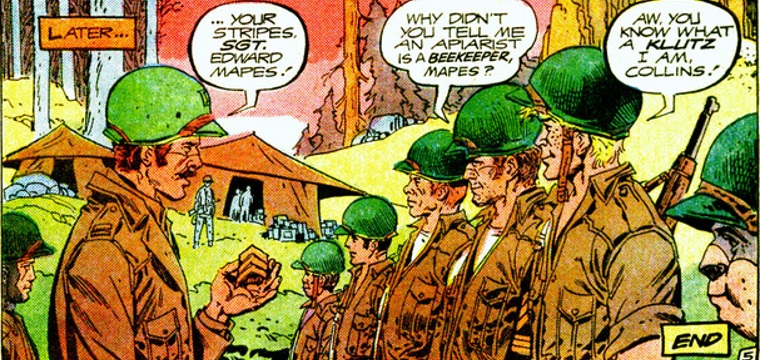
Beekeeper Eddie Mapes is a private in the unit, but he isn’t very good at it. His Sergeant sees him as a worthless klutz and makes sure that Eddie know it. When the tank makes a sudden night attack, Eddie runs off into the woods and the Sarge thinks he was deserting, so he attempts to have him tried.

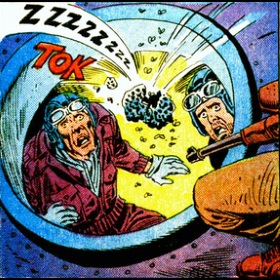
But actually, Eddie had never intended to desert. He’d actually gone out into the woods to find a beehive. Sarge considers this the craziest thing he ever heard, but the unit’s Captain decides to give him the benefit of the doubt and Eddie gets to go ahead with his plan. The next time the tank attacks, Eddie crawls stealthily up to it, climbs on top, opens the hatch and throws his beehive in. The Nazis are driven into a panic by this sudden bee assault and crash their tank and die. Promotion ahoy!

Note that Eddie could probably have done this plan just as well with a grenade. Or he could even have used the gun that he brought with him. But that ain’t how beekeepers roll.

We don’t know all that much about Eddie. He’s probably at least a normally successful beekeeper, but what about supernatural powers? Well, he holds on to the beehive for hours without so much as being bothered by a bee, so either they knew he was able to keep them calm (smokelessly) or they were just cool with him to begin with. Also, the fact he was able to find the beehive in the woods in the first place could be a sign of some sort of bee-sense. Nothing that raises him to the potential demi-god status of beekeeping, but it makes up for his initial failures as a fighter.

Two Honeycombs out of Five.

Beekeeper Review: Mirasol

“When human beings first discovered honey, they had hunted the wild bees and followed them back to their nests. Some enterprising honey-lover must have noticed that bees often nested in hollow trees, and so, perhaps, rolled or dragged or hacked out a suitable log nearer hoe, left it at a convenient spot, and hoped a passing swarm might settle in it. Eventually someone began experimenting with making hives out of straw, mud, clay, pottery, and with sowing the seeds of plants bees were seen to like; and eventually with breeding more docile bees.”

This history of beekeeping comes from the point of view of a young lady called Mirasol. The protagonist of the novel “Chalice” by Robin McKinley, Mirasol lives in a place called the Willowlands in a fantasy universe that relies very heavily on traditions. The Willowlands are governed by a body called the Circle, eleven mystically appointed individuals who keep the realm from tearing itself apart, literally and figuratively.

At first, Mirasol is just an ordinary civilian, keepin’ bees out in the forests of the Willowlands. Even at this point, she’s damn good at beekeeping. From a line of beekeepers going back at least as far as her great-grandmother, she is the most successful beekeeper in the Willowlands. It is widely acknowledged that her bees produce the best honey “because they like [Mirasol]” and she knows how to treat wounds, such as burns, with honey and make candles from beeswax that contain honey for scenting. Her bees are “unusually large” and “only their bellies were striped yellow; their backs were a black as velvet-gloss as a fine horse’s.” She also has a policy of helping her colonies survive through the winter, instead of culling them as the other beekeepers in the realm do (which probably is why the bees like her).

But that’s just the beginning for ol’ Mirasol! Because after a tragic turn of events that results in the death of several members of the Circle, Mirasol is chosen by the mystical powers that guide the land. Mirasol is made the new Chalice, which is not only a member of the Circle, it is the highest ranking member. The bad news is that Mirasol was never given the training she needed for a magical and highly ceremonial role. To make things worse the turmoil of Willowlands are “teetering on the edge of disintegration” because of this traumatic changeover. Spoilers though: in the end thing turn out well enough for the Willowlands. I’m here to talk about her powers.

Becoming the Chalice gives Mirasol’s already impressive Beekeeping Stats an incredible boost. Every Chalice is connected to a symbolic fluid, mostly water or wine, though there are historical precedents for milk or blood, but Mirasol becomes the very first Honey Chalice. Almost as soon as she is chosen as Chalice, her bees just go into overdrive. They dedicate whole hives to storing honey without combs, so Mirasol can drain the honey without the need to break anything, and in other hives they store empty wax for her to use for things such as make candles. They even seem to store excess pollen for the winter. Furthermore, she develops an ability to “listen” to honey and tell what kind of benefits it has, which is good because her bees produce a bunch of different types of honey. There’s a honey for helping one sleep and another for giving one energy to stay up. One is good for curing stomach-aches and another keeps dogs from barking. Basically, she’s got a bunch of magic potion honeys on tap and ready to use.

Given that they already liked Mirasol, it is no surprise that in her powered-up form, her bees never sting her and she never needs smoke to calm them. They also develop a tendency to follow her around in small groups, helping her out or protecting her. When the final climactic scenes of the book come, her swarm is joined by bees that aren’t from her hives, and even wild bees.

Finally, Mirasol does get angry from time to time, but never to an extent that it seems to be Beekeeper Rage. Thus, I have to say that the one and only thing that keeps Mirasol from getting a perfect score is that she shows no skills as a fighter. And personally, given how well she picked up being the Chalice of the Willowlands, I bet that if she tried it out, she’d master it pretty easily.

Four Honeycombs out of Five.