Planet Gurx: Strondovarian Reproduction

The Strondovarians (and, indeed, most life on Planet Gurx) don’t have the biological sex differentiation that we see here on Earth. Every Strondo has the same reproductive organ (they call it a Thebwont), which is located between their legs inside an orifice from which it can protrude when needed for copulation. The Thebwont has bits for expelling genetic material, as well as bits for receiving it. During copulation, a Strondo’s Thebwont docks with their partner’s Thebwont and they exchange their material and take it into themselves, where impregnation can happen.
Unlike humans, while a Strondo is pregnant they can not copulate, so it is fortunate that they don’t place the value on sex that we do (they like it fine, but their hedonistic tendencies more often point toward eating and mind-altering substances). The Thebwont undergoes a transformation during pregnancy, taking on the role of a womb. Gestation lasts for about six Earth-months (I’m just going to use Earth times for now for ease of translation) and the infants (usually one or two at a time) are born live, after which the Thebwont will return to copulationable form. If a Strondo has been pregnant about five or six times, the Thebwont can become incapable of the transformation, leaving the Strondo still capable of performing the sex act, but sterile.

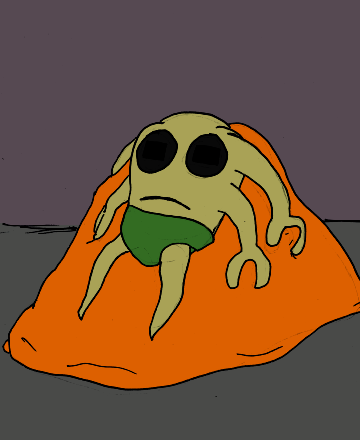
Here we see Nibnassin, our Strondo volunteer, as an infant from an old family picture. The intricate musculature and large brains of a Strondo are still developing when they are newly born, so they need a lot of help for the first couple years. Fortunately, Strondo parents (the Strondo who gave birth being the one considered the parent) are usually quite attentive.
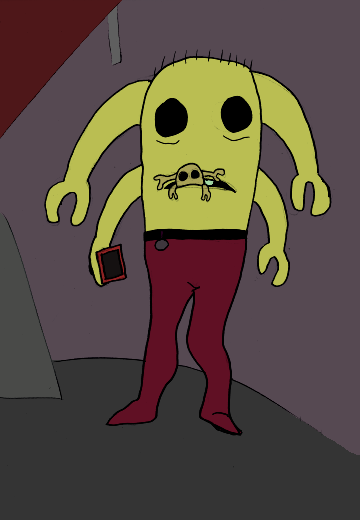
For about the first five years of their lives the young Strondos are in a “toddler” stage, learning to walk and move and speak and all that as they get bigger. Here were see young Nibnassin hanging out in their parent’s mouth, which is a common thing on Gurx. Because things in the mouth cavity aren’t digested unless the Strondo consciously focuses their Rel tow the task of pulling it apart and forcing it into the stomach, it’s actually a safe place for Strondos to store things, including their young kids. While in the mouth cavity the young Strondo can share food being eaten by the parent and, in the process, pick up valuable bacteria from their parent to develop a healthy gut biome.

After about five years the young Strondos are usually too big to fit in their parent’s mouth anymore, but that’s okay because they’re also now able to walk and move as deftly as they would be for all their life. They continue to grow until about eighteen to twenty years, at which point they reach their mature adult size and would now be capable of reproduction.

An average natural lifespan for a Strondo is about 120 Earth years, but they rarely live by their natural standards anymore. Technology has advanced enough for the species that the lifespan can be extended in various ways, including suspended animation used, most often, in space travel. There are Strondos out there who were born over three thousand Earth years ago, but most of that time was spent in stasis.
Planet Gurx: The Strondovarian Legs

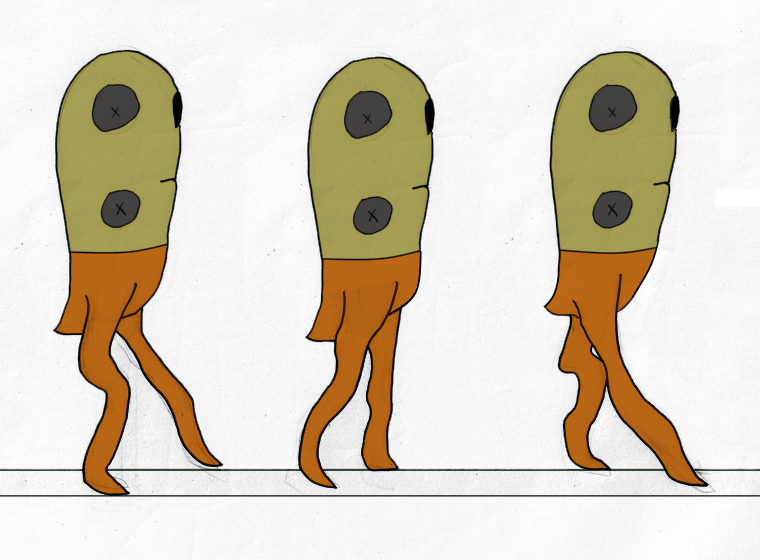
Strondovarians stand bipedally on legs quite unlike those of human legs. A human seeing a Strondo’s legs would think they look serpentine and bend all wrong, but that’s just how they function.

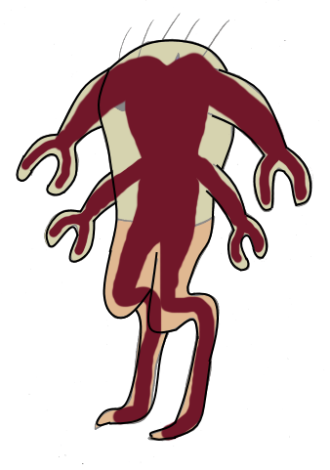
As I’ve said in previous posts, they Strondos don’t have skeletons as we know them on Earth. Instead they have an interlocked system of dense muscles, tendons, and sinew that support their weight and can push and pull against each other to achieve movement. This setup allows for their limbs to be extremely flexible.

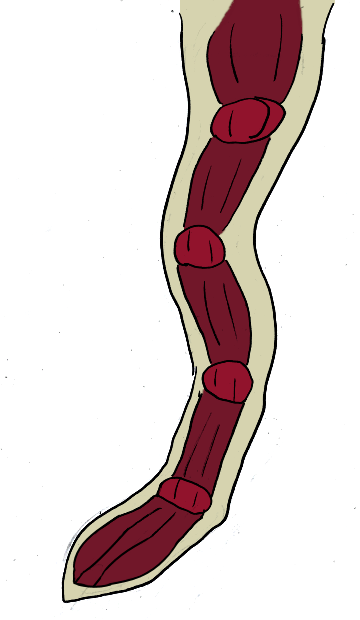
Here we can see a rough, simplified look inside Nibnassin’s leg. The multiple “knees” in a Strondo leg are clumps of muscle able to swivel in multiple directions and also to “lock” so that they remain in a certain position while other muscles use them as leverage for moving themselves. The longer muscle masses in the legs can rotate and stretch or contract as needed. The primary function of this design is to be able to shift around and funnel the weight of the Strondo to the “sole” where the leg actually comes into contract with the ground while keeping the torso at a generally consistent level.

When walking, the weight is shifted to one leg and then the other end probes forward to find a foothold. When that foot is planted, the weight shifts and the other leg catches up. This is all done with minimal conscious awareness from the Strondo. It would look strange to human eyes, but rest assured they would find our endoskeletal lumbering just as strange.

Strondo hands are similarly flexible, but I don’t think we’ll need to get into a post all about it at the moment.

This bodyplan, with these flexible legs making it possible to walk bipedally, has proven quite successful among Gurxian life in the current age, with many “animal” species being part of this type. They’re called “Aehubar” in the Strondo language. We’ll get to non-Strondovarian life on Gurx at some point down the line. Although there are Aehubar that can jump quite well, Strondovarians are not among them, with most not being able to jump at all.

Planet Gurx: The Strondovarian Tongue

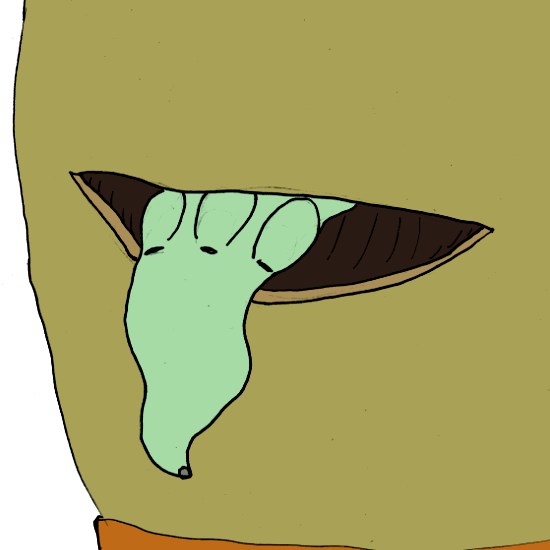
It’s not technically correct to call this organ a tongue, so I think I’ll use the Strondovarian word, the “Rel”. The Rel is positioned on the roof of the Strondo mouth and serves multiple functions. Let’s examine the Rel of our volunteer, Nibnassin:

Here, Nibnassin is straining to stick their tongue out as far as possible so we can get a good look at it. It’s a pretty flexible muscle organ, but spends most of its time inside the mouth. It does have a saliva-like secretion that can help break up food (in some Gurxian animals that saliva is also sticky so it can catch small prey, but not in the Strondos). When a Strondo is holding a piece of food in their mouth cavity, the Rel will poke at it and mash it around, making it easier to transition it into the stomach.

But the Strondo is also a sensory organ. The Rel is covered with cilia-covered sensors that picks up sound waves. In conjunction with the sensory organ around the breathhole on top of a Strondo’s head, they can get a stereophonic sense of the world around them, though less so than humans. In spite of their weaker hearing, the Strondovarians do have a spoken language akin to humanity’s many such languages.

The other sensory purpose of the Rel has evolved to help them speak that language. The base of the Rel is ringed by sacs which can intake air and examine the particles in them, like the olfactory system in humans. This is their sense of smell, and taste, that lets them enjoy the food being pummelled by the Rel and, as noted when we looked at the lungs, the Rel’s air-intake is not at all connected to the respiratory system. The second use of these sacs comes when they release their air: they make sounds. That, combined with the echo chamber of their mouth cavity, is how they make speech. It is a breathy language and, because one of the sacs can be taking in air while another is letting it out, they can speak interminably without our need to pause to inhale. (It’s worth noting that there is an enforced monoculture among the Strondos. Only one language is permitted to exist.)

So that’s the Rel. A tongue, several noses, an ear, and a voice all in one. You can tell a Strondo is paying attention when their mouth is open, so the Rel has its clearest sense of the world.

Planet Gurx: The Strondovarian Body Plan (pt 2)

Picking up where we left off last time, let’s take a look at (simplified PDR-style drawings of) what it looks like inside Nibnassin, our Strondovarian volunteer.

The Strondovarian Body Plan, Inner Workings

Strondovarians don’t have skeletons. Their bodies are supported purely by a system of sinew and muscle. The gravity of planet Gurx is less than that or Earth, so they can support a denser mass of muscle than Earth-bound beings. Their legs are an especially complex system, but I’ll have to give them their own post sometime.

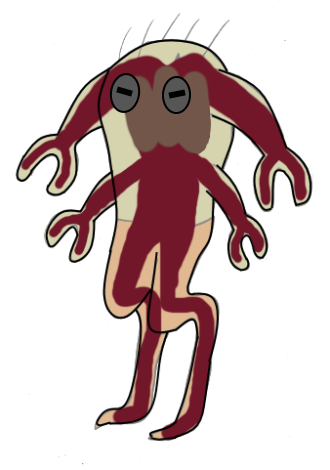
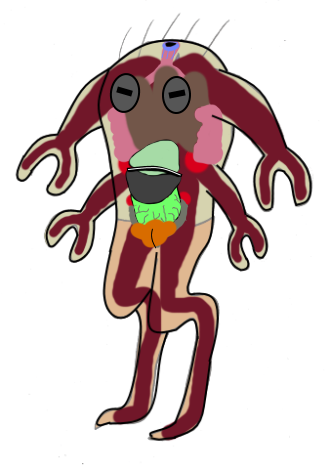
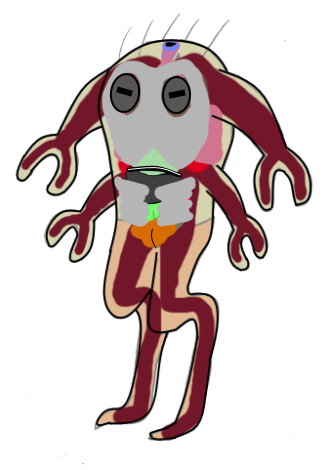
Here we see the three-sectioned Strondo brain, as well as their eyes. Note that the sclera of the eyes is usually darker than this, but it’s been lightened so that we can make out the pupils.

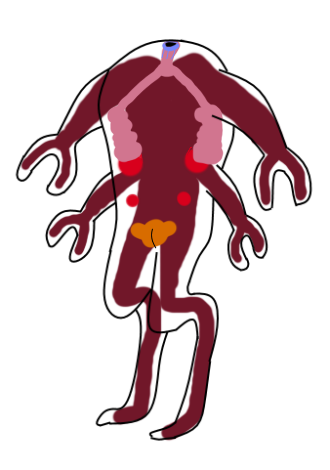
The breathhole on the back of the Strondo head is connected to two lungs, one on each side of the Strondo’s brain. Around the entry of the breathhole is a sense organ the main purpose of which is to test the temperature of the air, but which also does pick up a bit of audio input (Strondo hearing is not as strong as human hearing). There are four hearts to pump blood through the Strondo body, two of which are directly connected to the lungs. The reproductive organ is positioned between the legs and can expand through an orifice to exchange genetic information with a partner, or it can take in genetic information from a partner and use it to create new life, which is gestated inside for a time before being born live, though significantly smaller than a human newborn.

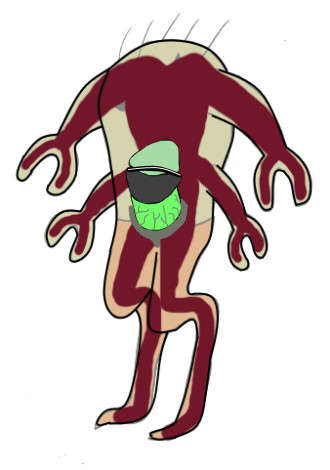
The top of this group of organs is one which we can call a tongue, but which is actually much more complex than that. It, like the legs mentioned above, will merit its own post, but in brief it is involved in eating, hearing, speaking, and smelling. Below the tongue, right behind the mouth opening, is a cavity in which food is kept and picked apart by the tongue, to be dropped into the stomach, which is that acidic organ below the mouth cavity. The stomach essentially works like that of humans, and leads into a short digestive track that pumps the good stuff back into the body via the lower hearts and pumps the bad stuff out through the tube in the rear.

Here we see as many of those organs as we’ve covered thus far. There are other small organs in there as well, but this is getting long again, so we’ll not worry about them right now.

But before we wrap up for today, we should note that even without a skeleton, the Strondos do have some hardened plates held in place by their musculature that have developed to protect the vital organs from the front. From behind, these organs are already protected by the dense musculature. None of these plates are as strong as the human skull, but combined with the leathery skin of a Strondo, they do alright.

Planet Gurx: The Strondovarian Body Plan (pt 1)

A few years back I did a couple years of “Alien Sundays” where I would introduce ideas for alien species. Eventually those posts had to wind down, but just because I haven’t posted about them in a long time doesn’t mean that I’ve stopped thinking about my aliens. I do an awful lot of worldbuilding that I don’t tend to put on my site because I hope to use it in stories, but then I never get around to writing those stories.

Over the past few months Youtube has been suggesting an increasing number of speculative biology videos to me. I love that sort of thing, so the algorithm is correct to suggest them to me, but more importantly, it occurs to me that if there are so many videos on the topic, there may be some audience out there who may have a hunger for the kinds of ideas I’ve been working on. The problem is that those videos are done by smart people who have done actual scientifically valid calculations and thoughts of how their imagined lifeforms would evolve. I didn’t do that.

For example, my Strondovarians: I had the species name in some notes for a story idea. I also had a sketch of an alien with weird legs and four arms that I doodled once. When I felt like working on it, I decided that that alien sketch could be a Strondovarian. It was only then I started fleshing out their world. I did it utterly backwards compared to the speculative biology folks I enjoy so much. But y’know what? That’s fine. My universe is already one in which magic and monsters exist, so it was never scientifically accurate. I can just have my fun.

So I’ve decided I’m going to first go public with my notes relating to the planet Gurx, home of the aforementioned Strondovarians (Strondos for short). I figure I have enough in my notes to do a weekly post for a year, so it’ll be just like old times, only moreso!

The Strondovarian Body Plan

This is Nibnassin, a fairly typical Strondovarian. In the hopes of making it into medical history books, Nibnassin has volunteered to be scanned by various medical devices for the benefit of students. Thankfully this means I can teach you some of the basics of the Strondovarian body plan (bearing in mind that PDR’s drawing style is oversimplified and cartoony).

Here we have Nibnassin without their clothing and tattoo. Don’t feel embarrassed for our volunteer Strondo, though, because the Gurxian monoculture holds no taboos about nudity. This allows us to see the main bits of a Strondo. Two eyes and a mouth in a layout that humans would be familiar with, and an orifice between the legs involved in reproduction, again in a place that humans would recognize. Light fuzz on the top and back that can occasionally grow long. It is, of course, worth noticing that the Strondos have four arms in addition to their two legs.

Here we have Nibnassin from behind. On his head there is his breathhole. The Strondo mouth is not connected to the respiratory system, all oxygen is taken in through this orifice. Down in what humans would call the butt region we have what looks like a little tail, but is actually a tube with a hole that is the end of the Strondo digestive system. They expel their waste through there.

Well, I’d hoped I could be getting into the inside parts of a Strondo in this post, but it’s already much too long, so we can do that next week.