June 2 Phone Guys

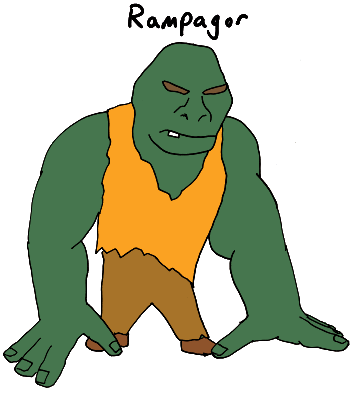
Rampagor
John Hong is not a bad guy, but he has an unfortunate condition. When exposed to certain levels of pollution, John transforms into a hulking monster and proceeds to demolish anything in sight that he deems unnatural. When the monster’s temper wanes, John turns back to normal and has no memory of what happened. While the monster, Rampagor, obviously has to be stopped, the only way to do it seems to be to keep John in a pristine biodome.
Rampagor is a Hulk-style character, but without the idea that underneath it all he’s a hero. Rampagor is a beast that, without superhero intervention, can level cities, but is it right to kill, or even just to imprison John for its actions? That’s the sort of thing we would have to think about in a Rampagor story.
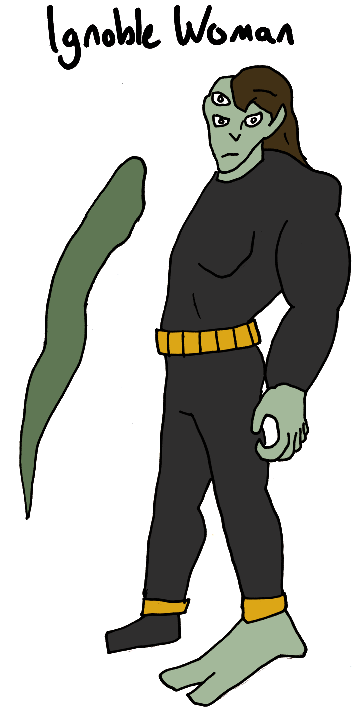
Ignoble Woman
When a being as powerful as Noblewoman shows up, that attracts attention. For scientist Amalia Tiglao, that attention came in the form of jealousy. Why should some superhuman freak get to enjoy the advantages of higher spatial dimensions while she, a scientific genius, was stuck in the limiting three dimensions? It took a lot of work, and some shady deals to acquire funding, but she eventually devised a process that would, in theory, replicate the hero’s powers. Unfortunately, those powers came at a cost, leaving her transformed into a strange and chaotic form. Now Amalia blames Noblewoman for her predicament and, of course, is now a supervillain intent on bringing down the world’s most powerful hero.
One of the things that bugs me most in superhero comics is how “personal” the stakes always have to be. It seems like every series gets to the point where the only thing the hero does is react to villains who are actively driven by their hatred of the hero. I like it when superheroes solve problems for people, not just to be dealing with their own dramas while crumbling cities around them. Anyway, Ignoble Woman is an example of the sort of thing I don’t like, so the stories about her would have to directly deal with all that.
Like the villain Hurtch, Ignoble Woman is a being that extends into higher space, so parts of her, the tentacle arm thing, appears unconnected in three dimensions.
It’s 1935 and all is not well in the penitentiary system. But here comes Ol’ Agnes MacPhail to bust some heads. She’s the first woman to check out the conditions in the prison and she doesn’t like what she sees. Her train of thought seems to be: “Hey, beating these guys up isn’t making them better citizens and actually might cause some problems in the long run so, maybe let’s not do that?”. The guys in Parliament assure her that she’d just too delicate, because she’s a boobhaver, to know what prison is all about. She shows them what actually goes on in the prison (I guess they’d never actually bothered to check) and seems to pretty quickly get people on her side.
It’s a good thing to remember both our first “woman MP” and that improving prisons is a good thing, so that’s nice. The “Is This Normal!?” is definitely memorable, but it is not especially useful as a quoteable line. The parliament scene reminds me of the bit in the Moment about the women in the medical system. An established patriarchy trying to shout down the women who are trying to making progress. At least that other group had some glorious sideburns. I think I settle somewhere about Four out of Six Pieces of PDR’s Reviewing System Cake here.
Latest SecGov Page:
