Planet Gurx: A Timeline

So far in my Planet Gurx series, I’ve covered a lot of information about the Strondovarians, the current dominant species of the planet, and not a lot about the planet Gurx itself. So today, let’s just lay out the history of the planet. (To avoid complication, we’ll be measuring in Earth years, instead of translating the system Strondos use to keep time.)

Roughly 6 Billion Years Ago: The planet Gurx comes into being around a star that the Strondos will eventually name “Ahan”. As time goes on, the planet is bombarded by meteors and oceans form and all that good stuff.

Roughly 4 Billion Years Ago: Multi-cellular life begins to form in the oceans of Gurx. Over time it evolves into what we would recognize as the Gurxian equivalent of animals and plants.

Roughly 1 Billion Years Ago: Complex life has spread through the oceans of the planet. While there are many types of animals around this point, one of the most successful and widespread is a family of four-sided symmetrical creatures with exoskeletons (Strondos will call this branch of the tree of life on Gurx “Vootuph”, or Four-siders).
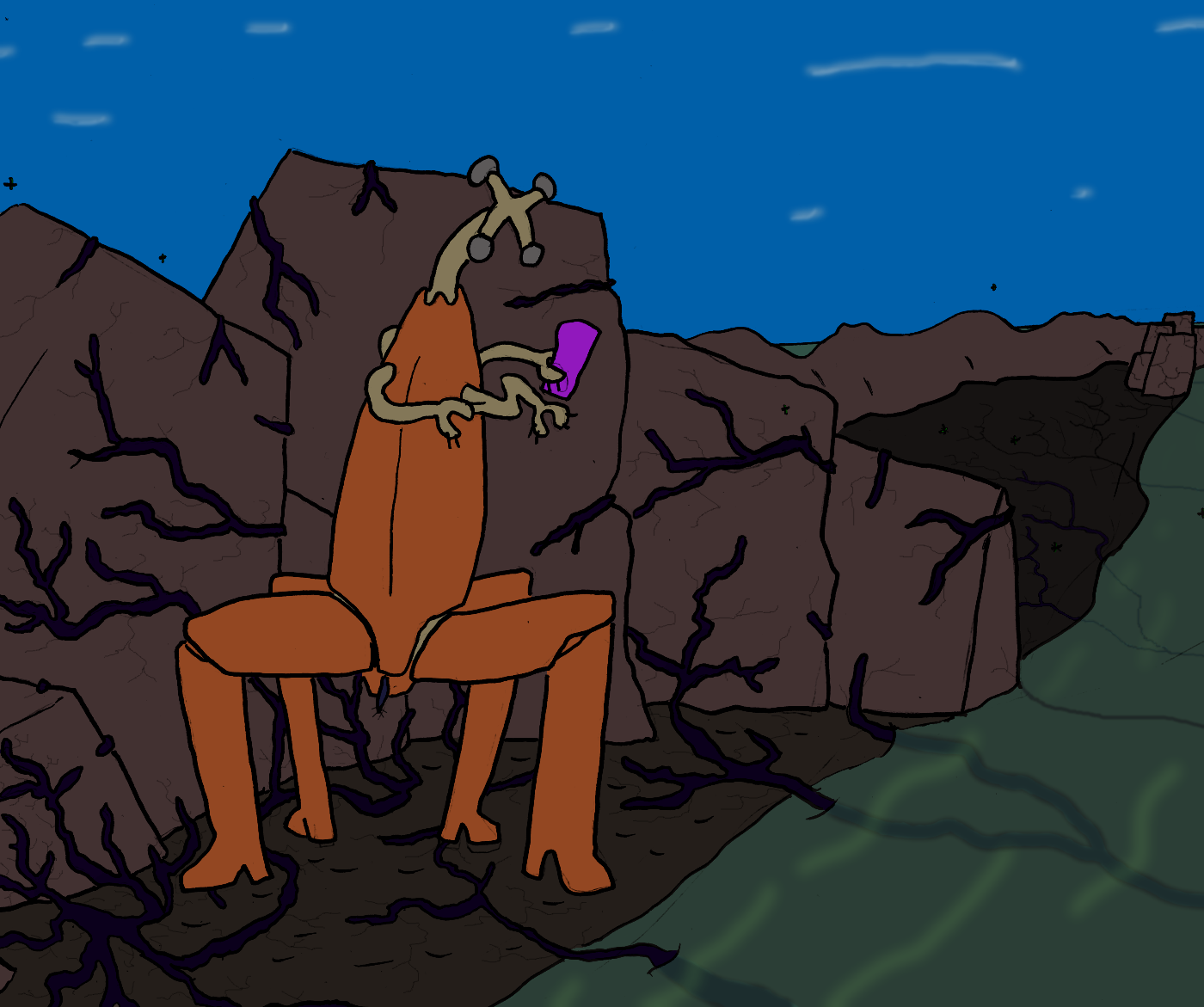
Roughly 500 Million to 250 Million Years Ago: Life has spread to the surface of Gurx, as plants and as Vootuph that have adapted to an aquatic lifestyle. Back in the waters one of the newer family of animals to come along has a body plan that includes musculature that functions as a skeleton and six limbs (“Lapaouger”). In the later years of this era a species of Vootuph will evolve traits such as community, tool-use, and intelligence that would be recognized as being on par with human or Strondo life, but their time is brought to an end by an extinction event that wipes out most of the life on the surface of the planet and a sizable chunk of that in the ocean as well. The Strondos know little to nothing about the intelligent Vootuph that once lived on their world.

Roughly 200 Million to 50 Million Years Ago: While Vootuph animals are not totally extinct, the Lapaouger group spreads into many of the evolutionary niches they once held, including eventually finding their way onto land and having considerable success. Some land-based Lapaouger evolve hind legs that allow them to stand upright and walk bipedally. This upright subsection of Lapaouger will be known as “Aehubar”. This is also the era when the Slimelands (“Chooeviv”) come into being.

Roughly 30 Million to 2 Million Years Ago: The ancestors of modern Strondovarians are using tools by this point, and by the end of this span they have begun to spread around the continent forming various tribes and communities, one such group becoming modern Strondovarians. The Strondos of today use the word “Varian” (meaning “folk”) to describe the closely-related species who had intelligence similar to their own.

Roughly A Million to 40000 Years Ago: By this point the tribes and communities of Varians have developed into nations and cities. Civilizations begin to rise and fall. The population of Varians on the planet grows frequently, but is often brought back down by natural disasters, disease, and war. This era will come to be known as the “Neboosidih”, which can best be translated as “the Times Lost To The Wind”. It was a time of struggle that ended with the only when the non-Strondovarian Varian species were wiped out by various means. In the ages that followed the Strondos were the only Varian left alive, and their dominance over the planet Gurx begins in earnest.
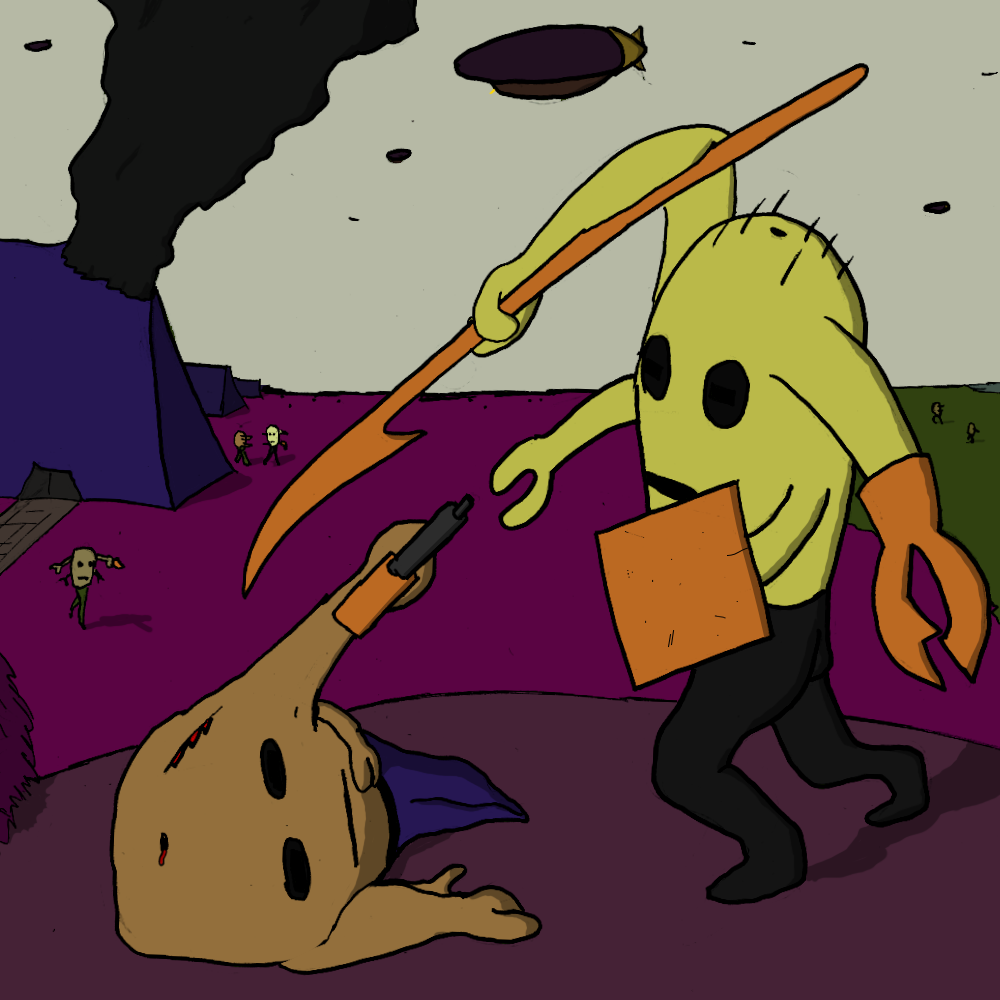
Roughly 12000 Years Ago: Among the nations of a more technologically-advanced Strondo population, a decades-spanning war wages. One Strondo nation, one that values knowledge and esteem more than anything else, is able to conquer or convert all the other Strondo nations on the planet. This results in the Strondo Culture that will create the Knowledge Base of the Strondovarians, the record of all information deemed worth knowing and remembering. This culture also makes a point of preventing the degradation of their language by enforcing strict rules and wiping out other languages.

Roughly 9000 to 7000 Years Ago: This is the era in which the Strondos reach out into space for the first time. They explore their own star system, and soon generation-ships are launched to other systems by those who want to be famous for founding cities on other worlds. The spread of Strondos to other planets is helped by advances in suspended animation and, eventually, the “Buloggo Engine” is developed, which makes travel to other star systems much more easy. On one world (“Doaphean”) Strondos find living alien animal life, though it seems unintelligent by their standards. They begin colonizing Doaphean.

Roughly 6000 Years Ago: The Strondos make first contact with a species of similar intellect to themselves and it does not go well. The newly-met species, which the Strondos call “Rootfolk” (“Pwot Pharvarian”), seem to have values incompatible with those of the Strondo Culture and conflict arises. To make matters worse, that contact is noticed by other even more powerful alien forces and Strondos and Rootfolk are both pulled into a Great Cosmic Conflict that, to this day, they still don’t fully understand. The Great Cosmic Conflict waged for more than a thousand Earth years, during which time the Strondos put utmost importance on keeping the location of their homeworld a secret from their foes, though the settlements on Doaphean suffer unimaginable losses. Eventually the conflict seemed to cease on its own and Strondo Culture returned to its exploration of the systems it could reach, now aware they had enemies.

Roughly 3000 Years Ago: It is decided among the Strondovarians that the planet Gurx is not good enough to be the capital of Strondo culture. Thus began the biggest project in the history of the species: the creation of a new homeworld from scratch. A better star is chosen and space stations and asteroid bases are built there. A large segment of the population makes a pilgrimage to the new system and take up roles in what will surely be a historically noteworthy mission.

And that brings us to today. Strondo culture, as intentionally stagnated, combined with the fact that there are Strondos alive who were alive when the New Gurx project was begun, means that the planet Gurx of 3000 years ago is remarkably similar to that of today. And the Strondovarians have no intention of changing their plans any time soon.
PDR’s Controversial Beliefs: Sneed’s isn’t a good joke

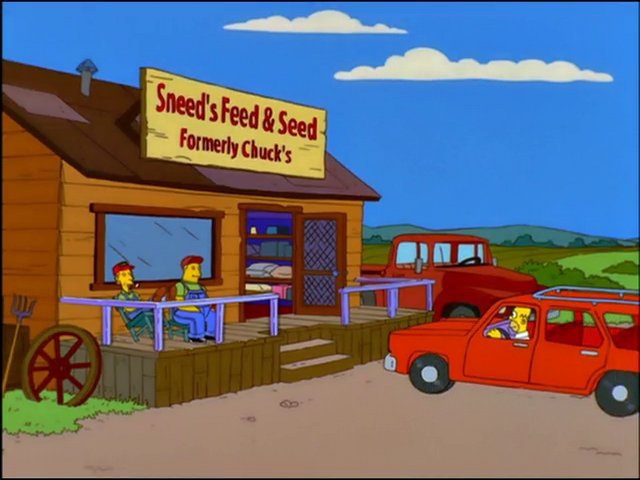
There’s a joke from an episode of the Simpsons, from the period that I consider “later” Simpsons, but which is actually probably less than a third into the run of the show by this point. The joke is that there is a store with a sign that says “Sneed’s Feed and Seed” with the information that the store used to be called “Chuck’s”. I mean, I’ve got the image right there, you can see it. The “joke” is that back when the store was called Chuck’s, it would have been “Chuck’s Fuck and Suck”, get it? It makes you think of a dirty word! How subversive and cool! It is to laugh. And yet I’ve seen people online cite this as a good joke.

I don’t find it that funny. I’ve mentioned before that I don’t seem to get the same value from using “curse words” as most people. I don’t get it. They’re just words to me. I find them neither offensive nor thrilling. But at least I understand that other people do enjoy them on some level I don’t get, so I can understand what the Sneed’s joke is trying to do. It may only be a minor step above having a character just say “Fuck” and then bleeping it as far as jokes that put a swear into the listener’s mind without actually saying it out loud, but that is still a step above that. That little bit of cleverness should count for something.

But here is what ruins the joke: business signs don’t work like that. If the store used to be Chuck’s, it was Chuck’s Feed and Seed. If it was an entirely different business, they wouldn’t put what it used to be on the sign. If an accountant’s office moves into a place that used to be a Pizza Hut, they don’t put “Formerly Pizza Hut” on the damn sign. If that accountant’s office changes its name, but remains an accountant’s office, then they might put their former name on the sign so that customers would know they’re the same business. Even if accountant’s names rhyme with Pizza Hut! It’s irrelevant that Sneed’s used to be Chuck’s unless Chuck’s was the same business. The leap in logic is too great for it to work.

It frustrates me to see people laud this joke. But hey, if people love it, I must be missing something.

Planet Gurx: The Map

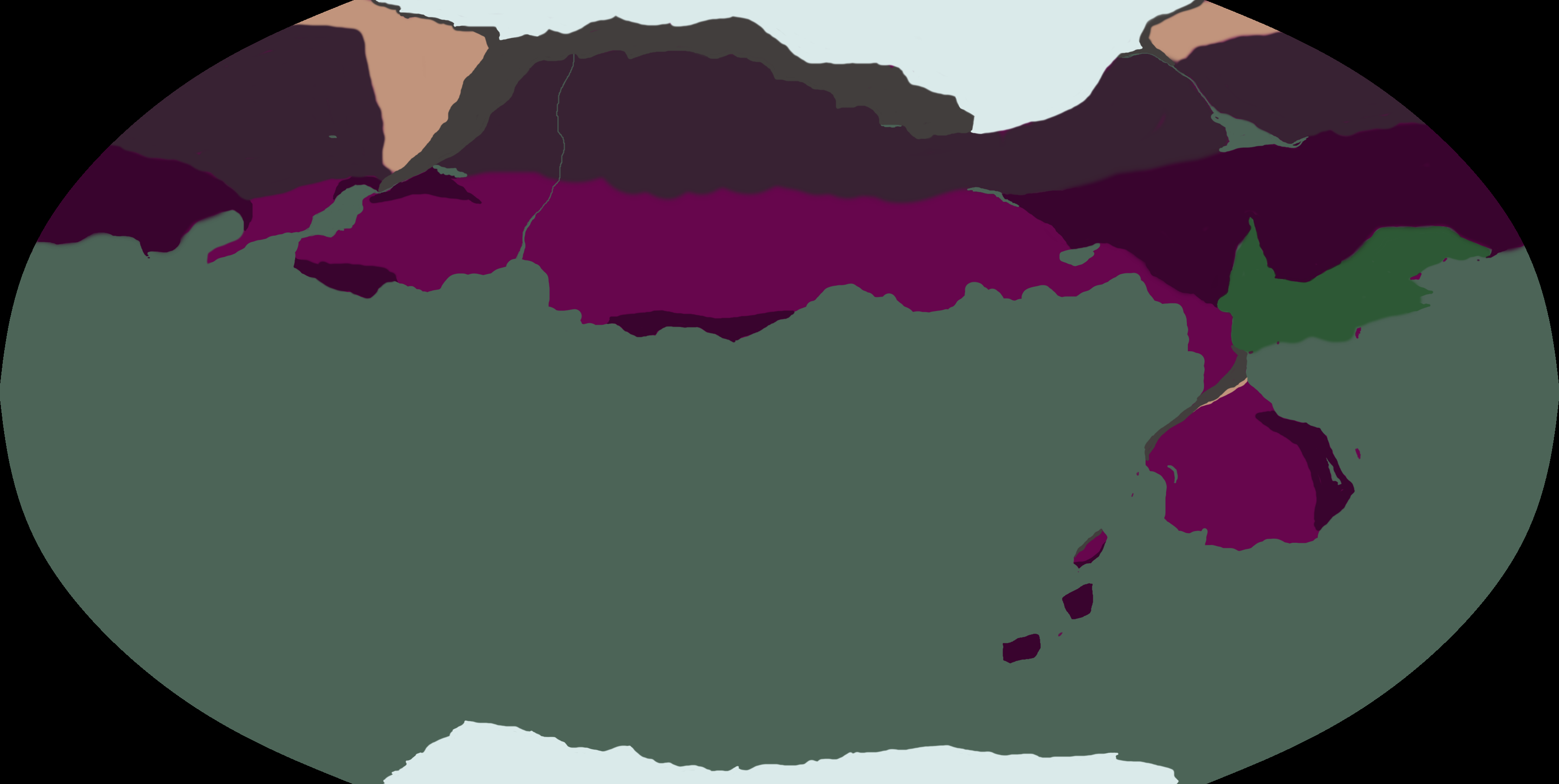
Today we’re looking at a map of the planet Gurx, as provided by Nibnassin. It’s not exhaustively detailed and I can’t guarantee the quality of the projection is 100% accurate and all that, but it covers the basics we’ll need for the rest of our look at the planet.

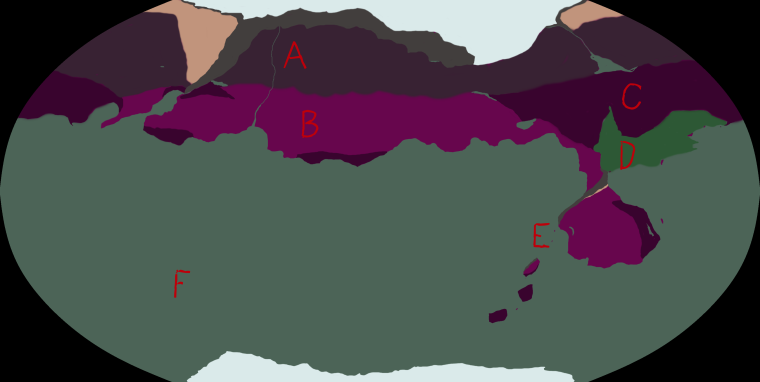
Most of the land mass on Gurx is currently located in a single Pangaea-like continent in the planet’s Northern hemisphere. Let’s take a look at some specific regions:

  • A: The region depicted here in a kind of greyish purple is the Gurxian equivalent of a tundra, called the “Evboviv” in Strondo language. Cool and dry compared to the more southerly regions, the Evboviv of Gurx is made up of hilly areas, lots of rivers and lakes, and grasslike plants that grow dozens of metres tall in some areas. To the north of the Evboviv you’ll find volcanic mountain ranges, chilly deserts, and the polar ice cap. Strondovarians only sparsely populate this region, but a lot of their spaceports are located in cities around here.
  • B: The brighter purple on the map is the rocky grasslands, which the Strondos know as the “Koneabb” and it is where most of Strondo population of Gurx lives. Though trees and forests can spring up here, generally the ground doesn’t support the large plants of Gurx very well, so only smaller grass-like plants can thrive. This makes a lot of room for Strondo development.
  • C: The dark purple on this map is the dense forest region the Strondos call the “Yaouphar” and encompasses dryer forests of the north and the humid forests in the equatorial regions. Strondos have not always treated the Yaouphar with respect, but since they’ve begun populating other planets, few Gurxian Strondos have found it worth the effort to live there. Nature has reclaimed many of the former Strondo dwellings there and the Yaouphar are once again thick and teeming with diverse kinds of life, plants and animals, large and small.
  • D: Slime is very common in the waters of Gurx, but the green on this map represents a region of ocean on which slime floats in a mass so thick and permanent on the surface and a whole ecology has grown on it. We might call these the “slimelands” but to the Strondos they are the “Chooeviv”. There are small Strondo settlements on the Chooeviv, mostly farming communities, but like the Yaouphar the population has decreased since the days before Strondos reached other worlds.
  • E: The peninsula and islands in the South are the result of tectonic activity. These islands are so separated from the rest of the Gurxian landmass that animals and plants here had significant evolutionary differences from the rest of the world.
  • F: And of course there is the ocean, or the “Agedda” as the Strondos call it. It makes up most of the surface of the planet and, while it doesn’t reach the depths that Earth’s oceans do, it is full of life as well.

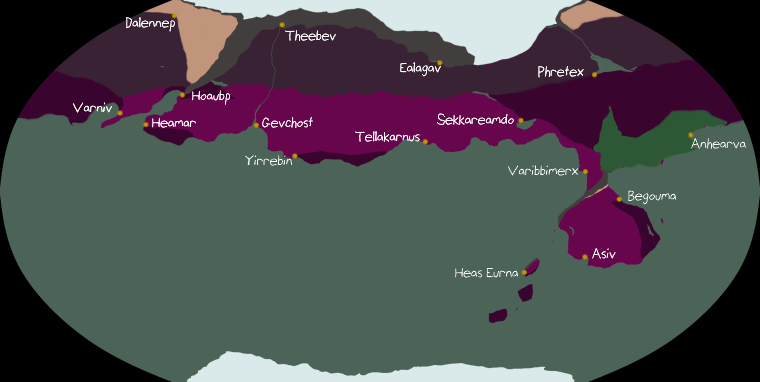
Now lets look try to get to know the basics about the sixteen largest Strondovarian cities on the planet:

  • Varniv: A port city with a reputation for being home to tough Strondos, Varniv is home to arenas where fights to once waged by Gurxian gladiators. While the “to the death” aspect has been dropped, there are still fighting exhibitions proudly waged here.
  • Heamar: Once the seat of a mighty empire in times long ago, Heamar is now the most populous city on the planet. All Strondovarian cities are rich with monuments, but Heamar has more than any other city.
  • Dalennep: The last city before the desert, and home to the world’s largest spaceport, Dalennep has a reputation as a place where adventures begin and is thus a tourist attraction to visiting Strondos (especially those coming to visit from colonies on other worlds). It is also home to the planet’s most successful electronics manufacturers.
  • Hoaubp: The joke among Strondos is that Hoaubp is a boring place, but the Strondos that live there lead lives as rich as anyone else’s. In fact, Gurx’s largest poetry recitation club is in Hoaubp.
  • Gevchost: Built at the mouth of the planet’s largest river, Gevchost has a long history as a farming region. Indeed a lot of Strondos in the region still do farming, but a prominent entertainment industry is also housed in Gevchost, creating the entertainments enjoyed by Strondos all over Gurx and beyond.
  • Theebev: A city built in the mountains that uses geothermal energy from nearby volcanoes for power, Theebev is the world’s highest location and is also home to several of the most prominent schools on Gurx. Strondo parents all dream that their offspring will increase their credibility by studying here.
  • Yirrebin: Yirrebin is home to one of the most important aspects of Strondovarian culture: The Knowledge Base. While the physical copies of the base aren’t as important as the information they hold, that information does need to be held somewhere. While the largest and most database of Knowledge Base files is kept in a space station far from Gurx, the database in Yirrebin is the planet’s strongest link to the Knowledge Base and is the broadcast of the information to which all Gurxian computers sync up to remain up to date. Incidentally, our Strondo volunteer Nibnassin was born in Yirrebin.
  • Tellekarnus: Tellekarnus is a city full of canals instead of streets because at some point in ancient history, some leader in Tellekarnus decided that rafts and boats were easier to carry goods on than roads and designed a whole city around the plan. While it hardly let to Tellekarnus becoming the most successful city on Gurx, the canals and bridges of the city are renown for their uniqueness.
  • Ealagav: Located near the world’s largest waterfall as well as several hot springs, the city of Ealagav is famous for its clear waters. A poet from the city hundreds of years ago used the imagery of Ealagav water in several poems. The denizens of Ealagav love the water, but sometimes they strive too hard to make more claims to fame for their city, which is why they’ve carved the side of one mountain into the largest monument on the planet (which they did in the likeness of that same poet).
  • Sekkareamdo: The smallest of these sixteen large cities, Sekkareamdo has a sad and tragic history as the location of various infamous murders. This causes a problem because one of the things Strondo’s value is fame. Occasionally some Strondo desperate to have their name make it into the Knowledge Base will think that doing more murders in Sekkareamdo, becoming part of the legend.
  • Heas Eurna: Heas Eurna was founded by outlaws and rebels who sought escape from the rest of the world. In the millennia since, the Strondos have created a single planets-wide culture that stomps out individuality where it can (the Knowledge Base being a useful tool for this) so the uniqueness of Heas Eurna has faded, but it remains in the reputation of the place. It’s also why there are so many secret tunnels around the place.
  • Varibbimerx: The oldest still-active city on the planet, Varibbimerx is in the general area where Strondos first evolved. In many ways Strondovarians are not sentimental about ancient artifacts, but nonetheless there is a section of the old city still standing and preserved for historical reasons (and tourism).
  • Asiv: The biggest seaport on Gurx, the biggest fishing industry, and the biggest shipbuilding facilities are all located in Asiv. While airborne (and spaceborne) vessels are widely used on Gurx now, the oceans still provide for Strondos and the denizens of Asiv don’t forget it.
  • Phretex: When Strondovarians invented space travel capable of reaching other worlds, Phretex was the city with the foresight to build the “official” Welcome to Gurx Spaceport, with residences and industries designed to welcome visitors. While most of the visitors are Strondos who were born in space or on other planets, the hope is that someday the Strondos may be on good terms with some alien species and they might come to visit. It hasn’t happened yet, but the population of Phretex has grown as Strondos who want to be part of the business have moved there.
  • Begouma: The city of Begouma is named after an ancient Strondo hero who is generally considered the most famous Strondo to have ever lived (assuming they did ever live outside of legends). Begouma regularly holds a festival in honour of the hero that brings in visitors from all over. The largest cemetery on the planet is also located here.
  • Anhearva: Although the slime-based landmass of the Chooeviv is indeed thick enough to have structures built upon it, it is subject to the tides in a way that actual solid land is not, which is why the port city Anhearva, the largest city in the region, is built on an island for more stability. Most Strondo settlements do have slime farms of their own, but Anhearva still exports a lot of slime-products all over the world.

I don’t know that I’ll be getting back to maps with more detailed close-ups before I give up on this project, but I feel like we now know as much as we’ll need.