Planet Gurx: The Map

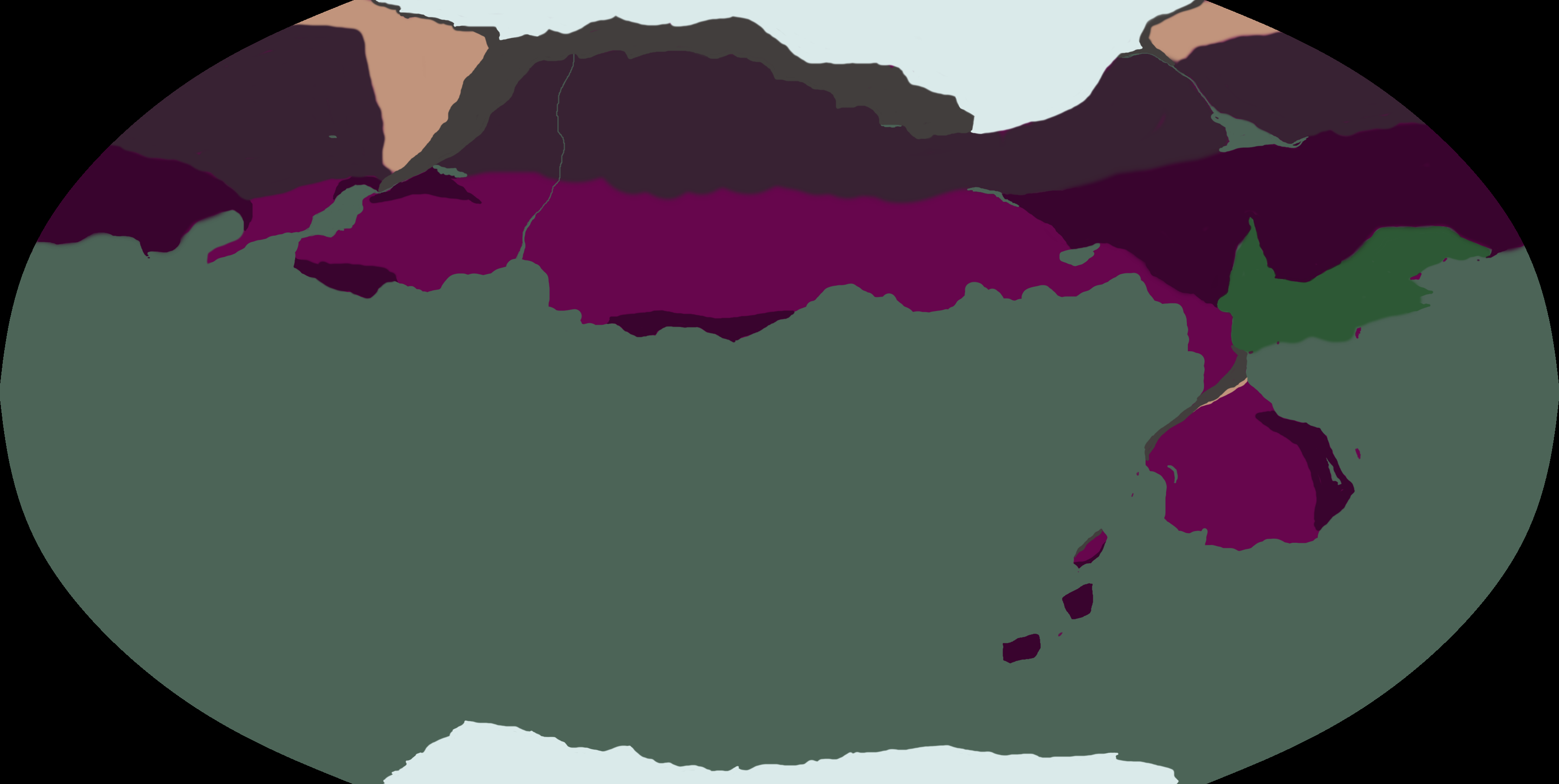
Today we’re looking at a map of the planet Gurx, as provided by Nibnassin. It’s not exhaustively detailed and I can’t guarantee the quality of the projection is 100% accurate and all that, but it covers the basics we’ll need for the rest of our look at the planet.

Most of the land mass on Gurx is currently located in a single Pangaea-like continent in the planet’s Northern hemisphere. Let’s take a look at some specific regions:
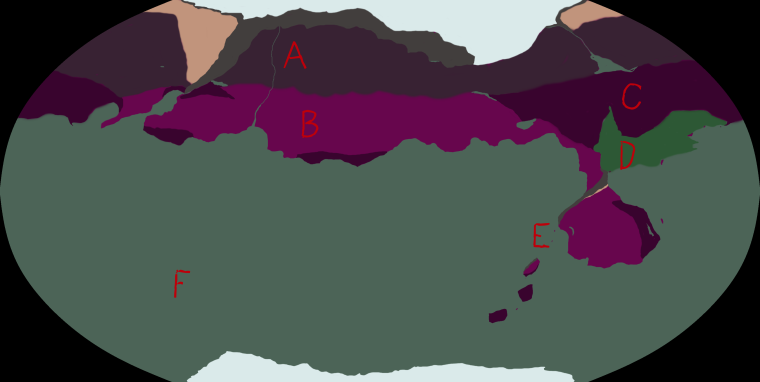
  • A: The region depicted here in a kind of greyish purple is the Gurxian equivalent of a tundra, called the “Evboviv” in Strondo language. Cool and dry compared to the more southerly regions, the Evboviv of Gurx is made up of hilly areas, lots of rivers and lakes, and grasslike plants that grow dozens of metres tall in some areas. To the north of the Evboviv you’ll find volcanic mountain ranges, chilly deserts, and the polar ice cap. Strondovarians only sparsely populate this region, but a lot of their spaceports are located in cities around here.
  • B: The brighter purple on the map is the rocky grasslands, which the Strondos know as the “Koneabb” and it is where most of Strondo population of Gurx lives. Though trees and forests can spring up here, generally the ground doesn’t support the large plants of Gurx very well, so only smaller grass-like plants can thrive. This makes a lot of room for Strondo development.
  • C: The dark purple on this map is the dense forest region the Strondos call the “Yaouphar” and encompasses dryer forests of the north and the humid forests in the equatorial regions. Strondos have not always treated the Yaouphar with respect, but since they’ve begun populating other planets, few Gurxian Strondos have found it worth the effort to live there. Nature has reclaimed many of the former Strondo dwellings there and the Yaouphar are once again thick and teeming with diverse kinds of life, plants and animals, large and small.
  • D: Slime is very common in the waters of Gurx, but the green on this map represents a region of ocean on which slime floats in a mass so thick and permanent on the surface and a whole ecology has grown on it. We might call these the “slimelands” but to the Strondos they are the “Chooeviv”. There are small Strondo settlements on the Chooeviv, mostly farming communities, but like the Yaouphar the population has decreased since the days before Strondos reached other worlds.
  • E: The peninsula and islands in the South are the result of tectonic activity. These islands are so separated from the rest of the Gurxian landmass that animals and plants here had significant evolutionary differences from the rest of the world.
  • F: And of course there is the ocean, or the “Agedda” as the Strondos call it. It makes up most of the surface of the planet and, while it doesn’t reach the depths that Earth’s oceans do, it is full of life as well.

Now lets look try to get to know the basics about the sixteen largest Strondovarian cities on the planet:
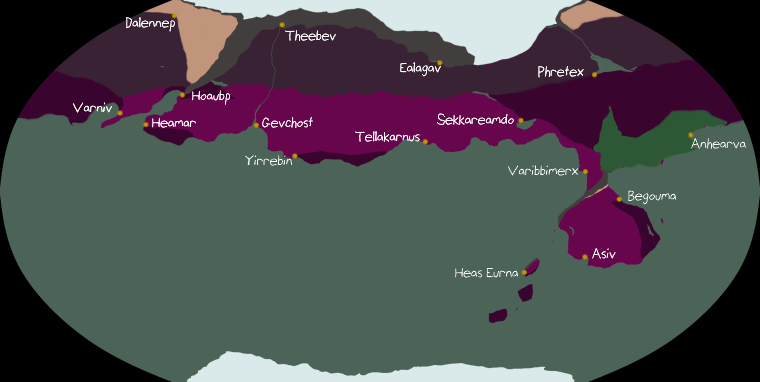
  • Varniv: A port city with a reputation for being home to tough Strondos, Varniv is home to arenas where fights to once waged by Gurxian gladiators. While the “to the death” aspect has been dropped, there are still fighting exhibitions proudly waged here.
  • Heamar: Once the seat of a mighty empire in times long ago, Heamar is now the most populous city on the planet. All Strondovarian cities are rich with monuments, but Heamar has more than any other city.
  • Dalennep: The last city before the desert, and home to the world’s largest spaceport, Dalennep has a reputation as a place where adventures begin and is thus a tourist attraction to visiting Strondos (especially those coming to visit from colonies on other worlds). It is also home to the planet’s most successful electronics manufacturers.
  • Hoaubp: The joke among Strondos is that Hoaubp is a boring place, but the Strondos that live there lead lives as rich as anyone else’s. In fact, Gurx’s largest poetry recitation club is in Hoaubp.
  • Gevchost: Built at the mouth of the planet’s largest river, Gevchost has a long history as a farming region. Indeed a lot of Strondos in the region still do farming, but a prominent entertainment industry is also housed in Gevchost, creating the entertainments enjoyed by Strondos all over Gurx and beyond.
  • Theebev: A city built in the mountains that uses geothermal energy from nearby volcanoes for power, Theebev is the world’s highest location and is also home to several of the most prominent schools on Gurx. Strondo parents all dream that their offspring will increase their credibility by studying here.
  • Yirrebin: Yirrebin is home to one of the most important aspects of Strondovarian culture: The Knowledge Base. While the physical copies of the base aren’t as important as the information they hold, that information does need to be held somewhere. While the largest and most database of Knowledge Base files is kept in a space station far from Gurx, the database in Yirrebin is the planet’s strongest link to the Knowledge Base and is the broadcast of the information to which all Gurxian computers sync up to remain up to date. Incidentally, our Strondo volunteer Nibnassin was born in Yirrebin.
  • Tellekarnus: Tellekarnus is a city full of canals instead of streets because at some point in ancient history, some leader in Tellekarnus decided that rafts and boats were easier to carry goods on than roads and designed a whole city around the plan. While it hardly let to Tellekarnus becoming the most successful city on Gurx, the canals and bridges of the city are renown for their uniqueness.
  • Ealagav: Located near the world’s largest waterfall as well as several hot springs, the city of Ealagav is famous for its clear waters. A poet from the city hundreds of years ago used the imagery of Ealagav water in several poems. The denizens of Ealagav love the water, but sometimes they strive too hard to make more claims to fame for their city, which is why they’ve carved the side of one mountain into the largest monument on the planet (which they did in the likeness of that same poet).
  • Sekkareamdo: The smallest of these sixteen large cities, Sekkareamdo has a sad and tragic history as the location of various infamous murders. This causes a problem because one of the things Strondo’s value is fame. Occasionally some Strondo desperate to have their name make it into the Knowledge Base will think that doing more murders in Sekkareamdo, becoming part of the legend.
  • Heas Eurna: Heas Eurna was founded by outlaws and rebels who sought escape from the rest of the world. In the millennia since, the Strondos have created a single planets-wide culture that stomps out individuality where it can (the Knowledge Base being a useful tool for this) so the uniqueness of Heas Eurna has faded, but it remains in the reputation of the place. It’s also why there are so many secret tunnels around the place.
  • Varibbimerx: The oldest still-active city on the planet, Varibbimerx is in the general area where Strondos first evolved. In many ways Strondovarians are not sentimental about ancient artifacts, but nonetheless there is a section of the old city still standing and preserved for historical reasons (and tourism).
  • Asiv: The biggest seaport on Gurx, the biggest fishing industry, and the biggest shipbuilding facilities are all located in Asiv. While airborne (and spaceborne) vessels are widely used on Gurx now, the oceans still provide for Strondos and the denizens of Asiv don’t forget it.
  • Phretex: When Strondovarians invented space travel capable of reaching other worlds, Phretex was the city with the foresight to build the “official” Welcome to Gurx Spaceport, with residences and industries designed to welcome visitors. While most of the visitors are Strondos who were born in space or on other planets, the hope is that someday the Strondos may be on good terms with some alien species and they might come to visit. It hasn’t happened yet, but the population of Phretex has grown as Strondos who want to be part of the business have moved there.
  • Begouma: The city of Begouma is named after an ancient Strondo hero who is generally considered the most famous Strondo to have ever lived (assuming they did ever live outside of legends). Begouma regularly holds a festival in honour of the hero that brings in visitors from all over. The largest cemetery on the planet is also located here.
  • Anhearva: Although the slime-based landmass of the Chooeviv is indeed thick enough to have structures built upon it, it is subject to the tides in a way that actual solid land is not, which is why the port city Anhearva, the largest city in the region, is built on an island for more stability. Most Strondo settlements do have slime farms of their own, but Anhearva still exports a lot of slime-products all over the world.

I don’t know that I’ll be getting back to maps with more detailed close-ups before I give up on this project, but I feel like we now know as much as we’ll need.

Planet Gurx: Strondovarian Reproduction

The Strondovarians (and, indeed, most life on Planet Gurx) don’t have the biological sex differentiation that we see here on Earth. Every Strondo has the same reproductive organ (they call it a Thebwont), which is located between their legs inside an orifice from which it can protrude when needed for copulation. The Thebwont has bits for expelling genetic material, as well as bits for receiving it. During copulation, a Strondo’s Thebwont docks with their partner’s Thebwont and they exchange their material and take it into themselves, where impregnation can happen.

Unlike humans, while a Strondo is pregnant they can not copulate, so it is fortunate that they don’t place the value on sex that we do (they like it fine, but their hedonistic tendencies more often point toward eating and mind-altering substances). The Thebwont undergoes a transformation during pregnancy, taking on the role of a womb. Gestation lasts for about six Earth-months (I’m just going to use Earth times for now for ease of translation) and the infants (usually one or two at a time) are born live, after which the Thebwont will return to copulationable form. If a Strondo has been pregnant about five or six times, the Thebwont can become incapable of the transformation, leaving the Strondo still capable of performing the sex act, but sterile.

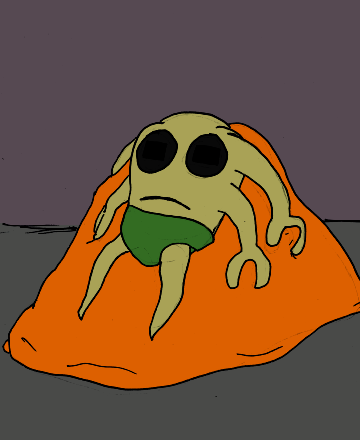
Here we see Nibnassin, our Strondo volunteer, as an infant from an old family picture. The intricate musculature and large brains of a Strondo are still developing when they are newly born, so they need a lot of help for the first couple years. Fortunately, Strondo parents (the Strondo who gave birth being the one considered the parent) are usually quite attentive.

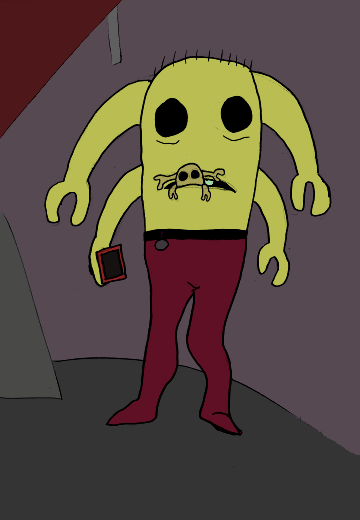
For about the first five years of their lives the young Strondos are in a “toddler” stage, learning to walk and move and speak and all that as they get bigger. Here were see young Nibnassin hanging out in their parent’s mouth, which is a common thing on Gurx. Because things in the mouth cavity aren’t digested unless the Strondo consciously focuses their Rel tow the task of pulling it apart and forcing it into the stomach, it’s actually a safe place for Strondos to store things, including their young kids. While in the mouth cavity the young Strondo can share food being eaten by the parent and, in the process, pick up valuable bacteria from their parent to develop a healthy gut biome.

After about five years the young Strondos are usually too big to fit in their parent’s mouth anymore, but that’s okay because they’re also now able to walk and move as deftly as they would be for all their life. They continue to grow until about eighteen to twenty years, at which point they reach their mature adult size and would now be capable of reproduction.

An average natural lifespan for a Strondo is about 120 Earth years, but they rarely live by their natural standards anymore. Technology has advanced enough for the species that the lifespan can be extended in various ways, including suspended animation used, most often, in space travel. There are Strondos out there who were born over three thousand Earth years ago, but most of that time was spent in stasis.

Planet Gurx: The Strondovarian Legs

Strondovarians stand bipedally on legs quite unlike those of human legs. A human seeing a Strondo’s legs would think they look serpentine and bend all wrong, but that’s just how they function.

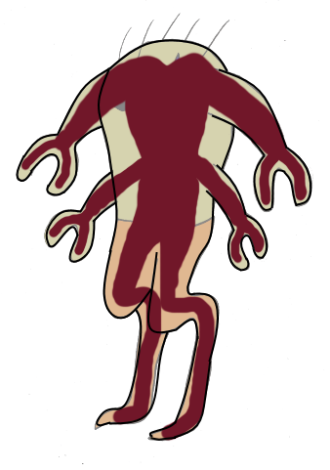
As I’ve said in previous posts, they Strondos don’t have skeletons as we know them on Earth. Instead they have an interlocked system of dense muscles, tendons, and sinew that support their weight and can push and pull against each other to achieve movement. This setup allows for their limbs to be extremely flexible.

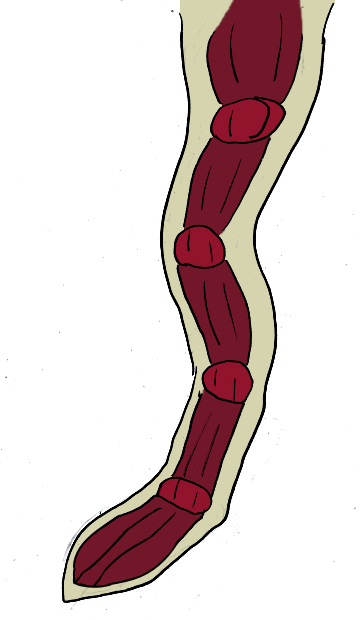
Here we can see a rough, simplified look inside Nibnassin’s leg. The multiple “knees” in a Strondo leg are clumps of muscle able to swivel in multiple directions and also to “lock” so that they remain in a certain position while other muscles use them as leverage for moving themselves. The longer muscle masses in the legs can rotate and stretch or contract as needed. The primary function of this design is to be able to shift around and funnel the weight of the Strondo to the “sole” where the leg actually comes into contract with the ground while keeping the torso at a generally consistent level.

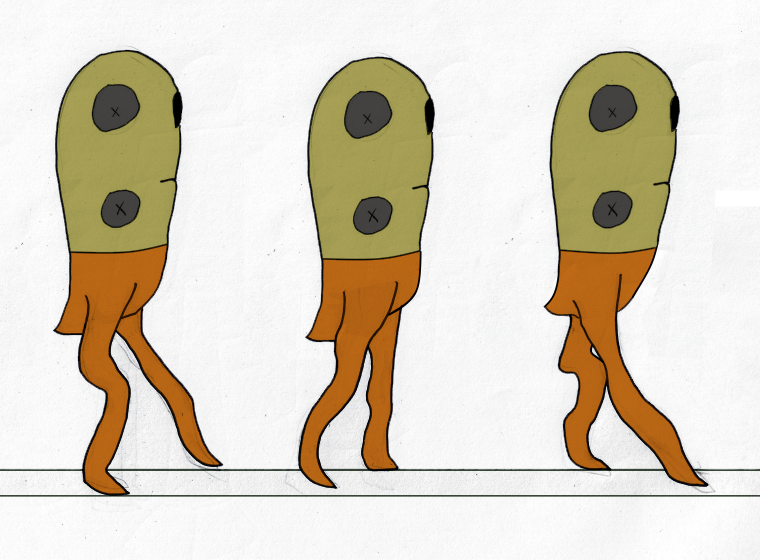
When walking, the weight is shifted to one leg and then the other end probes forward to find a foothold. When that foot is planted, the weight shifts and the other leg catches up. This is all done with minimal conscious awareness from the Strondo. It would look strange to human eyes, but rest assured they would find our endoskeletal lumbering just as strange.

Strondo hands are similarly flexible, but I don’t think we’ll need to get into a post all about it at the moment.

This bodyplan, with these flexible legs making it possible to walk bipedally, has proven quite successful among Gurxian life in the current age, with many “animal” species being part of this type. They’re called “Aehubar” in the Strondo language. We’ll get to non-Strondovarian life on Gurx at some point down the line. Although there are Aehubar that can jump quite well, Strondovarians are not among them, with most not being able to jump at all.

Planet Gurx: The Strondovarian Tongue

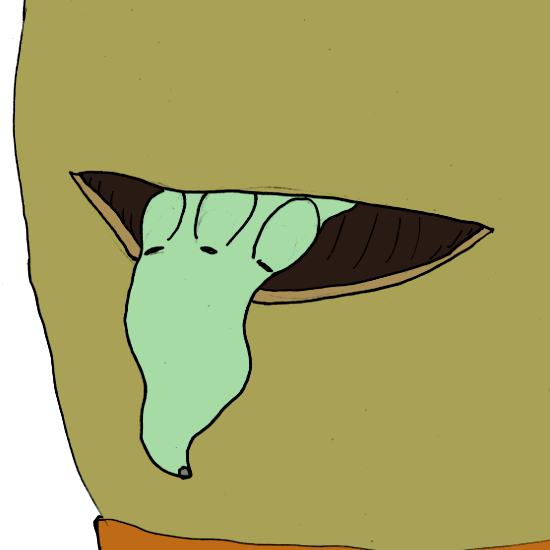
It’s not technically correct to call this organ a tongue, so I think I’ll use the Strondovarian word, the “Rel”. The Rel is positioned on the roof of the Strondo mouth and serves multiple functions. Let’s examine the Rel of our volunteer, Nibnassin:

Here, Nibnassin is straining to stick their tongue out as far as possible so we can get a good look at it. It’s a pretty flexible muscle organ, but spends most of its time inside the mouth. It does have a saliva-like secretion that can help break up food (in some Gurxian animals that saliva is also sticky so it can catch small prey, but not in the Strondos). When a Strondo is holding a piece of food in their mouth cavity, the Rel will poke at it and mash it around, making it easier to transition it into the stomach.

But the Strondo is also a sensory organ. The Rel is covered with cilia-covered sensors that picks up sound waves. In conjunction with the sensory organ around the breathhole on top of a Strondo’s head, they can get a stereophonic sense of the world around them, though less so than humans. In spite of their weaker hearing, the Strondovarians do have a spoken language akin to humanity’s many such languages.

The other sensory purpose of the Rel has evolved to help them speak that language. The base of the Rel is ringed by sacs which can intake air and examine the particles in them, like the olfactory system in humans. This is their sense of smell, and taste, that lets them enjoy the food being pummelled by the Rel and, as noted when we looked at the lungs, the Rel’s air-intake is not at all connected to the respiratory system. The second use of these sacs comes when they release their air: they make sounds. That, combined with the echo chamber of their mouth cavity, is how they make speech. It is a breathy language and, because one of the sacs can be taking in air while another is letting it out, they can speak interminably without our need to pause to inhale. (It’s worth noting that there is an enforced monoculture among the Strondos. Only one language is permitted to exist.)

So that’s the Rel. A tongue, several noses, an ear, and a voice all in one. You can tell a Strondo is paying attention when their mouth is open, so the Rel has its clearest sense of the world.

Planet Gurx: The Strondovarian Body Plan (pt 2)

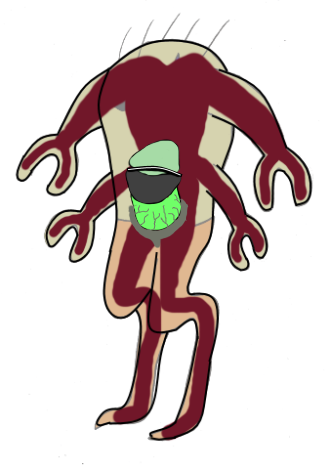
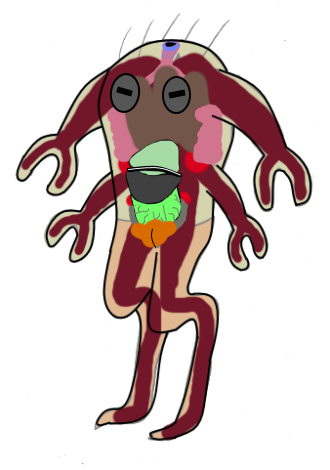
Picking up where we left off last time, let’s take a look at (simplified PDR-style drawings of) what it looks like inside Nibnassin, our Strondovarian volunteer.

The Strondovarian Body Plan, Inner Workings

Strondovarians don’t have skeletons. Their bodies are supported purely by a system of sinew and muscle. The gravity of planet Gurx is less than that or Earth, so they can support a denser mass of muscle than Earth-bound beings. Their legs are an especially complex system, but I’ll have to give them their own post sometime.

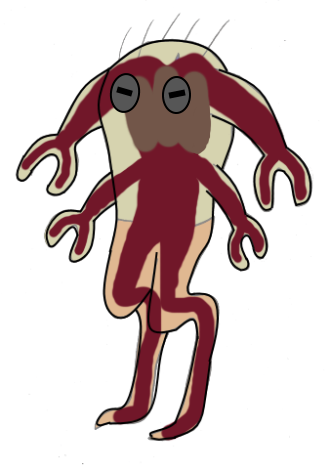
Here we see the three-sectioned Strondo brain, as well as their eyes. Note that the sclera of the eyes is usually darker than this, but it’s been lightened so that we can make out the pupils.

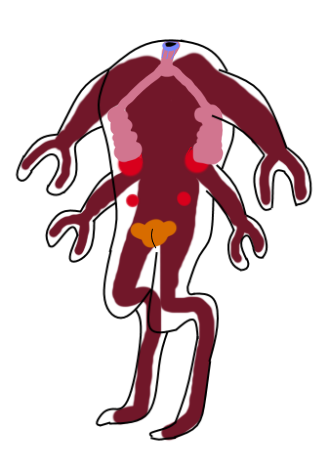
The breathhole on the back of the Strondo head is connected to two lungs, one on each side of the Strondo’s brain. Around the entry of the breathhole is a sense organ the main purpose of which is to test the temperature of the air, but which also does pick up a bit of audio input (Strondo hearing is not as strong as human hearing). There are four hearts to pump blood through the Strondo body, two of which are directly connected to the lungs. The reproductive organ is positioned between the legs and can expand through an orifice to exchange genetic information with a partner, or it can take in genetic information from a partner and use it to create new life, which is gestated inside for a time before being born live, though significantly smaller than a human newborn.

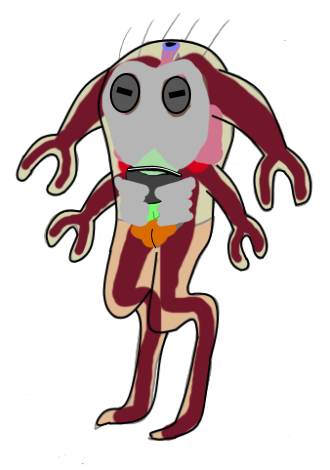
The top of this group of organs is one which we can call a tongue, but which is actually much more complex than that. It, like the legs mentioned above, will merit its own post, but in brief it is involved in eating, hearing, speaking, and smelling. Below the tongue, right behind the mouth opening, is a cavity in which food is kept and picked apart by the tongue, to be dropped into the stomach, which is that acidic organ below the mouth cavity. The stomach essentially works like that of humans, and leads into a short digestive track that pumps the good stuff back into the body via the lower hearts and pumps the bad stuff out through the tube in the rear.

Here we see as many of those organs as we’ve covered thus far. There are other small organs in there as well, but this is getting long again, so we’ll not worry about them right now.

But before we wrap up for today, we should note that even without a skeleton, the Strondos do have some hardened plates held in place by their musculature that have developed to protect the vital organs from the front. From behind, these organs are already protected by the dense musculature. None of these plates are as strong as the human skull, but combined with the leathery skin of a Strondo, they do alright.