Phone Guys: New Boat

Gloueb had not seen the skies of planet Gurx in many years. Though born here, in this very city of Dalennep, Gloueb had spent more than half of their lifetime so far working in space. Gurx didn’t feel like home anymore.
And now Gloueb was stuck here, along with the large percentage of the Strondos who had been working as astronauts, but had now been called back to their home planets. They were being treated like they were Nexvar, being put away until they were needed again. But unlike Nexvar, Gloueb wasn’t being put into suspended animation between jobs. They had a chance here to fill their time with all sorts of experiences on Gurx, but did they want to?
That’s what Gloueb was wondering as they looked out the window at Dalennep. Then, rubbing a tapestry, Gloueb activated lights woven into the fabric and turned into the room. They wondered what it meant that they didn’t like it here. It was comfortable at least. Anyone credited as working on the New Gurx project could stay at any of the city’s hotels, so Gloueb had taken up residence in the hotel nearest the spaceport, as though, they thought, staying close to it would ensure that the news that they could get back into space would reach them that little bit sooner. But why did they want to go back? There were innumerable fresh experiences on this planet, lots to do and see.
The problem was how slow it was here. The stars, even Ahan, sat so still. Sure, Gloueb knew that planets and stars all moved quite quickly. But compared to spaceship with a buloggo engine? Gurx was a standstill.
Gloueb turned to a tabletop terminal and switched on a connection to the Knowledge Base. For the first time in their lifetime, they looked up what it takes to become a registered Nexvar.
Wise Chargan sat and looked out the window of their mountaintop home. They did not spend as much time on Gurx as they once did, but the automatic units kept the home in perfect order. It was a comforting feeling to sit in a familiar chair and listen to audio updates from the Knowledge Base. Chargan could use any comfort they could get.
The audio updates were full of the latest news approved to be heard by the masses, but Chargan knew things that had not, and may never, make it into them. Worrying things.
A Rootfolk armada found lifeless, recently destroyed, within Strondo space. It was a mystery how a fleet of ships designed by their most frequent enemies had made it so close to Gurx without being spotted. It was a further mystery how they had been destroyed without a battle being noticed. And it was the most disturbing mystery of all that their destroyer remained unknown. The Rootfolk fleet had been technologically advanced, Chargan had seen it. More advanced than anything the Strondos possessed at this time. Finding them dead was the best outcome. Certainly better than it would have been to learn of them only when they attacked.
Who killed the Rootfolk fleet? Where were these killers now? What could they want? What could Strondovarian culture do to protect itself? The Wise had agreed to decrease unnecessary activity in space for the time being, to avoid attracting attention, but construction of New Gurx had to continue. It was unrealistic to believe they could avoid notice for long. And whose notice were they trying to avoid?
Chargan could, for now, only worry about potential answers.
And now we’ll take another look at some of the animals one could find on planet Gurx.
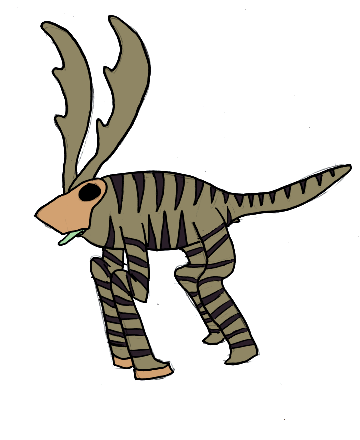
The Abpeaoulee graze in the tundra lands. Their top limbs, having evolved into an antler-like shape, are often used in fighting one another to establish standing in their herds, but instead of using them to fend off predators, they tend to tuck them down down along their back to become more aerodynamic as they flees. They are some of the fastest runners on Gurx.
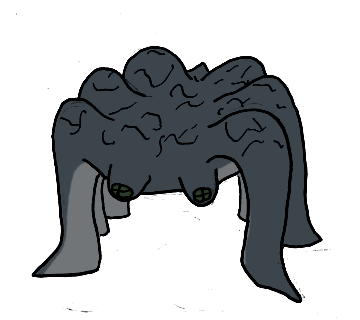
Bottom-feeding Lapaouger, Eenag are adapted for living at the bottom of the oceans of Gurx, eating whatever they can find down there. Perhaps the most notable thing about them is the fact that they are considered the most-recently discovered and catalogued “Oaheem” (Roughly translating to “large animal” in differentiating them from plants or microscopic animals) on Gurx, the scientist who discovered them being still alive.
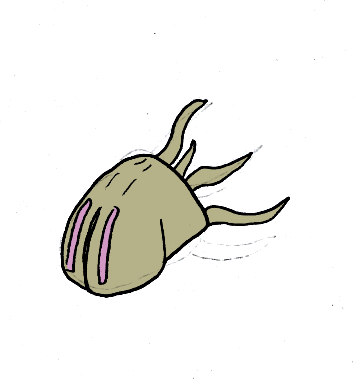
With a name that is meant to evoke the idea of a biting tattoo, the Gloyantib are a tiny relative of the Loyoloy. They dwell in the water until some larger, preferably land-dwelling, creature happens to swim into their reach, at which point they grab on and hitch a ride. Once they’re in the air, they feed off the blood of their host.
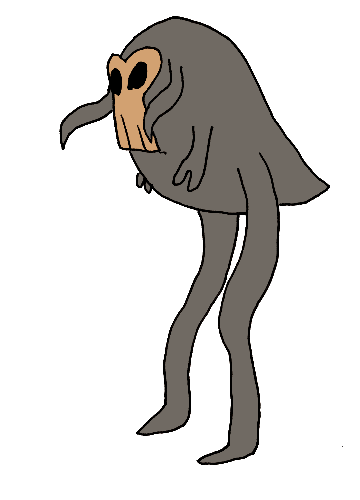
The dominant predator in the tundra regions is a Aehubar species that lives and hunts in packs. Their top limbs are adapted for grasping their prey, allowing them to hang on until the victim tires itself out. They may not be able to run down an Abpeaoulee, but Okloat are extremely intelligent animals, capable of tracking and flanking the animals they hunt. Larger relatives of the Okloat once hunted Varians during the Neboosidih, and though those ones were wiped out, modern Strondos are still not overly fond of Okloat and will kill them if they come too near cities.
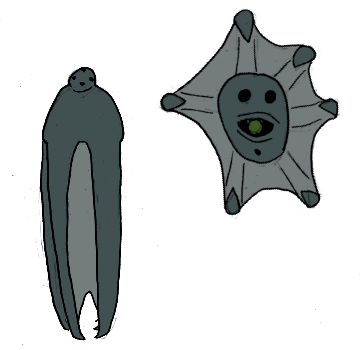
Related to the Stepao, Phollop are smaller than their cousins and spend a lot more time living in the water. They do leap out so they can glide down on prey swimming near the surface. Unlike Stepao, the Phollop have no particular reputation as an ill-omen in Strondo culture, but they do consider them annoying beasts who hang around cities near the ocean.
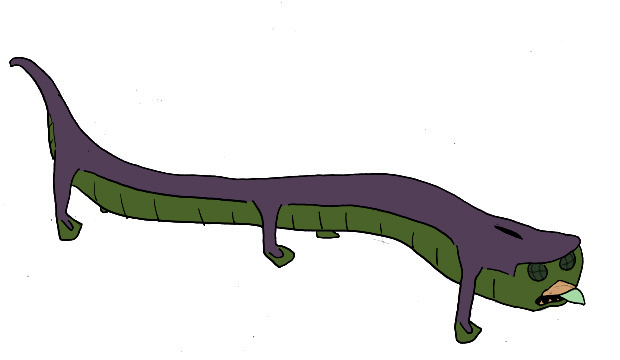
The forest-dwelling Aigreeloa are long creatures that swiftly move about and scoop up plantlike food while they run about. Anything resembling teeth are rare on Gurx, usually food is dismantled by the Rel while being held within the mouth cavity, but Aigreeloa have something toothlike. Bony protrusions along the bottom of their mouths help to quickly sever the plant matter from its roots, allowing the Aigreeloa to keep on the move.
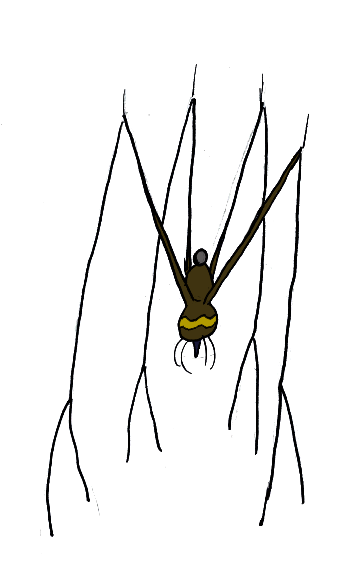
A little kind of Vootuph, only about three centimetres in size but with a highly potent venom. They act as ambush predators, hanging out in tall grass, usually near water, until they get a chance to sting small animals that come nearby. They can only eat so much of an animal’s corpse though, so they often share with others of their kind. They are not a particularly social species, but meeting while eating is also when they find a chance to mate.
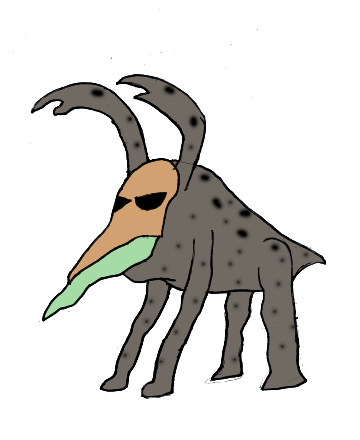
Another species from the tundra, Uttatib are scavengers who don’t directly compete with the Okloat when the hunters have superior numbers, but if Uttatib come across a lone Okloat with a kill, they will certainly drive them away and steal the meal. Otherwise, the Uttatib tend to make do by catching corpses where they can find them.