There was an episode of the ’90s Spider-Man cartoon that had Robert Farrell in it. They never actually call him “the Rocket Racer” in the episode, but he does all the usual Rocket Racer stuff. It’s got to be the most prominent appearance of the character outside of the comics so far, and it’s likely to remain that way for a long time.
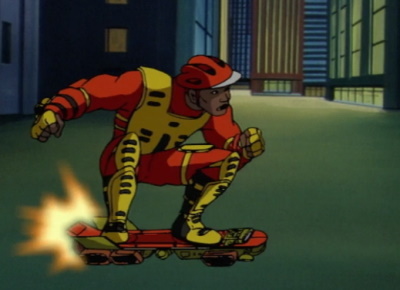
In the fifth episode of the third season, titled “Rocket Racer” we meet Robert Farrell, voiced by Billy ‘Pop’ Atmore.
Watching the episode, I find that we get a lot of the things I want to see in a Rocket Racer story. There’s subtle commentary on race and how ex-criminals aren’t given a fair shot at finding their way back into society. We’re shown Bob struggling to help out his sick mother, whose illness is never identified. We’re shown that the neighbourhood where Bob lives is on his side (a pharmacist gives him a discount on medicine). Bob shows no signs of romantic interest in anyone. We even get the Big Wheel making an appearance. All in all, this is about as faithful an appearance to the comics version as possible. So here’s where I pick out what is different about Rocket Racer here and his usual portrayal in the Marvel Universe.
- Bob is young here. I’ve mentioned this one before, but usually Bob is depicted as being at least as old as Spider-Man, but in this episode he is a teenager who is actually a student being tutored by Peter Parker. I don’t mind that he’s aged down for this (as I’ve said, you’d expect a skateboard-themed character to be young), but I don’t like that he knows Peter Parker. That makes the world feel very small.
- Bob’s story is backwards. In the comics, Bob was an upstanding and smart young child who had to resort to crime because he couldn’t afford to take care of his family when his mother got sick. In the cartoon, Bob was a criminal child who turned his life around to help his mother when she got sick. There’s a place for each kind of story, sure, but I prefer the original, because it casts the broken aspects of society as the impetus.
- Bob’s family doesn’t exist here. In this cartoon Mrs. Farrell (never named Emma, but we can assume) is shown to be a single mother, but instead of having seven children, she seems to only have Bob. I do feel that Bob’s siblings represent untapped potential for Rocket Racer stories, but this isn’t a Rocket Racer story. This is a Spider-Man show that only goes to the Rocket Racer well one time, so it doesn’t need all those other kids around to complicate things. It is understandable to have excised them. (Also, Mrs. Farrell is depicted as much thinner and more conventionally attractive than her comics counterpart. That I don’t like. Let’s have more representation of large people, please. But I guess having six fewer children made a difference.)
- Mrs. Farrell owns a grocery store. We’re never told what Mrs. Farrell did for work in the comics, but in this cartoon she owns Farrell’s Grocery. Maybe the comics version has this store too. Maybe it’s manned by Bob’s adult siblings we never see. We simply don’t have the information.
- The Big Wheel’s story is also backwards. In the comics, Jackson Weele was an embezzling businessman who was conned by Bob when the Rocket Racer did crimes on corporate types. That caused Jackson to create the Big Wheel persona for revenge. In the cartoon, the Big Wheel is an existing criminal mastermind with a gang of henchmen in power-suits called the Rocket Raiders. I’d guess maybe this was changed to make Bob a more sympathetic character, since blackmailing someone so hard that they become a supervillain isn’t a great look if you want the kid to be a poor wretch who deserves better, right?
- Bob steals equipment from the Rocket Raiders to create his own Rocket Racer equipment. In the comics, Bob gets his equipment from junkyards and the Tinkerer. This is a very minor change, given that we’re still shown Bob assembling the equipment himself and Peter admits that Bob knows a lot about gyroscopic science or whatever it is. Sure, it seems like it’d be less impressive to build a rocket skateboard from pre-made equipment than from scratch, but it’s only really done to drive the conflict here. I’ll allow it.
So that’s my report on the Spider-Man Animated Series episode Rocket Racer. Let’s see what the people on the Internet have to say about it. “This episode and The Spot are considered by most fans to be the two worst episodes of Spider-Man: The Animated Series.” Ah. Well. At least it’s a tie, and not dead last.
If I have a series called “Rocket Racer Thoughts” on my site, I should at least offer my thoughts when the character appears in the comics. He recently did. In the most recent issue of Amazing Spider-Man (from either this week or sometime within this month anyway) our boy Bob gets a whole panel!
There’s a Big Event Crossover Story going on in the Marvel Universe right now and it’s all about a giant space god that is attempting to judge every person on Earth to see if they’re “worthy” or not. Usually this entails it appearing to the person being judged in some form that means something to the person being judged (a dead relative, a symbolic figure, even the person themselves, and cetera). The space god watches them for a bit, then gives a thumbs up or down to indicate it’s findings. A lot of people in the world have not reacted well to this whole situation. One of those people is Robert Farrell.
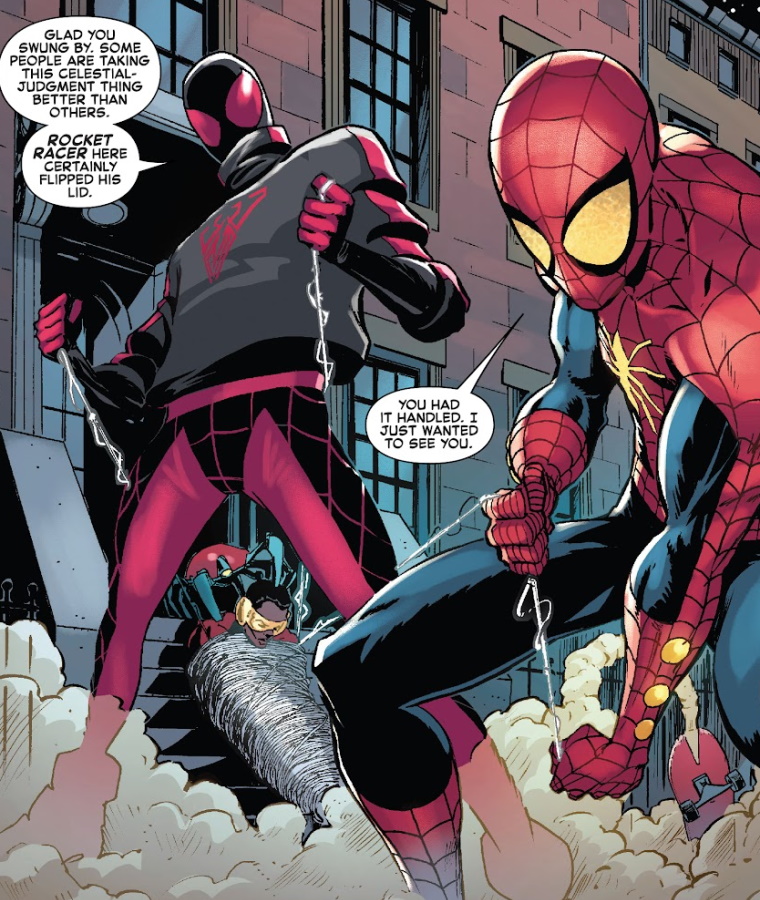
We’re only told that Rocket Racer “flipped his lid” and had to be stopped by Miles Morales. As the biggest fan of the character, I declare this appearance a good one. Yes, this comic in which Bob doesn’t get to say a word and in which he is presumably badly beaten off-panel is entirely in keeping with what I consider to be in character for Bob.
How would Bob react to knowing that he’s being judged by some cosmic being? Well, Bob is definitely, painfully aware that he has not lived up to his potential in life. He’d probably try to argue about how he couldn’t live up to that potential because of his circumstances, what with having to take care of his family and all that. But then he’d feel bad for blaming his family for his own failures. Then he’d deflect again, blaming society, but then he’d remember how he’s tried to improve society in the past, but absolutely failed to follow through with it (or gone about it in stupid ways). And this back-and-forth would go on for a while (I guarantee he’d make fun of himself for having a childish gimmick) and then, yeah, he’d probably flip his lid. And yeah, he’d probably get punched in the face a couple times as a result.
Typical Rocket Racer.
It’s something I’ve complained about very often: I don’t think superhero comics give enough focus to the normal human supporting casts of their heroes and villains. Therefore, it should be no surprise that, even though the Rocket Racer has a large family, there has been little to no focus on the supporting case of this, if we’re being very generous, Z-list Marvel character.
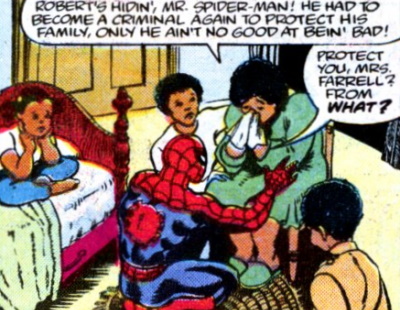
While Bob’s family are one of his primary motivations as a character (he is the oldest of seven children and feels like he needs to help his ill single mother support the family), they have hardly been seen. Only one of them has a name (his mother, Emma), and only half of his siblings have even been depicted (most likely the three youngest). We know that Bob’s father left the family when Bob was a teenager and that Bob thinks he is a loser. Every other detail about Bob’s family is an unknown that can offer potential stories.
But if anyone cared about tapping that potential, I worry they’d ruin it. I dislike so many of the things that are usually done with superhero supporting casts that I fear those would be the first stories told using the Farrells. Naturally I have plenty of story ideas I don’t want to give away, so what I’ll do now is list some things I absolutely don’t want to happen to them:
- First of all, don’t kill them all. One of the first instincts superhero writers have is to take things away from the heroes to create a momentary burst of drama. It’s usually done in a damned lazy way, and if someone were to kill off Bob’s whole family, it’d be such. I may not like it, but I admit you could kill one or two. If Emma dies, it would be sad, but I feel like it’d be a bit of a relief to Bob and he’d hate himself for it, so there’s story potential there. If someone HAD to kill off one of his siblings, at least there would still be more to work with. If Bob’s father died, it could prompt a story about Bob’s relationship with his father, and that is something we need, though this way would cut off potential for ongoing stories on the topic.
- On the topic of Bob’s father, they should absolutely not reveal him to be “important” in some way. Obviously he is important in that he is Bob’s father, but I don’t want a reveal about how he is a super-secret government agent or a secret supervillain or an alien prince or something. The fact that Bob is from inauspicious roots is a core facet of the character and we need more “unimportant” people in our fiction.
- Similarly, I wouldn’t want to reveal that any of his siblings are mutants. Mutants are randomly-powered people who can manifest in the Marvel world, so there is no in-universe reason that one of his siblings couldn’t suddenly gain powers, but I just find it would be too much of a coincidence. If one of them became a hero or a villain as a result of what Bob has been through, that would be a believable consequence of what has come before, but one of them who just happens to have powers strains credibility.
- But of course, I wouldn’t want all of his siblings to become superheroes or villains. Much like the killing, if it happened to one I could accept that because there would be more. But what I want from this family is a look at a normal family with few means trying to get by in the world of superheroes.
I know I’ll never be happy unless I’m the one who gets to reveal the details of this family, but if someone else bothered to do it, I could accept that if they avoid these potential pitfalls.
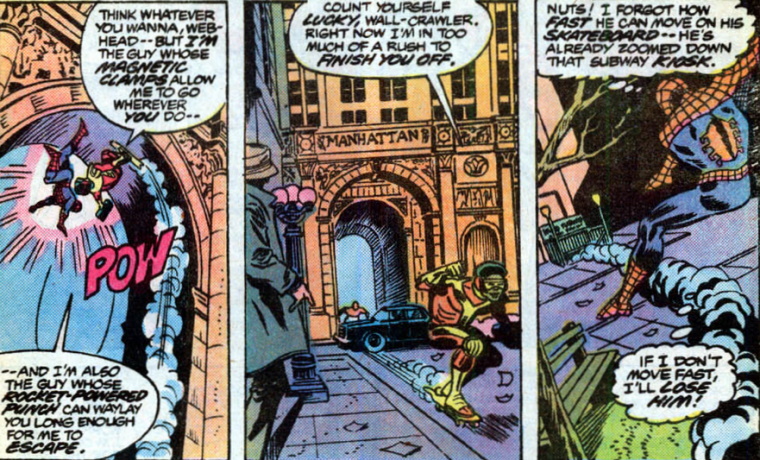
I’ve said already that I don’t want writers to take Robert Farrell and treat him like he’s one of the smartest people in the world. But I want to make it clear I don’t want them to treat the Rocket Racer as if he’s incapable of kicking a little ass.
I get that he’s a skateboard-themed supervillain and your instinct is that he’s a goofy joke character. I can understand that impulse. The inherent goofiness of the character is part of the appeal to me. But this is the superhero genre, people! It’s all goofy as hell! One of the most popular guys is a rich amateur detective who dresses as a bat so he can drive around in a bat and throw little bats at the bad guys. Just because this stuff is goofy doesn’t mean we can take it seriously.
I don’t want Rocket Racer to be one of the most powerful forces in the Marvel Universe, mowing down cosmic enemies with ease. I don’t even want him to be on par with the heavy hitters on the Avengers or the X-Men or whatever. As with his intellect, I want him in the middle. I just want it to be such that if some street-level hero or villain is up against the Rocket Racer, he’s not someone who is taken out in a panel because he’s “lame” and “lame” characters are bad.
Bob Farrell is definitely a loser and probably has only grown to doubt himself more as his career has been a trainwreck, but he is also an above-average skateboarder who has designed clever bits of technology to help him do what he does. If we make enough stories that treat someone like that as a human, readers will learn to take it seriously. Like that amateur bat detective guy.
I feel like it is important to note that Bob Farrell, the Rocket Racer, is at least as old as Peter Parker, the Spectacular Spider-Man, if not a year or two older. The only time we’re given an exact age is Spectacular Spider-Man #104, in which a newspaper article notes that Bob is twenty-three years old. This is in an era when Peter was in university, and so probably only around twenty-one himself.
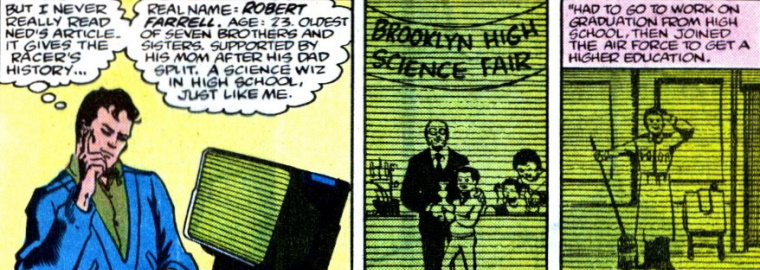
But some of the stories that came after that had a tendency to act as if he were a teenager. When they told the story about Bob going to university, they felt the need to include a line about him passing a high-school equivalency test first, forgetting that he was already an adult high school graduate when he first appeared. When he tried to register with the government as a superhero, they stuck him in the “Avengers Academy” for training alongside a bunch of teenagers. And later, when one of those same teenagers tried to gather a bunch of other young heroes to fight a threat that could control adults, they included Bob on a list of potential recruits.
It’s clear that people, both inside and outside the Marvel Universe, think of the Rocket Racer as if he were a teen.
There’s something to be said about the way society treats Black men simultaneously as naive children when it wants to and other times as dangerous adults, but I don’t think that even I can say that’s what’s been happening in Rocket Racer stories. I really just think that people have an understandable tendency to assume the skateboard-themed character is a teenager. If I were to start telling someone about a skateboard-themed character from superhero comics, I’m confident most would assume “teenager” until told otherwise. And, indeed, the idea that he’s got an embarrassingly “childish” style is one source of Bob’s self-esteem issues.
I don’t have much of a deeper thought behind this post. I’d just like for writers to remember Bob’s correct age when they write him. For posterity I must note: Bob’s appearance on the 90s Spider-Man animated show did indeed treat him as a teen. Perhaps that’s correct way to have taken the Rocket Racer, but I think his adult failures in the real Marvel Universe make him a more compelling character.

