Planet Gurx: Slimelands Animals

Bwotyaxchooeviv
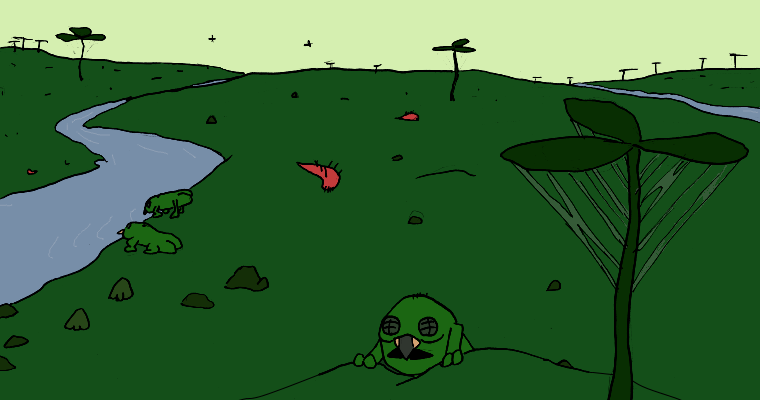

The slimelands: a continent-sized region where a super-thick layer of slime floats atop the ocean, strong enough to support an ecosystem on its surface. Here, a Heppoig pokes out of its mound beneath a mucus-covered plants to look around, while others of its pack take a drink from a nearby stream. Sekuoarmil wander the area, and some Huthchoo are hidden among the blobs of slime.
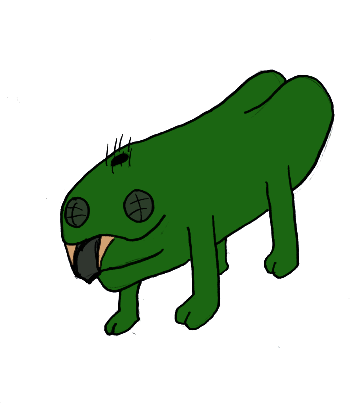
Heppoig

Heppoig are a type of Ekkpay, related to the Aunip found in cities all over Gurx, and we should at last examine that group more closely. Ekkpay use their top four limbs to move in a quadrupedal manner, while their lower limbs are short stumps on the rear of the animals that they use to slap on the ground for communication (they hear through their feet and bottom side), or to slap together and create a large sound that might scare predators. This is why the closest translation to English for the word “Ekkpay” would be “Clapbutt”. Heppoig specifically are a type of Ekkpay that thrive in the slimelands, using their beaks to burrow tunnels into the slime. But unlike tunnels built in dirt or soil, the slime is constantly trying to fill them in again, so the Heppoig work together in packs to maintain their living space. They can even allow the tunnel entrances to grow closed again for extra protection.
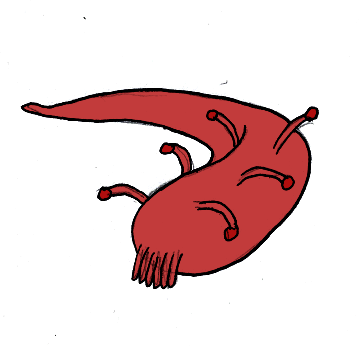
Sekuoarmil

The Sekuoarmil can afford their bright red colour because they are highly toxic. No predator in the slimelands would be stupid enough to eat one. And so, Sekuoarmil are free to wander the slime, living off the waste of other creatures. At the end of their lives, the Sekuoarmil head to the water to lay eggs and die.
Huthchoo

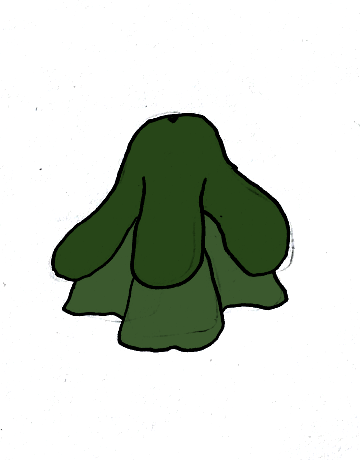
Hidden in the scene above are some Huthchoo, a type of Vootuph that has adapted to life in the slimelands by developing a hard shell that resembles a blob of slime, and so goes ignored by predators. The slime that makes up the pseudo-ground beneath them is largely the dead slime cells which have been forced to the top, but the Huthchoo have long, piercing tongues that poke downward and absorb nutrition from slime over a metre beneath the surface. Incidentally, wind can be harsh in the slimelands (as well as dust storms if it has been dry and the top layer of the slime begins to flake off), so the tongues of the Huthchoo also allow them to anchor in place during such events.
Planet Gurx: Strondovarian Gestures

For social creatures, the Strondovarians don’t have much in the way of facial features. Although a human may find Strondos to be cold and unemotional in many ways, they do in fact have emotions and, even without eyebrows to furrow or lips to curl, they can get their feelings across to others non-verbally.

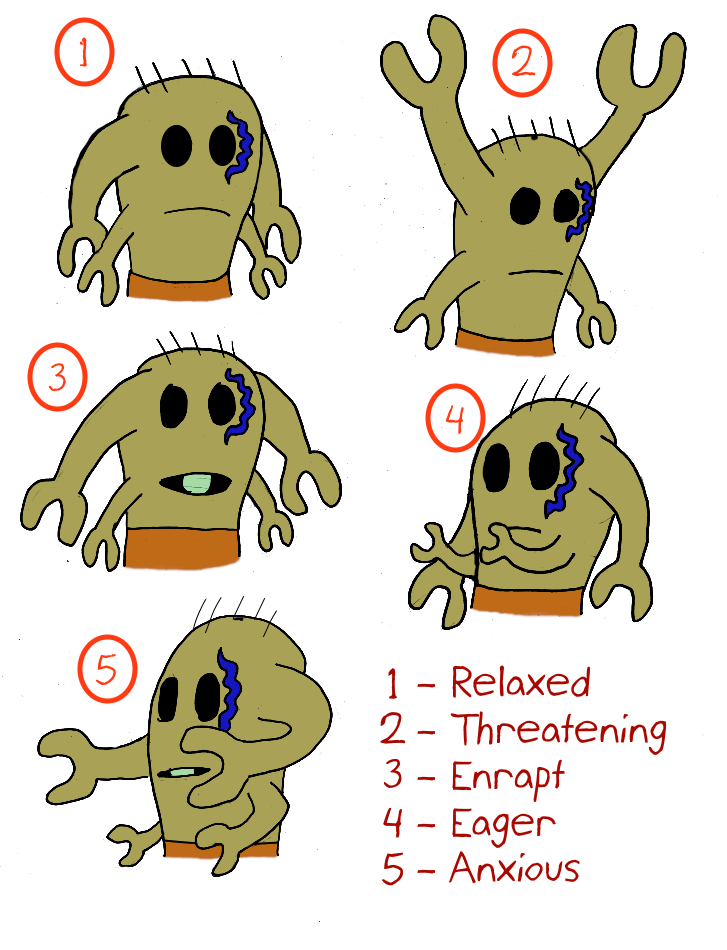
Here, Nibnassin gives some examples of body posture and what emotion it may be revealing:

The upper arms of a Strondo are the biggest indicators. These limbs (they call them “Thast”) tend to droop when a Strondo is relaxed, often getting tucked behind their back when most comfortable. Contrary to that, if a Strondo is raising their Thast, you can be sure they’re trying to be imposing, and since they can swing a Thast in a powerful blow, they are pretty imposing.

Given that a significant part of a Strondo’s auditory sense organs are located behind their mouth, it is appropriate that the Strondo word for their lipless mouth hole is “Hear”. Though they only close their Hear tightly when eating, if they are especially interested in listening to something, they will open it wider to let more sound into the mouth cavity (which they call “Aaruo”) that serves as an echo chamber for the sound taken in.

The lower set of arms for a Strondo (the “Thae”) are more commonly used for finer manipulation, so if a Strondo has raised them, it is apparent that they are ready to engage in activities that require a more active role on their part. When they raise them, they’re ready to think and act in a less blunt way then with the Thast.

So that’s the basics you’d need to know to get the basic idea of how a Strondo is feeling. There are other little things they do (like shaking a single Thae to indicate impatience, or curling limbs inward to indicate feeling tense), but among Strondos, if you really want to catch their meaning you need to listen to what they’re saying.

Planet Gurx: City Animals

Bwotyaxvaribba


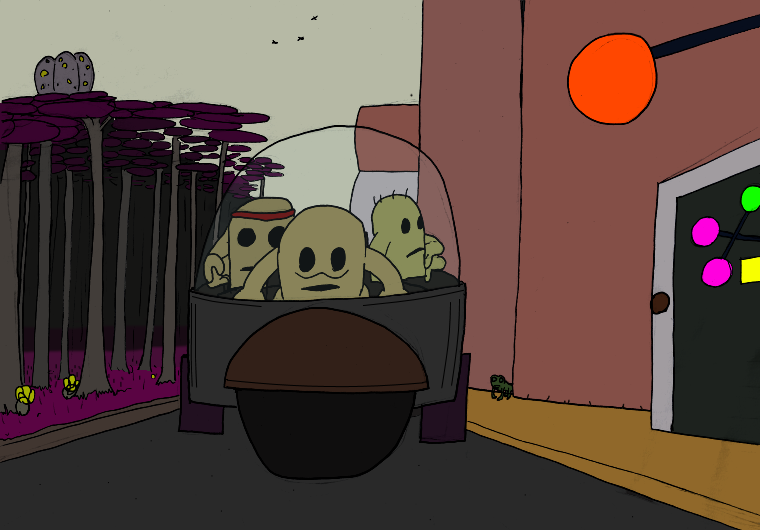
In this scene a vehicle full of Strondovarians drives along the outside road of a city, while animals of various kinds are nearby. An Aunip cautiously stays close to the buildings, in the sky above a handful of Eklooan are flying about, and near the tops of the forest just outside the town a large Tessen feeds.

Aunip

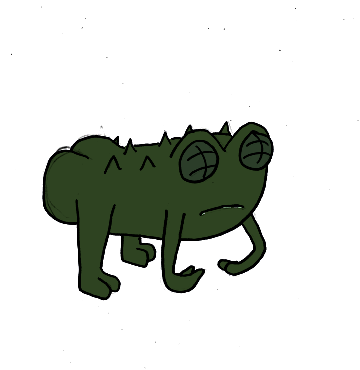
The Aunip may look like a four-limbed animal, but it is indeed a six-limbed Lapaouger. It’s just that they are from a sub-group called Ekkpay, which walk on their two frontmost limbs and their other two have retracted into stumps. Most Ekkpay dwell in the wilderness, but Aunip have adapted to living alongside Strondo civilization so they have spread Gurx-wide. We’ll go into the other Ekkpay at a later date, but we can note here that Aunip specialize in collapsing their musculature down and squeezing through tiny cracks to seek food in Strondo buildings.

Eklooan

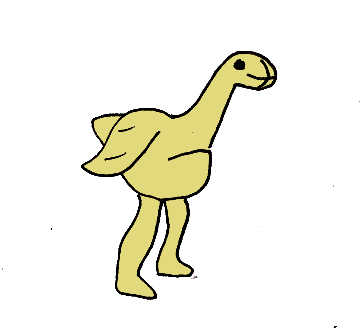
Flying high in this picture are some Eklooan. Eklooan are a small Glounaph species that have evolved specifically to live off the kind of garbage that would wind up in a Strondo city. The build nests similar to Earth’s birds, and specifically do it in the nooks and crannies of Strondo buildings. A lot of Strondos consider them an annoyance, but some treat them kindly and feed or even provide homes for them.

Tessen

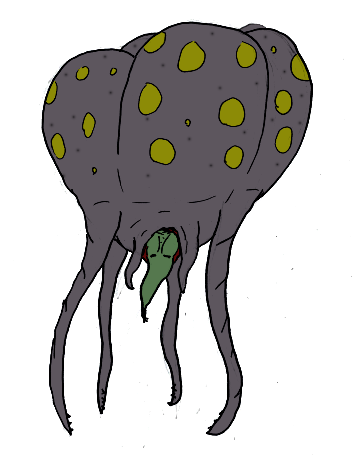
Most Lapaouger, including Strondos, have a sort of gas bladder attached to their lungs that fills with lighter-than-air gasses to help keep their dense muscular system upright, but that particular system is most highly developed in the Tessen. These massive hot-air-balloon-style creatures float along the tops of forests and hold onto the tops of the trees, from which they will eat for hours. They are completely sightless and communicate with loud songs that can be heard far and wide. When a Tessen dies, it falls to the forest floor and provides a hearty feast for the animals and plants below. While they aren’t necessarily “city animals” they will try to keep near cities in forests because Strondos tend to treat them well and the constant traffic of Strondo vehicles can scare away predators.