Young Men Comics #22, The Flash Foster Story

In the first Flash Foster story we got an origin story of sorts for the High-Gear Hot-Shots, a group of teens who started a hot rod club. That outing felt pretty lacklustre to me, but let’s see how their second story goes:
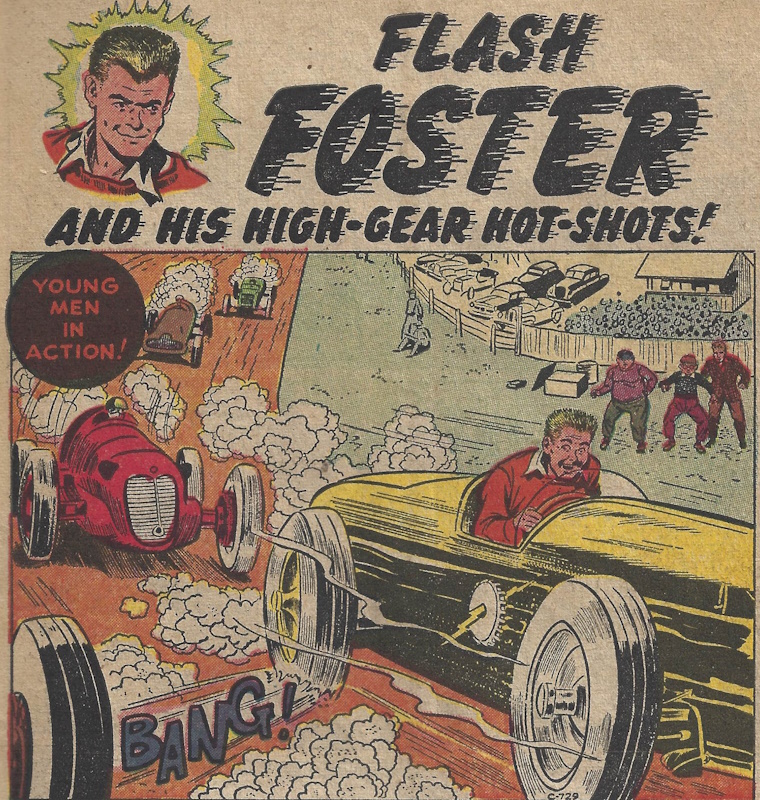
The splash image still promises us “Young Men In Action!” and we’re given a scene of Flash racing a car with what appears to be a delirious glee, but one of his tires is bursting. Oh no, watch out Flash! The splash in the previous issue (also a racing scene) didn’t actually happen in the story, it was just an example of the kinds of things that could happen to Flash. Will this be another fake-out, or will for action will be slaked?

It’s another seven-pager, and it picks up weeks or months after the last one. As of the end of the origin the team hadn’t begun their competitive racing career, but now we’re told they do it every Saturday. Flash is a good racer, but the car is letting them down.
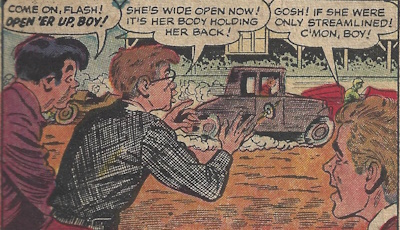
The first thing I notice here is that the Model TNT, which was their big star vehicle last time, is no longer treated as a cool car. It’s never even called the “Model TNT” anymore, instead being referred to as the (or a) Ford Puddle Jumper. It’s not good enough, we’re told. It needs to be streamlined, they say. What happened?

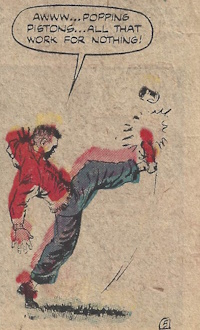
It feels like someone’s nephew read the first story and told them that actually kids don’t want to read about old cars. Kids want the sleek, streamlined cars. I do assume that the Model T was originally chosen because it was the cool car of the writer’s youth, but it had to be left behind. Whatever the reason for the change, they swerve into a lane today’s kids can enjoy (by which I mean “today’s kids” of 1953). The change is fine with me. Apart from liking the “Model TNT” name, I had no sentimental attachment to that car. If they want to make some changes to appeal to kids, I say go for it. WITH ONE EXCEPTION! At no point in this issue does Flash exclaim “Popping Pistons!” Has some nephew decided that catchphrases aren’t cool and the creative team taken that to heart? God, I hope not. There must be an in-story reason. Maybe Flash just isn’t up to using his catchphrase because his father is sick.

Oh yeah, I should get to the actual story.
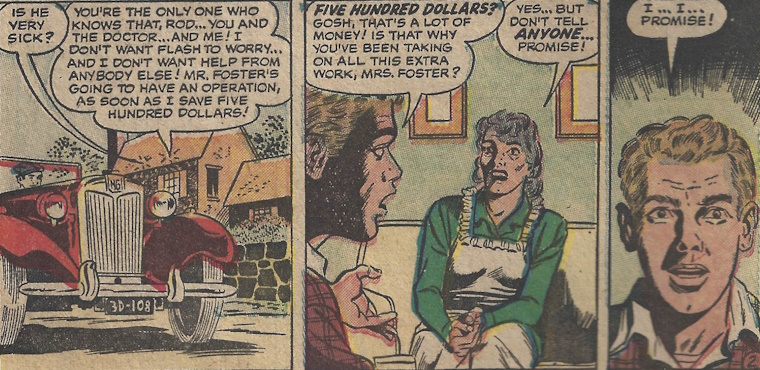
Remember how one of the High-Gear Hot-Shots was a rich kid named Rod Randall? He’s the star of this issue for some reason. It goes like this: Flash’s father is sick, so Flash and his mother are doing a bunch of extra work to stay afloat. This is how we learn that Flash’s mother works as a maid for Rod’s family. I have never been a rich teenager (and it’s getting a little late for me to turn into one) but I can’t help but feel like if your best friend’s mother is your maid that’s weird. Right? Am I wrong about that? I don’t know. Anyway, Mrs. Foster confides in Rod that they need five hundred dollars to get an operation to save Mr. Foster. This is news that Flash himself doesn’t know, so Rod has to keep it a secret.

It turns out that there’s a big race coming up and the prize for it is five hundred dollars! Are you thinking what I’m thinking? Rod should just get his rich father to pay for the operation! Yes, but that’s not what the story is thinking. I suppose that after Rod spent the whole last issue saying “My father could just buy us a car” and Flash kept saying “No, we need to earn this ourselves” that Rod assumes Flash wouldn’t accept money, so it is time for trickery.

The gang insist they can’t win the race if they don’t get a new, sleeker body for their car, but Flash can’t fix the car if he’s so busy with his extra newspaper route work. Rod volunteers himself and the other members of the crew to deliver Flash’s papers while he works on the car. Everybody wins! And indeed everybody does win. The car is fixed up, they enter the race, we get a less-exciting version of the tire-popping from the splash that they have fixed two panels later, and they win. After the race, the gang intend to split the winnings until Rod gives it to Flash’s mother to pay for the operation. Rod even acts like the rest of the team was in on his plan, instead of taking all the credit for himself. Could it be that Rod Randall is a nice person? Weird. Unexpected. Give me a Rod Randall, Teen Millionaire comic!
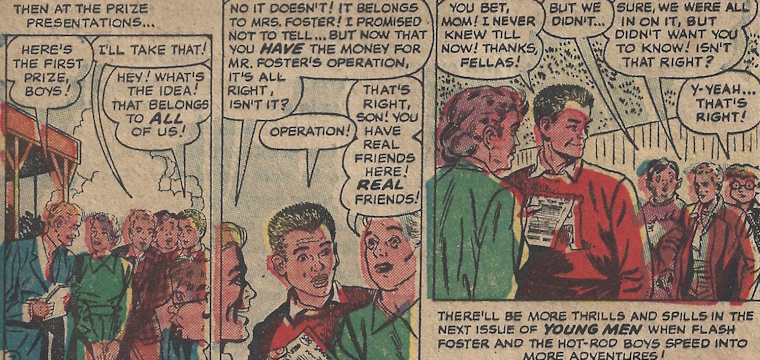
For the record, two of the other High-Gear Hot-Shots kids from the previous issue show up in this one. The big kid is called Drag and the bespectacled one is called Hub. These are nicknames that prove they are devoted to racing. These are the names of heroes. One character from last time who does not reappear is Sandra, the girl. Granted, she was never a member of the team, but she isn’t in this one at all. It’s like someone’s nephew thinks girls are gross and don’t need to be in the book.
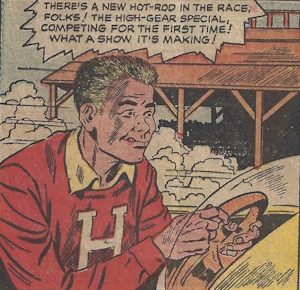
In the end, I must admit that this Flash Foster story is marginally more action-packed than the first. The climactic race gets only a couple panels more than the rainstorm drive did in the first story, but the difference is that that rainstorm drive was sprung upon us suddenly after pages of kids just wanting a car. This time, the story is propelled toward the race from the beginning like, you know, a story. Add in the stakes of Flash’s father being sick and Rod keeping a secret and I could actually see a child enjoying this.

I have still not determined whose uncle was writing these comics, but the Internet knows who drew them. Ed Moline was an artist on a lot of Atlas crime, western, and horror stories. I can definitely see how his style would work well for horror, but his work on Flash Foster seems a minor footnote in his career (it isn’t even mentioned on that page I linked to). He’s not a bad artist by any means, as I feel the images from this issue (with the colours are a lot better than the last) should reveal, and he can draw the heck out of the cars in a way I bet most artists would find tedious. But most important is this paragraph from that site: According to the artist’s daughter, “Dad was a healthy, strong, and very funny man! He often worked at home at a drafting table in his private studio in the basement. I remember he decorated the walls with a drawing of a gorilla eating my mother!” Truly a brilliant artistic mind.
Young Men Comics #21, The Flash Foster Story

These days the medium of comics has become synonymous with the superhero genre in ways that, frankly, annoy me. I hear people refer to the latest Marvel movie as a “comicbook movie” or they refer to the silly tropes of superhero stories as the sort of thing that happens “in comics”. But superhero stories are a genre, not a medium. Saying that a movie is a “comicbook movie” is as nonsensical as saying that a movie based on a novel is a “prose movie”. Gibberish.

Comics can do any genre. Comics should do every genre. Because of that, I have a fascination with the era between the end of World War Two and the 1960s when superheroes fell out of fashion in mainstream American comics. It was an era filled with horror and sci-fi comics, my favourite genres, but also westerns, romance, comedy, crime, and more.

I want to do a look into that era, to see what it may have offered that has been swept aside for our costumed crimefighters. And if I were to pick a single issue to examine that might best represent the between-superheroes era, I’d have to choose Young Men #21, the June 1953 issue. Why that issue? Well, because I own a copy of Young Men #21, which sure makes examining it more possible than if I didn’t. Anyway, let’s check out the first story in that issue to see what comics were providing for the children of the 1950s.

FLASH FOSTER AND HIS HIGH-GEAR HOT-SHOTS

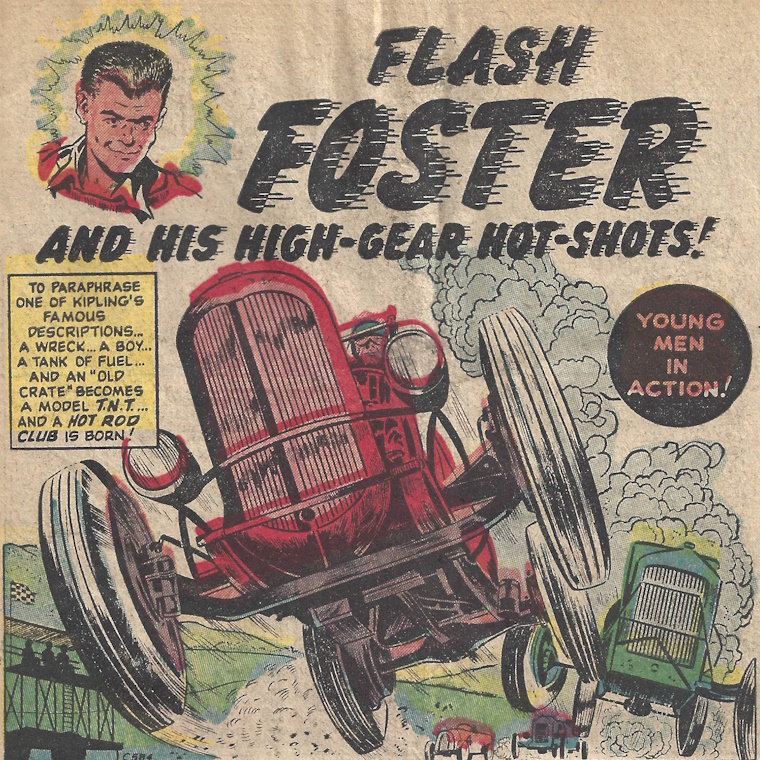
Oh yeah! Check out that splash! Cars racing! A bold declaration of “Young Men In Action!” A paraphrase of Rudyard Kipling! Surely this is going to be a rollicking good time!

This seven-page story is an origin for Flash Foster (real name Frederick Foster Jr.) and his custom hot-rod, the Model TNT. Sometimes character origins are great stories, that’s why superhero movies spend so much time on them. Less than a decade after this issue, Marvel will give us Spider-Man’s origin, one of the all-time greats. Does Flash Foster have a similarly excellent origin?

He does not.

It’s like this: Flash sees a hot rod drive by and decides that he and his friends should start a hot rod club, so they do. Okay, fine. I guess technically the origin also includes how he gets his car, so I’ll add that: they want a car for a while but can’t afford one, but then Flash finds a farmer with the beat-up remains of an old Model T. They buy that for cheap and then fix it up.

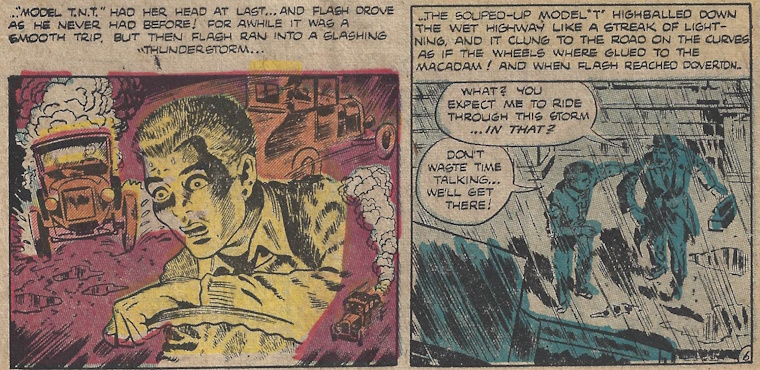
I feel like a comic, especially one that promised us action, could have condensed that previous paragraph to a single page. Or even a few pages if it wanted to sprinkle in some character bits. This comic waits until the second-to-last page to introduce any conflict beyond Flash wanting a car. That conflict? A young boy is sick, the doctor needed to save him is in a different town, and there’s a storm raging! Now we’re talking! Action at last! Here, I’ll show the single most action-packed segment of the comic:

Okay, we get that cool panel of Flash, sweat pouring down his face, driving intensely through the storm. Sure, the narration ruins it by saying that most of the trip was actually smooth, but don’t worry because the next panel also ruins it by cutting directly to the destination. Our dramatic climax is over and that one cool panel of driving is our reward for listening to this kid pine for hot rods for the rest of the story. (The trip back is even worse, a single panel of the car driving without any of the impressionistic fun).

Well, what about Flash himself? Is he at least a compelling protagonist? A cool hot-rodding rebel? A charming rogue who loves to race? The kind of kid who takes an old Model T and upgrades it into what he calls a “Model TNT” must be fun to read about, right? Let’s try something: here’s a handful of quotes that a kid like Flash might say about his chosen hobby. Try to pick out which one is really from this issue:

  1. “We’re not doing this just for glory […], it’s so we can learn to do things on our own!”
  2. “Now we can speed down the open roads! We can be free for the first time in our lives!”
  3. “Racing is work! Anything good is work!”
  4. “And we obey traffic laws! Yep, proving we’re not a menace is a big part of our job!”
  5. “I took care to make it safe as well as fast! All serious hot rodders do!”

So which one is real? I tricked you! All of these are real quotes except #2. That’s right, Flash said all those things about hard work and safety, but not the one about the freedom that cars would bring him. Flash Foster is a little wiener kid.

There are no credits on the issue, so I don’t know who the writer is, and I can only eliminate artists who were working in this era but whose art I can tell this is not (it’s not Kirby, Ditko, or Colan, for example). I don’t know who created Flash Foster. But I can tell you this, they were definitely grown men who thought they were creating a good role model here. To be clear I, Patrick D Ryall, want young people to learn about the value of safety and respect and stuff, but I can tell you who wouldn’t love that: ten-year-old boys.

I admit, there are kids out there who will find themselves drawn to a goody-two-shoes type of character. I was that kind of kid. But I’d argue that those kids don’t need the lessons taught here as much as the reckless kids. If you want a protagonist to reach those kids, you’d need make Flash cool first and then smuggle the positive lessons in through the story. The kids who need to learn the value of car safety are not the ones who will see Flash saying “Car safety rules!” and say “Yeah, this guy gets it!”

Oh wait, I just remembered that Flash’s catchphrase is “Popping Pistons!”

I take it all back. This kid is cool as Hell.

Now to address the “and his high-gear hot-shots” part of the title. Flash Foster does, inexplicably, have friends. The majority of them are not named in this issue, but one is fat and one has glasses, so you can predict the kind of personalities they will develop if they make it into the next couple issues. There is also Sandra, a girl and enthusiastic friend of Flash who is not actually part of the hot rod gang, but her uncle is a reporter who could give them publicity (this does not happen in the story). The only one of Flash’s friends who is actually notworthy in this issue is Rod Randall, and I can not tell you how annoyed I am by the decision to name one of the kids in the hot rod comic “Rod”. It’s begging for confusion. Anyway, Rod is rich and he spends all his time asking “why don’t we just get my father to buy us a car?” so that Flash can argue the value of earning it themselves.

It’s a fine batch of friends. One can see this gang developing into a cast with personalities that play off each other like the Riverdale kids or something, but in this origin story they all have to take a back seat to Flash’s responsible car ownership.

So, is there anything in this story that I think would appeal to kids? Well…

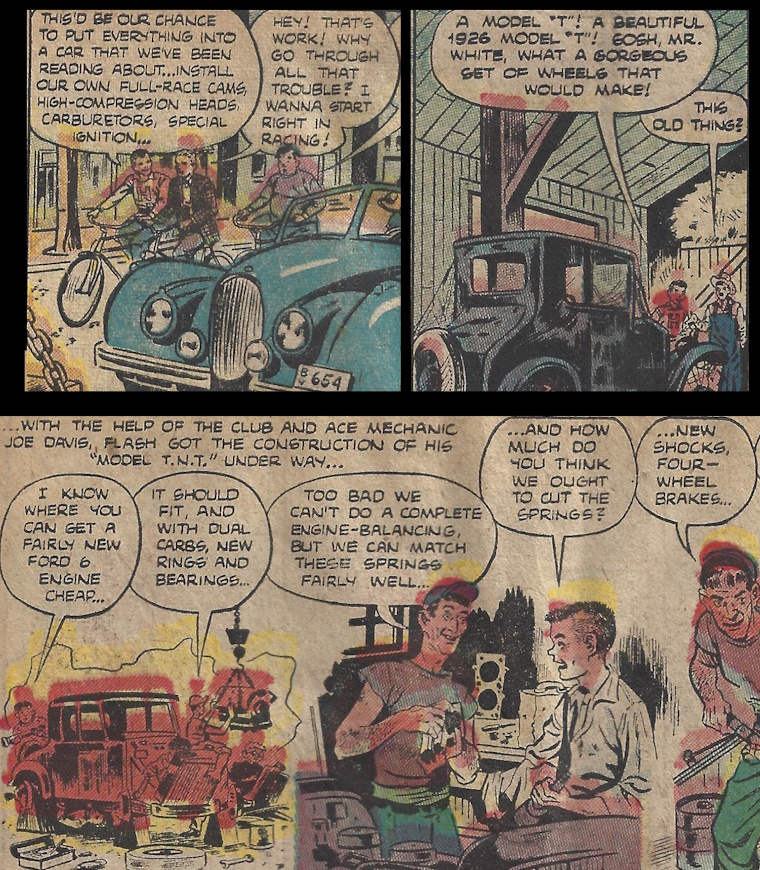
If you’re a little 1950s kid who is into cars and likes thinking about cars and wants to read a comic where people talk about car stuff, this story mentions a bunch of car stuff. Come and get it!

A final aside: Marvel owns these guys, right? So you may wonder if Flash Foster exists in the Marvel Universe. Well, yeah. There’s a different “Flash Foster”, who was like a footballman or something, who appeared in the ’40s and I believe he has been referenced in modern comics, but out little hot-rodder here has not, to my knowledge. But the policy as I understand it is that characters like this are considered to exist in the Marvel Universe as long as nothing in canon contradicts their existence. So if they ever want Johnny Storm to go back in time to the ’50s and do a hot-rod race against some teens, well we’ve got the teens right here ready to go.

If I’m rating how this story stacks up against the superhero genre, I have to admit that nothing here makes racing stories seem like a winning genre for the medium. Still, there are still two more issues of Young Men with Flash and friends and they simply HAVE to be more action-packed than this one. It would simply not be possible for them to be less so.