Young Men Comics #22, The Flash Foster Story
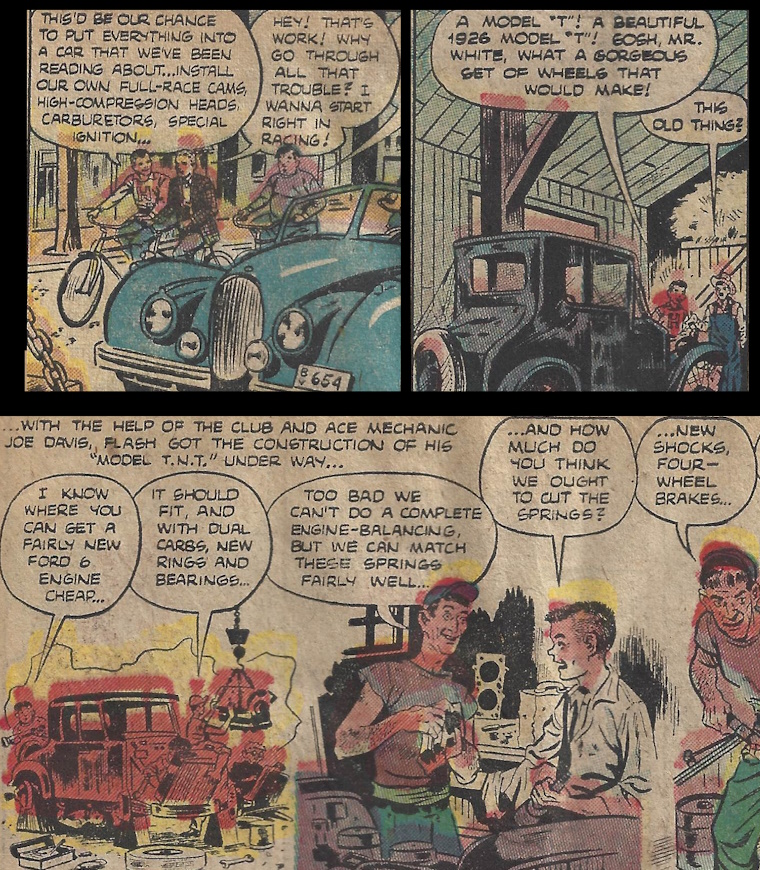
In the first Flash Foster story we got an origin story of sorts for the High-Gear Hot-Shots, a group of teens who started a hot rod club. That outing felt pretty lacklustre to me, but let’s see how their second story goes:
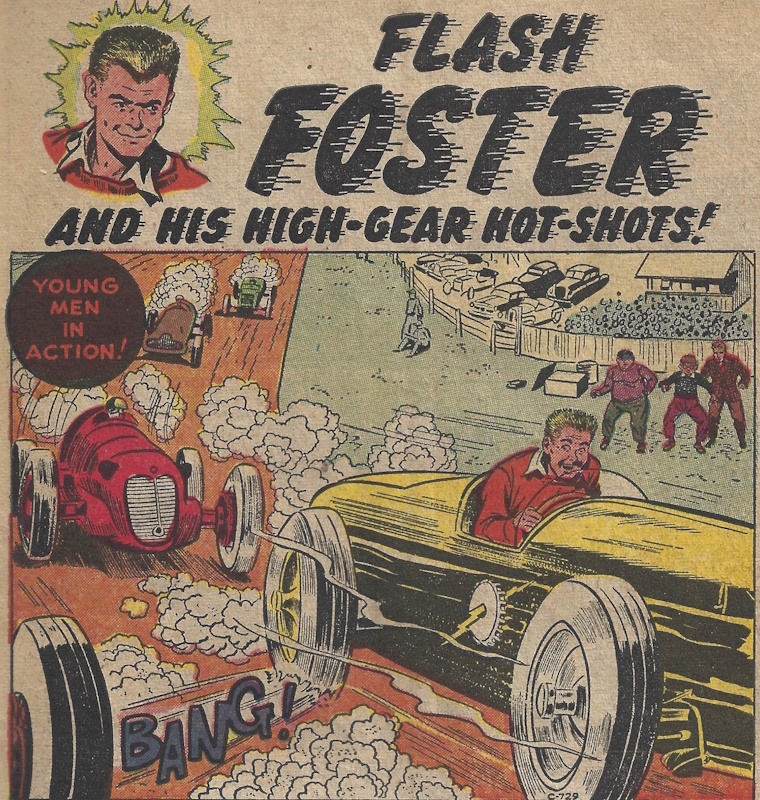
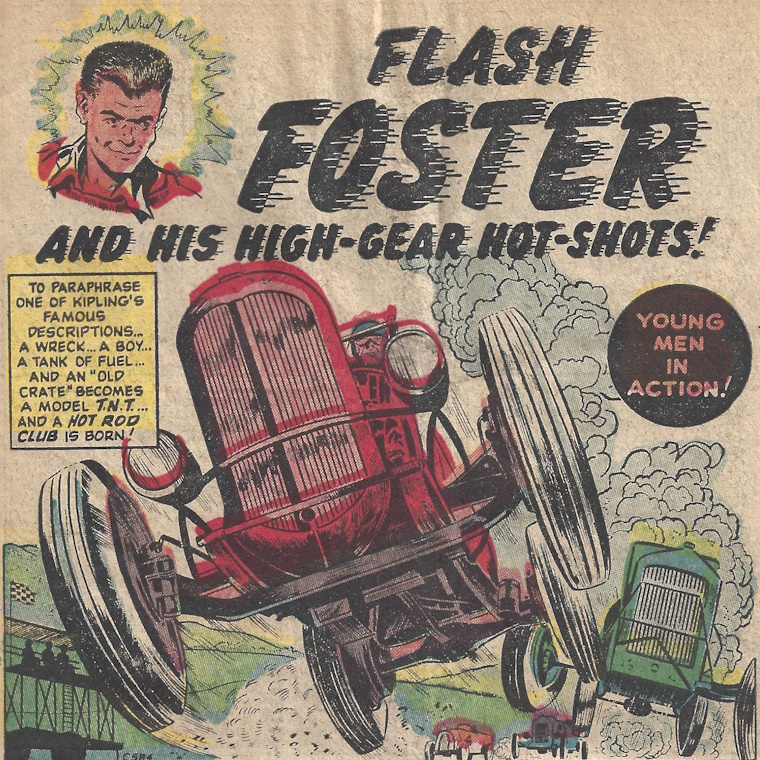
The splash image still promises us “Young Men In Action!” and we’re given a scene of Flash racing a car with what appears to be a delirious glee, but one of his tires is bursting. Oh no, watch out Flash! The splash in the previous issue (also a racing scene) didn’t actually happen in the story, it was just an example of the kinds of things that could happen to Flash. Will this be another fake-out, or will for action will be slaked?
It’s another seven-pager, and it picks up weeks or months after the last one. As of the end of the origin the team hadn’t begun their competitive racing career, but now we’re told they do it every Saturday. Flash is a good racer, but the car is letting them down.
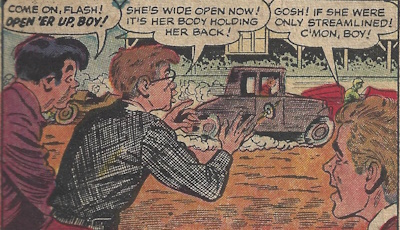
The first thing I notice here is that the Model TNT, which was their big star vehicle last time, is no longer treated as a cool car. It’s never even called the “Model TNT” anymore, instead being referred to as the (or a) Ford Puddle Jumper. It’s not good enough, we’re told. It needs to be streamlined, they say. What happened?
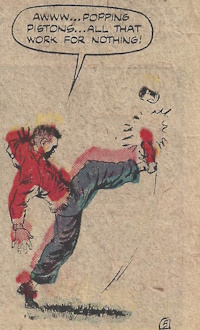
It feels like someone’s nephew read the first story and told them that actually kids don’t want to read about old cars. Kids want the sleek, streamlined cars. I do assume that the Model T was originally chosen because it was the cool car of the writer’s youth, but it had to be left behind. Whatever the reason for the change, they swerve into a lane today’s kids can enjoy (by which I mean “today’s kids” of 1953). The change is fine with me. Apart from liking the “Model TNT” name, I had no sentimental attachment to that car. If they want to make some changes to appeal to kids, I say go for it. WITH ONE EXCEPTION! At no point in this issue does Flash exclaim “Popping Pistons!” Has some nephew decided that catchphrases aren’t cool and the creative team taken that to heart? God, I hope not. There must be an in-story reason. Maybe Flash just isn’t up to using his catchphrase because his father is sick.
Oh yeah, I should get to the actual story.
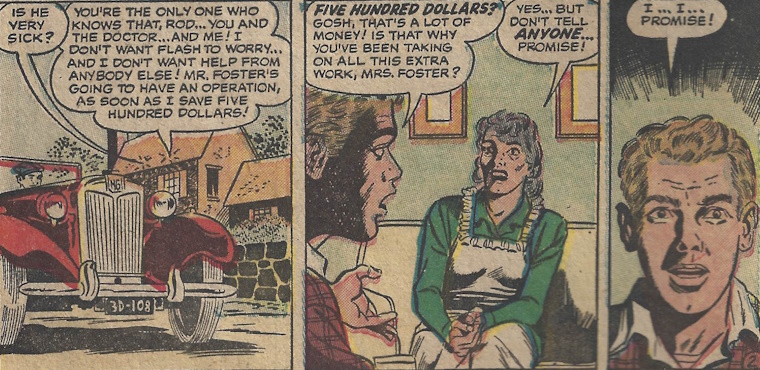
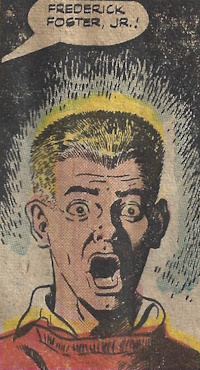
Remember how one of the High-Gear Hot-Shots was a rich kid named Rod Randall? He’s the star of this issue for some reason. It goes like this: Flash’s father is sick, so Flash and his mother are doing a bunch of extra work to stay afloat. This is how we learn that Flash’s mother works as a maid for Rod’s family. I have never been a rich teenager (and it’s getting a little late for me to turn into one) but I can’t help but feel like if your best friend’s mother is your maid that’s weird. Right? Am I wrong about that? I don’t know. Anyway, Mrs. Foster confides in Rod that they need five hundred dollars to get an operation to save Mr. Foster. This is news that Flash himself doesn’t know, so Rod has to keep it a secret.
It turns out that there’s a big race coming up and the prize for it is five hundred dollars! Are you thinking what I’m thinking? Rod should just get his rich father to pay for the operation! Yes, but that’s not what the story is thinking. I suppose that after Rod spent the whole last issue saying “My father could just buy us a car” and Flash kept saying “No, we need to earn this ourselves” that Rod assumes Flash wouldn’t accept money, so it is time for trickery.
The gang insist they can’t win the race if they don’t get a new, sleeker body for their car, but Flash can’t fix the car if he’s so busy with his extra newspaper route work. Rod volunteers himself and the other members of the crew to deliver Flash’s papers while he works on the car. Everybody wins! And indeed everybody does win. The car is fixed up, they enter the race, we get a less-exciting version of the tire-popping from the splash that they have fixed two panels later, and they win. After the race, the gang intend to split the winnings until Rod gives it to Flash’s mother to pay for the operation. Rod even acts like the rest of the team was in on his plan, instead of taking all the credit for himself. Could it be that Rod Randall is a nice person? Weird. Unexpected. Give me a Rod Randall, Teen Millionaire comic!
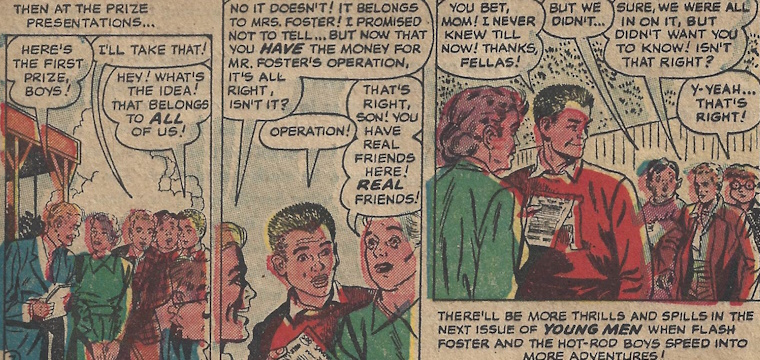
For the record, two of the other High-Gear Hot-Shots kids from the previous issue show up in this one. The big kid is called Drag and the bespectacled one is called Hub. These are nicknames that prove they are devoted to racing. These are the names of heroes. One character from last time who does not reappear is Sandra, the girl. Granted, she was never a member of the team, but she isn’t in this one at all. It’s like someone’s nephew thinks girls are gross and don’t need to be in the book.
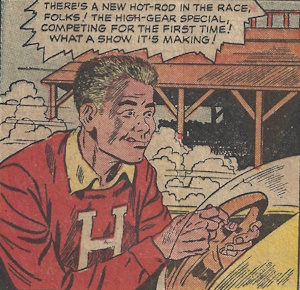
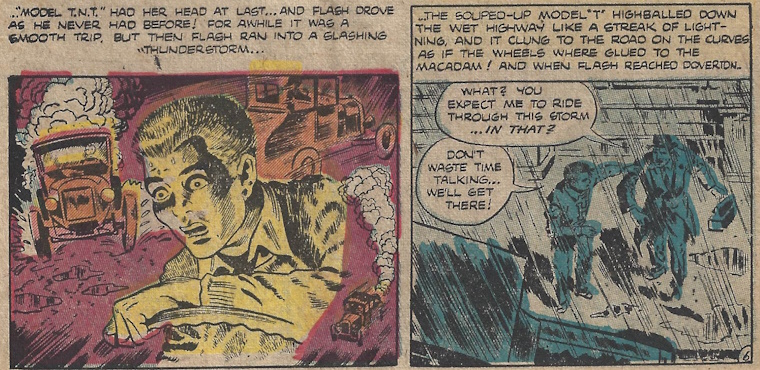
In the end, I must admit that this Flash Foster story is marginally more action-packed than the first. The climactic race gets only a couple panels more than the rainstorm drive did in the first story, but the difference is that that rainstorm drive was sprung upon us suddenly after pages of kids just wanting a car. This time, the story is propelled toward the race from the beginning like, you know, a story. Add in the stakes of Flash’s father being sick and Rod keeping a secret and I could actually see a child enjoying this.
I have still not determined whose uncle was writing these comics, but the Internet knows who drew them. Ed Moline was an artist on a lot of Atlas crime, western, and horror stories. I can definitely see how his style would work well for horror, but his work on Flash Foster seems a minor footnote in his career (it isn’t even mentioned on that page I linked to). He’s not a bad artist by any means, as I feel the images from this issue (with the colours are a lot better than the last) should reveal, and he can draw the heck out of the cars in a way I bet most artists would find tedious. But most important is this paragraph from that site: According to the artist’s daughter, “Dad was a healthy, strong, and very funny man! He often worked at home at a drafting table in his private studio in the basement. I remember he decorated the walls with a drawing of a gorilla eating my mother!” Truly a brilliant artistic mind.