Tenth Phone Guys of 2017


Kringdaru
The Kringdaru are a three-legged species that have a single dexterous claw. They are large compared to humanity, standing about two metres on average, but there are many species that are much larger on their homeworld. The Kringdaru were, in their history, frequently preyed upon by a number of large carnivores, but their greater intelligence allowed the Kringdaru to rise to the top and create their society in relative safety with their fancy technology.
One of the Kringdaru, with super powers beyond those that are typical of the species, has somehow gone off to the planet Earth to fight superheroes there while taking the name Invay Dor. It does not seem that Invay Dor’s desire to invade other planets is typical of the species, though.

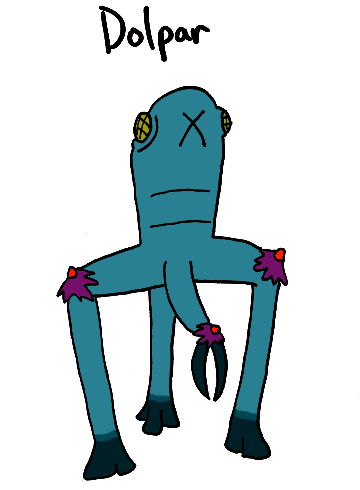
Dolpar is a breeder, whose life is devoted toward egg-laying. Breeders live in the center sections of Kringdaru cities, and are cared for by servants. Given that their lives are devoted to the sole task of laying eggs (they don’t even have to care for the young), the breeders are free to devote mental energy toward a game (we can compare it to chess, but it is fairly different). This game is the most popular sport of the planet. Dolpar does not rank among the best players in the world or anything, but is renowned enough to those who follow the game closely.
Wibbylo is a water capturer. The Kringdaru devote great amounts of resources to taking water from natural sources, like rivers and springs, loading it into containers, and bringing it back to their cities for use. If there is a reason they don’t just use water straight from the sources, or even use pipes or something, it is not a reason that we as humans can understand.

Zeechy is a nice young Kringdaru who enjoys spending time with friends, quiet nights, and long walks. Dislikes include excessively hot temperatures and comets. Zeechy collects rocks that have been shaped into spherical shapes and regularly volunteers for work at the crematorium where dead Kringdaru are burned and their ashes gathered for various industrial uses.
A Fact About Kringdaru: The Kringdaru are able to mimic the sounds made by other species of animal on their world with much accuracy. When they train an animal for some use, they are more likely to do it by almost speaking that animal’s species than to try to make the animal understand their own.
Universe: Orange
I have reviewed twenty-five Beekeepers since I started that project and I have just done an average score for them. So far, they average a mere 2.52 out of 5. Considering I started the Beekeeper Review project as a way of proving how awesome fictional beekeepers are, it is clear to me now that I have not done a good enough job. Gonna have to find some real winners from this point onward.

Today’s beekeeper appears in the Littlest Hobo episode called “Dragonslayer”. He doesn’t have a major role, the story is actually about some children that the protagonist doggie helps through some dangerous woods, but he the episode’s climax still focuses on the beekeeper.
The beekeeper is not given any name, but he has a cool black beekeeping outfit and carries a big stick. His land, which the kids wander through, seems to be rigged full of traps that he probably set (there are many dangerous animals in his woods too). Those are all pluses for a beekeeper’s score. Also, when he comes across a bear breaking into his hives, his instinct is to attack it.
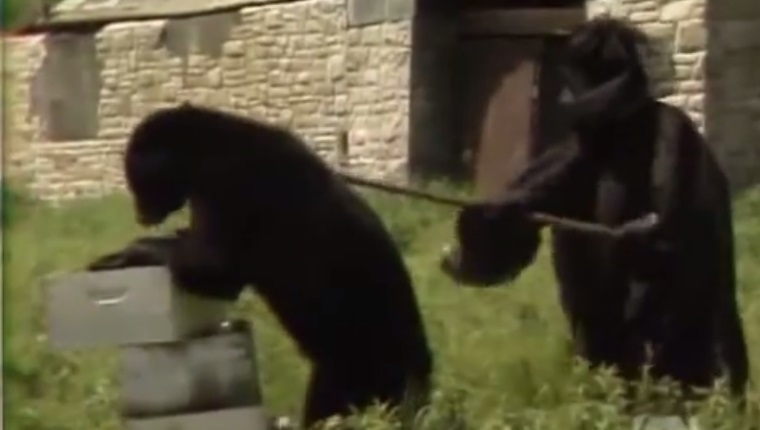
Granted, the bear beats him up and he has to be rescued by the star of the show, but still. He charged a bear. That’s pretty cool. If his loss to he bear was the only strike against him, that’d be a pretty good beekeeper score. Sadly, another concern is the scope of his apiary operations. It is probably a result of the show’s Canadian Television budget, but within the narrative, those boxes we see the bear attacking at the extent of this beekeeper’s honey farm. In spite of all the land he seems to own, that’s all he’s got.
It is also worth noting: when one of the kids asks why he didn’t just shoot the bear, the beekeeper says “No crime in a bear wanting honey, even if it is the best wild honey in the country.” There’s so much to unpack there. He holds no grudge against the bear, so he’s doing well for the Beekeeper Rage. But he also calls it “wild honey” which isn’t what a beekeeper’s stock would be. I don’t know what to make of that.

I wish I could go higher, but with the evidence we have there just isn’t enough to justify a higher score.

