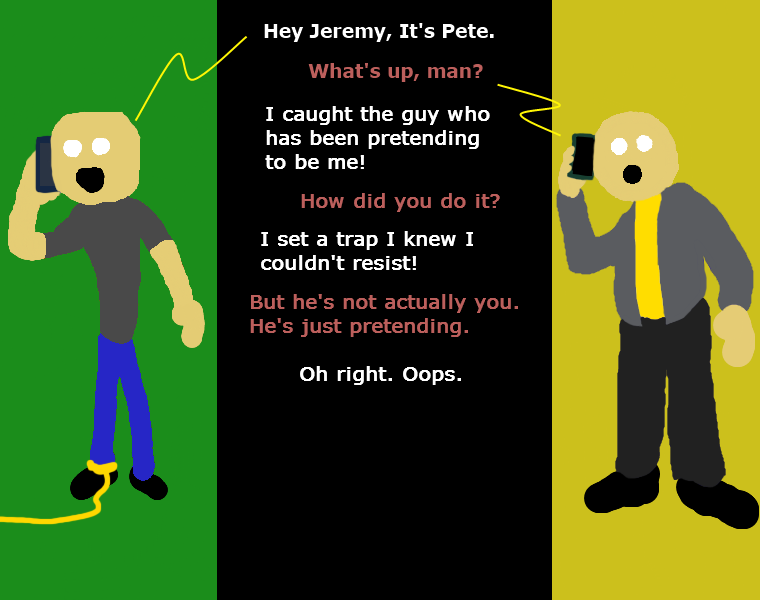
Phone Guys: Alien Message

I have found something incorrect about Superman… ON WIKIPEDIA!
I’ve noticed mistaken information about Superman on Wikipedia and other fan-written websites before but have generally taken it in stride. This time, I feel compelled to do something about it. While doing research for my most recent Superman versus Bigots article I found this claim on the Wikipedia page for Vathlo Island (the part of Krypton that has Black people):

This is false, but I admit that I don’t know enough about Wikipedia’s rules for editing to just delete the false statement. I know they have rules about “original research” that I don’t actually understand, but I also know that I need some sort of proof of my claim. They have a citation link to an article backing their claim, but even THAT website doesn’t say that the Kryptonian from Vathlo Island is the first Black character. That website says that the Superman comic didn’t have an African American character until the ’70s, then goes on to talk about the Black Kryptonian as a separate entity, which Wikipedia’s editors failed to catch.

So what can a PDR do? Well, maybe I can’t just edit the Vathlo Island article, but I can at least provide the ammunition needed to rectify its mistake. Black people who appeared in Superman’s book prior to issue #234: Here we go:
There we go. That’s all I could find. It’s certainly possible I missed some, but it’s also certainly a higher number than the zero that Wikipedia claimed. For posterity I must also note that I ignored several appearances of Egyptians, who are African but are not depicted as dark-skinned in the comics in the way that the Vathlo Island post is clearly talking about. This includes also ignoring depictions of the Sphinx, whose face I assume is based on some ancient Egyptian who could, for all I know, be dark-skinned. Furthermore, the information I’ve gathered here does not include people appearing in advertisements, or gag strips, or educational material in the issues that is not part of a Superman story. I saw examples in each of African or African American individuals, but they were not what I was there for.
And I also want to make it clear that this data comes only from the comic magazine entitled “Superman” because the wording of the claim only drew specific attention to that book. Superman stories have also appeared in places like “Action Comics“, “World’s Finest Comics“, and “Superboy“, and I’d also count books like “Superman’s Girlfriend Lois Lane” and “Superman’s Pal Jimmy Olsen” as Superman books. Each of these books told hundreds of stories with Superman and I’m sure plenty of those involved “primitive” tribes and witch doctors as well until the 1970s came and they started peppering Black people into backgrounds. I’ll note further that the Superman radio show, the cartoons from the ’40s, and the show starring George Reeves all had African characters from various parts of the offensive representation spectrum (somehow the show managed it best in an episode that included a villain in blackface).
Some further thoughts: Obviously this is not a good amount of representation for Black people in Superman over those decades. There’s not one Black person among those A to R that I would classify as an actual “character”. There are no names, only a handful have lines, and they almost never actually matter to the story in which they appear (something also true of the Kryptonian scientist in Superman #234 whose appearance started all this). But I didn’t go into this hoping I’d find out that the magazine had secretly diverse beyond our previous imaginings. I don’t think superhero comics are as diverse in representation as they need to be even now, let alone before the fight for civil rights. And furthermore: There is not a single face listed above I feel confident in saying is a Black woman. Maybe one of the two in the very last image, but even then I can’t be sure. It’s no wonder it has been so hard for creators to establish a Black Woman of the Daily Planet when it took decades to get a Black woman as a mere extra in there.
So, maybe we can change that one line on Wikipedia now that we have an article to cite, but what would be more important would be to keep expanding representation of not just Black people, but all kinds of people, in our popular culture. It can be done, but to do it we actually have to do it.