Beekeeper Review: Doc Beebles

By now it is clear that it is too common for beekeepers in the superhero/supervillain world to just be called “The Beekeeper”. Clearly that is an appeal to the pure mythic appeal of beekeepers as a profession, but you’d think they could come up with something more imaginative.

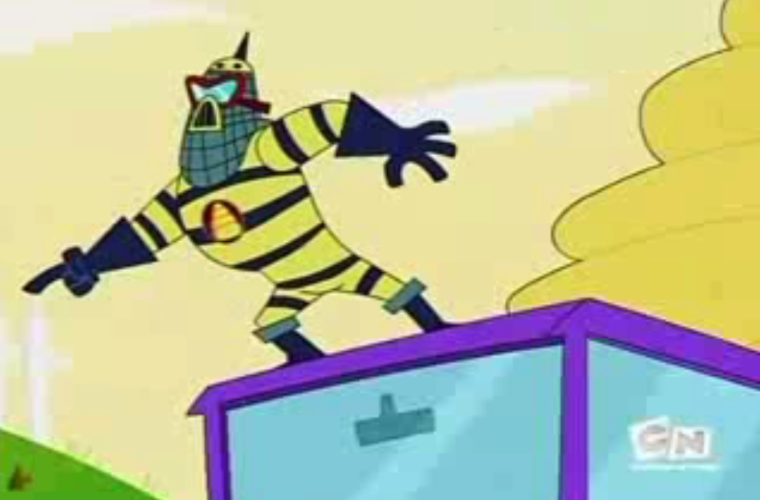
Anyway, today’s beekeeper is called “The Beekeeper”. He appeared on a show called Johnny Test. I didn’t know about the existence of this show until I was researching beekeepers, so I don’t have much to give as far as context is concerned.

Here’s the deal: Doc Beebles is an old man who runs a company that makes honey bars, a healthy snack. Nobody buys his product because they assume healthy snacks are gross. Beebles becomes the Beekeeper and goes on a citywide crime spree, stealing candy so that people won’t have any choice but to buy his products. His plot is foiled by Johnny Test and friends and, though they admit that the honey bars are actually good, Beebles is arrested. In a later episode the Beekeeper is trying to get his revenge on Johnny, but is mostly unnoticed as Johnny is trying to come up with a new holiday. That one ends with Johnny and the Beekeeper working together, with the Beekeeper as a sort of Santa-figure, using his bees to deliver his honey bars to all the kids in the world. The Beekeeper has, as far as my research can tell, remained reformed since. So he gets a happy ending, at least.
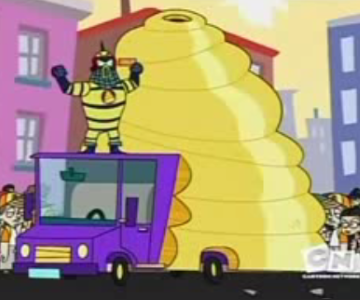
Beebles is at the borderline between awesomely competent beekeeper and not one of those. Sure he has good control over his bees, but he also loses that control very easily to Johnny in a bee costume. He owns his own business and makes a good product, but apparently his product doesn’t sell. He’s got cool gizmos (A beemobile, some sort of balloon floatation system, a “honey blaster” which seems to basically be a laser gun) but he is, of course a victim of Beekeeper Rage, as evidenced by his anti-candy crusade. Still, he’s quite active for an old guy, wants people to eat healthier, and he enjoys making bee-related puns. I admit it’s a close call. It has to be taken into account that, while they’re probably superheroes or something, Beebles, especially in the second of these episodes, was foiled repeatedly and casually by children.

Two Honeycombs out of Five. Maybe if he just had a better name than “The Beekeeper” he could have rolled over to a third comb.

Now, I just want to point out that my Beekeepers Reviews are never intended to be a review of the work in which the beekeeper appears, but I need to point out that I don’t much care for Johnny Test. I actually do think, based on these episodes, that the humour of the show could be in the right place, but it has this supremely annoying tendency to make unnecessary noise. Every second of the show contains a sound effect, or a musical sting, or both. I assume this is (the creators’ idea of) an attempt to appeal to kids with short attention spans, but I hate it. So much.

Beekeeper Review: Beorn

“He is a skin-changer: sometimes he is a huge black bear, sometimes he is a great strong black-haired man with huge arms and a great beard [. . .] He lives in an oak-wood and has a great wooden house; and as a man he keeps cattle and horses which are nearly as marvellous as himself. They work for him and talk to him. He does not eat them; neither does he hunt or eat wild animals. He keeps hives and hives of great fierce bees, and lives most on cream and honey. As a bear he ranges far and wide.”

That is Gandalf the Grey’s description of Beorn, today’s Beekeeper. Beorn is a character in the Hobbit, and there’s no getting around it: this is one awesome beekeeper. With such an open-and-shut case for beekeeper greatness, it’s a good chance for me to look at what I consider when I rate a apiarist.

First, there’s the general quality of their beekeeping skills. Beorn apparently keeps a large area of bee pastures, and his bees “were bigger than hornets. The drones were bigger than your thumb, a good deal, and the bands of yellow on their deep black bodies shone like fiery gold.” Whatever Beorn is doing, it’s working. He’s got healthy bees and plenty of ’em. He also knows how to work with bee-products: he is noted as having “red beeswax candles” and he knows how to make “twice baked cakes that would keep good a long time, and on a little of which [one] could march far” with honey. He’s a good beekeeper.

Second, are they badass? A beekeeper needs to know how to fight. Today’s guy certainly is: “Beorn was a fierce enemy” the text tells us, and it sounds true: he is a “huge man with a thick black beard and hair, and great bare arms and legs with knotted muscles [and] a large ax.” But we can’t go too far into this element of beekeeper reviewing without brushing up against the next, because next…

Next comes the matter of supernatural powers. They don’t have to be actually “supernatural” in nature, they can be technologically based or whatever, but a great beekeeper needs something that sets it apart from mere mortals. For starters, Beorn can turn to a freaking bear. He’s apparently massive in both human and bear form, so he has the advantages of two separate powerful forms. It seems he prefers fighting in bear-form, though. Check out some quotes from the Battle of the Five Armies:

  • “But even with the Eagles they were still outnumbered. In that last hour Beorn himself had appeared – no one knew how or from where. He came alone, and in bear’s shape; and he seemed to have grown almost to giant-size in his wrath.”
  • “The roar of his voice was like drums and guns; and he tossed wolves and goblins from his path like straws and feathers.”
  • “[N]othing could withstand him, and no weapon seemed to bite upon him. He scattered the bodyguard, and pulled down Bolg himself and crushed him.”

Beorn essentially won that battle. But don’t go thinking that being a bear is Beorn’s only skill. He can also talk to animals, all types of animals, and they like him well enough that they help him out around the house. That’s a sweet deal.

The final element to consider is, how do they handle the Beekeeper Rage? It’s a constant problem and Beorn is no exception. Before dropping in for their unannounced visit, Gandalf warns his comrades: “He can be appalling when he is angry, though he is kind enough if humoured. Still I warn you he gets angry easily.” And that’s how it is. He is angry, but if you can get past it, he is a pretty good guy. At first he doesn’t trust the protagonists, since they are strangers to him, but once he checks out their story “Beorn was most jolly for a change; indeed he seemed to be in a splendidly good humour and set them all laughing with his funny stories.” It is Beorn’s good luck that he exists in a fantasy world in which objectively evil people exist, so he can channel his Beekeeper Rage into mostly productive areas like Goblin removal.

So that’s it. I, as an expert, am able to give or take some ratings based on certain intangible qualities, my gut instincts or just a “certain something” that a character may possess, but the above metric is the most reliable way to tell how good a beekeeper is. So where does that leave us with Beorn?

“Beorn indeed became a great chief afterward in those regions and ruled a wide land between the mountains and the wood; and it is said that for many generations the men of his line had the power of taking bear’s shape, and some were grim men and bad, but most were in heart like Beorn, if less in size and strength. In their day the last goblins were hunted from the Misty Mountains and a new peace came over the edge of the Wild.”

Holy smokes.

Five Honeycombs out of Five. He’s top of the line.

Beekeeper Review: Trigona Ambrose

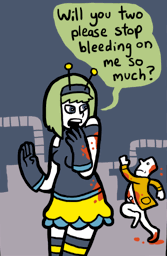
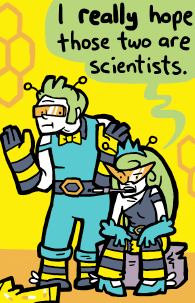
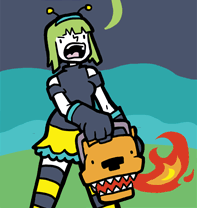
Trigona Ambrose is a character in a webcomic called Beeserker. It’s a very surreal sort of strip wherein some Sciencemen decide to create a robot powered by bees. Such a quest requires a lot of bees, and Trigona is the beekeeper who supplies them. So now that robot, the titular Beeserker, considers Trigona its mother figure and she’s got some bizarre friends to drag her into bizarre adventures. Most of the beekeepers I’ve reviewed so far have appeared once or twice and then their story was done, but Trigona is still appearing in an ongoing comic, so she’s still “active” if you will.

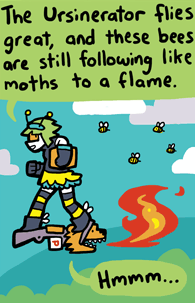
Called “Beegirl” by the Sciencemen, in many instances Trigona comes across as a voice of reason in the strip. But that is only because of how insane everyone and everything else is there. Trigona’s role as a bee-seller is, she admits, not typical of a beekeeper, but she’s bored with her life and doesn’t care much about the well-being of her bees. Considering her method of beekeeping seems to be entirely based around shooting them with a flamethrower made of a bear’s head (the Ursinerator), selling them as a fuel source is pretty consistent.

The Ambrose family is the latest branch of a long lineage of beekeepers, apparently. That is appropriately mythic. Her parents have been seen in the strip. Her father is Meliponini, who wielded the Ursinerator before Tringona. Her mother is Queenie, who seems to have the strongest bee control in the family (she is the queen after all) and apparently smoke-control. It’s very clear that in the universe of this comic, beekeepers are the supernatural force I’ve been saying they were all along.

So let’s run down the beekeeping powers Trigona has displayed so far: She’s got an antennae headband that allows her to translate “all bee languages”. She’s got goggles that allow her to track bee energies. The Ursinerator, of course, is a pretty cool flamethrower, but it also flies and functions as a phone. She even has transformation sequences to help her get dressed. In the Beeserker video game, she can double-jump. The Bee-Dome in which she lives, has some handy self-regenerative powers. She has a bit of a weakness for glue-fume-instigated hallucinations, but for the most part that’s a very impressive set of abilities. She’s held her own in many a fight and the fact that’s she’s got so many bees to sell indicates at least some success at keeping her colony active. Though I’d almost bet the bee-dome is self sufficient enough that it’d keep a good colony even if there were no Ambroses there at all.

Four Honeycombs out of Five. Very strong in the adventuresome aspects of the profession, but less so in the beekeeping parts.

Beekeeper Review: Reginald Prawnbaum

You can just watch this one for yourself, why not? It isn’t even five minutes long.

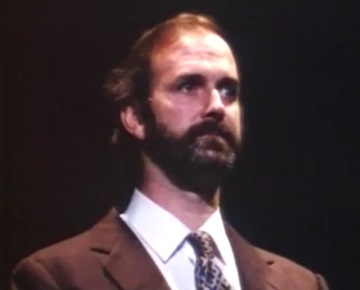
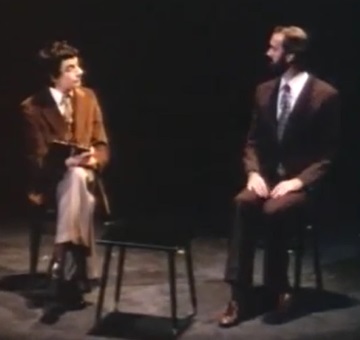
What we have here is Beekeeper Rage in action, right before our very eyes. Reginald, portrayed by John Cleese, is being interviewed by an interviewer, played by Rowan Atkinson, and it all goes downhill from there. As you can see for yourself, Reginald Prawnbaum is a very renowned beekeeper. So much so that he gets to appear on television! Television! If that’s not a measure of success, I don’t know what is. Reginald starts out very composed and together but less than five minutes later and he’s lost the constant struggle that rages in the heart of every beekeeper.

We learn quite a bit about poor Reginald in that time. He’s been a beekeeper for “over forty years” and whose love of bees began as a child. He kept notes about what kinds of flowers the bees visited even then. As a child! This is a man with so many experience points devoted to his beekeeping stats that I assume when he is among his swarms he is like unto a demigod. He’s not got much experience dealing with idiotic interviewers, though.

I mean, the interviewer is an idiot. I think there might even be some malice behind it. Are his tics real? I can’t actually be sure that this was a calculated attempt to discredit a beekeeper live on television, but the possibility exists.

But does the possibility that the interviewer is actively goading Reginald, or even the certainty that he’s extremely annoying, justify the wrath that Reginald brings down on him? Well, making him run around until he falls off the stage, that’s not so bad. Shooting him? That’s a touch more than necessary.

How good a beekeeper is Reginald? Well, we don’t see him do any beekeeping. I can (and do) assume he’s got all kinds of supernatural powers and fighting ability. But it isn’t just his stated beekeeping experience that make me suspect it. It’s the gun. Where does Reginald get the gun? Why does he have it at this interview? If you say he has it because it is funny, you’re missing the point of overthinking fictional beekeepers. If you’re PDR you realize there are two possibilities: Either he just carries around a gun because he’s the type who needs a gun on a regular basis because he’s fighting mobsters or something, or he just straight up summoned a gun from the ether (maybe he had his bees bring it to him instantly during the moment of darkness?). Either scenario means one thing: Reginald Prawnbaum is a badass beekeeper.

Three Honeycombs out of Five. I’m certain this guy is extremely powerful, but he unfortunately loses points for the Rage.

Beekeeper Review: Springfield’s Beekeepers

The Simpsons was a pretty great show. Season Six of the Simpsons was smack in the middle of its best years. Lisa’s Rival was a good episode. Homer getting a pile of sugar was an excellent subplot. That’s when the Simpsons got Beekeepers.

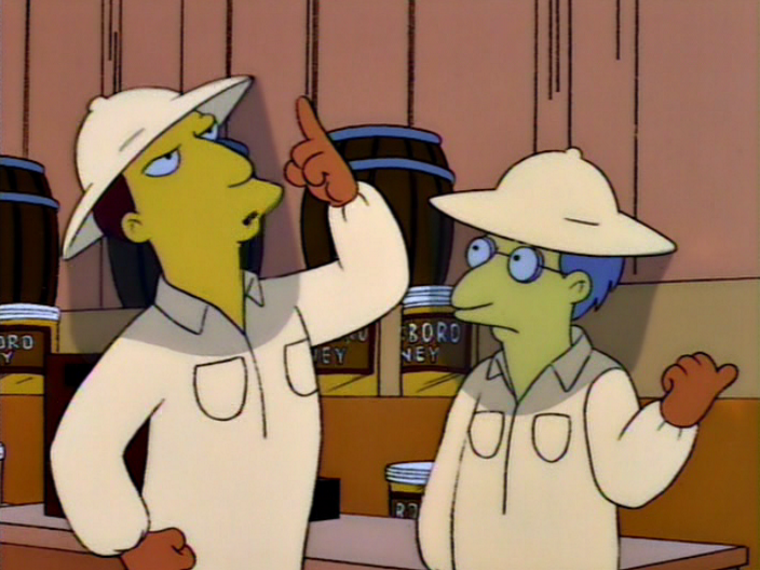
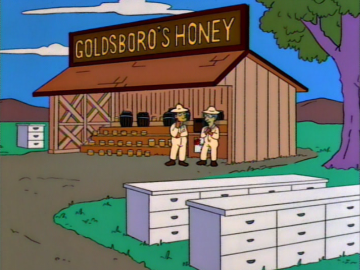
Homer gives a rousing speech about why it his right and his duty to protect and sell his pile of sugar when suddenly a swarm of bees descends upon it. He tries to fight them, but can’t win (“Ow! They’re defending themselves somehow!”). Soon the local beekeepers notice that their apiary is oddly quiet (“No noise… suggests no bees”). Seeing one lone bee, so they follow it in their “beemobile”, which is actually a Chevy, and track the bee to Homer and his pile. They assume that Homer has taken their bees on purpose and are prepared to pay him to get back their swarm, but then it starts to rain, the pile melts, and the bees head home. Homer gets nothing for all his hard work.

These two are pretty great. The taller one (voiced by Hank Azaria) is very much based on Adam West’s Batman. The shorter one (Harry Shearer) is the perfect compliment to the other. It astounds me that, on a show like the Simpsons, these guys never came back. I admit, there’s a decade and a half of Simpsons that I haven’t seen, but from what I can tell from the Internet these guys have never so much as appeared in a crowd scene or anything. They don’t even have a page on the Simpsons Wikia site. What the chunks?

I can only assume the beekeepers themselves didn’t want to be seen. They don’t really display any special powers, except perhaps being able to follow a single bee while they’re in a car, so maybe the power they did have was keeping hidden. They have no preternatural control over their bees at all. Still, being given a Batman-reference for a voice is an indication of badassness if nothing else is. They do seem fairly safe from Beekeeper Rage, though. Even as think Homer is a criminal genius they don’t get very angry at him. They almost seem to respect his cunning.

Incidentally, the name of their company, Goldsboro Honey, is a reference to a song called “Honey” by a guy called Bobby Goldsboro that there is, apparently. I learned that thanks to the Internet.

Two Honeycombs out of Five.

While writing this I learned that there’s an episode in the twentieth season that deals with beekeeping, but these guys aren’t even in there. I’ll have to deal with that one someday way, way down the line.