Beekeeper Review: Killer Beekeepers from Castle Crashers

Castle Crashers is a beat-em-up game in which Killer Beekeepers appear both as enemies and as a player character. The enemies appear in only a single level of the game and the player character has to be unlocked, both little touches that make the Killer Beekeepers feels rightfully special. But is that specialness justified?

Well, the enemy Killer Beekeepers are, as I say, rare. They will only attack when the player’s rampage brings them through the fields where the Killer Beekeepers’ bees live and work, and even then the only after the player has taken out a number of bees. In spite of the word “Killer” appearing as an adjective in their name, these Beekeepers just don’t show a sign of Beekeeper Rage. They legitimately just want to protect their bees. That’s admirable.

The unlockable player character Killer Beekeeper is a better study for the skills these Beekeepers can have as they level up. Upon starting the game the Killer Beekeeper is armed with a weapon called the Rat-Beating Bat, implying that they honed their skills protecting their hives from rats. As they level up their magical abilities, they gain the power to summon bees and use them as projectiles to fire at opponents (these bees are perfectly willing to die for the cause). And, indeed, with fully-levelled magic they can summon bees so quickly that enemies find it hard to resist being hurt. And while it isn’t directly related to beekeeping (though it is accompanied by smoke effects), they also have a magical jumping ability and can attack bosses while in the air, something apparently few other characters in the game can do.

It feels natural to compare the Killer Beekeepers with the Beekeeper from Fist Puncher. She was another who existed in the world of a beat-em-up game and could wander around fighting everyone who needs to be fought. A similar comparison would be the Beekeeper from Citizens of Earth, though she has numerous powers beyond just combat, such as healing skills, which give her the edge ratings-wise. The Killer Beekeepers show no talent as healers and have no talking bees or anything like that. They’re impressive fighters, but they have so much more to learn.

Four Honeycombs out of Five.

Beekeeper Review: Hachibee the Beekeeper

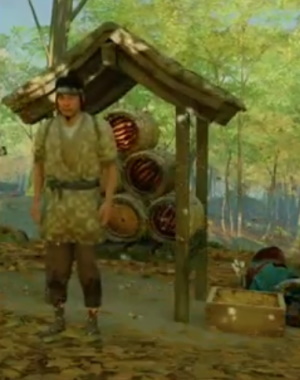
Hachibee is the Apiarist in Distress found in a Ghost of Tsushima expansion. This means he lives back in Samurai Times of Japan (I don’t feel it necessary to bother with a more detailed description of the era at this time.)

At this point I’ve covered enough of these that I could have told you how it goes before even looking: The hives/the Beekeeper are in danger, the game’s protagonist has to save them. It’s done by the numbers and doesn’t deviate.

I can’t rate Hachibee more than a Two for this. That’s the standard for this role. But Hachibee actually gets a little bit more detail than most of his fellows, which makes me wish I could go higher.

For example:

  • His honey is used for healing.
  • He writes poems for his bees.
  • He suggests his bees may be useful to the protagonist in a fight.
  • He has a good beekeeper name.
  • He refuses to abandon his hives even when the enemies arrive.

It’s all good stuff, but just not enough to escape the surprisingly cliche role of videogame Apiarist in Distress.

Two Honeycombs out of Five.

Beekeeper Review: Max Fischer

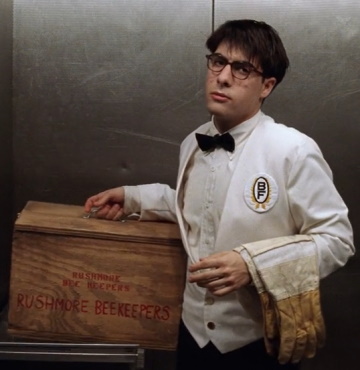
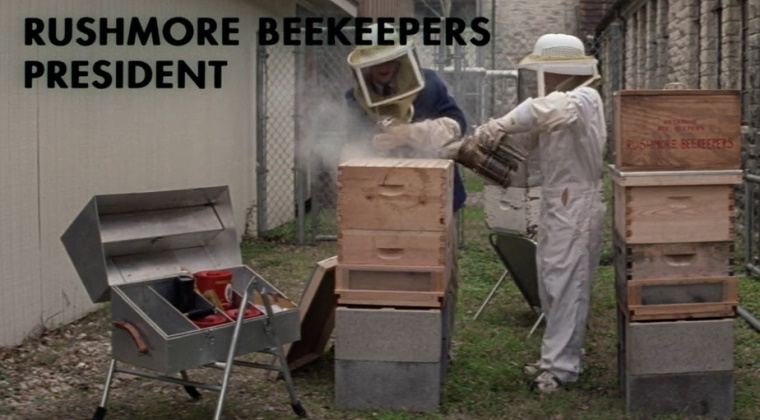
Those who haven’t watched Rushmore in some time may not immediately think of Max Fischer as a Beekeeper, but he was, and it wasn’t a minor thing. Max was the president of the Rushmore Beekeepers club, and Rushmore is a school with a bee on its logo. One thing people definitely will remember is that Max Fischer is a bit of a jerk. That’s the point of the movie, so it gets more focus than the Beekeeper stuff. But they’re both there, and they’re not unrelated.

First, I suppose, I should speak on Max’s good qualities. He’s an enthusiastic young man with a take-charge attitude and natural tendencies toward leadership. He has a wide variety of interests, of which Beekeeping is only one. He’s a talented playwright and is also in clubs for debate and fencing and wrestling and more, many of these clubs he has founded himself. If that seems to lessen the import of his Beekeeping club, I don’t think it’s an issue. One of the pluses of Beekeeping is that it is something worthwhile that someone can do that doesn’t take all their focus, allowing for multi-tasking and multi-disciplinary learning. I know that the movie points out that Max’s interest in these clubs overshadows his performance in school, so you might say, “how can he be learning multi-disciplinarily if he isn’t even passing his classes,” but PDR doesn’t hold our school systems in any sacred regard, so if Max learns better in his clubs, I’m all for it. It’s also worth remembering that I consider skills in combat and adventure a plus for Beekeepers, and while Max may not be especially good in a fight, he has clubs where he learns skills that an adventurer would need. When he is seen in a conflict, we have to note that the bees are one of the first weapons he picks.

But Max is, by no means, perfect. He begins his tale as a self-absorbed little prick. He’s a liar and a manipulator. He routinely hurts others as he strides toward his own goals. Max is definitely a sufferer of Beekeeper Rage.

It occurred to me while making this review that the real problem with Beekeeper Rage is how often it is motivated by selfishness. By definition, Beekeepers are people who solve problems by building and protecting a community. That community is largely made up of bees, but not solely, nd when a Beekeeper gets too caught up in their own self-importance, it causes problems and hurts the community, bees and others. Note that when Max tries to turn his life around, he does so by mending the breaks he made in his community. That’s what Beekeepers are for.

3 Honeycombs out of Five. Max makes mistakes, but he’s also young, learns some lessons, and has a lot of potential for growth.

Beekeeper Review: Basil

“[B]rother, I didn’t know that you’d STOLEN ONE OF MY BEES TO STING YOUR HORSE, UNTIL I COUNTED THEM”

In the interests of being thorough, I must review Beekeepers wherever I find them, which is why I’ve ended up with a list of over 200 Beekeepers Reviews I’ve got ahead of me. That’s a lot of research I must do, so when I find a relatively easy job, like Basil, the Beekeeper who appears in a parodic hypothetical period drama story, you know I’ll act quickly.

Basil has made millions selling his honey, so it must be good stuff, and he cares enough for his bees that he can count them and tell that one is missing. He is also the type who will give shelter to a distress runaway and the type who will investigate a mystery, both signs of the sort of nobility I ask in a Beekeeper. It’s also possible he fought in some manner of Bee Wars. All very impressive.

Basil’s scheming brother, the wealthy Lord Cucumberly, causes all the drama of the plot, but Basil reveals his brother’s lies and wins the trust of the heroine. It’s a happy ending for Basil, and for the heroine, who gets to spend her life with such a catch.

Four Honeycombs out of Five.

Beekeeper Review: The Far Side’s Beekeepers

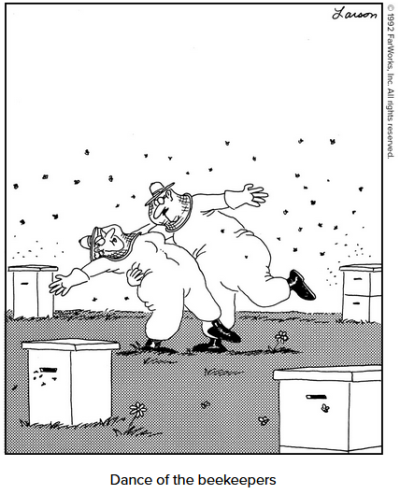
The Far Side is an often-brilliant non-serialized single-panel comic by Gary Larsen, and it was definitely one of the stones upon which my joy of reading comics was built. Naturally a comic which had to find a new topic every day for so long covered did touch upon Beekeepers, though I only remember one occasion. Luckily, that strip went up onto the official Far Side page today, so now I can finally review the two Beekeepers contained therein.

There’s only so much that I can glean from this panel, but what there is seems to indicate successful Beekeepers. They have multiple hives and lots of seemingly healthy bees going about. And I think their dancing is a sign that they are good at working together. They seem to have a nice healthy relationship and I approve of it. I ship them, as the kids say.

I can also make a case that their dancing could indicate something beyond mere ordinary apiary skill. The strip’s joke grows out of the fact that bees dance as a means of communication. Is it possible then that these Beekeepers have developed a method of dancing that allows them to communicate with their bees? I see no reason to assume otherwise.

3 Honeycombs out of Five.