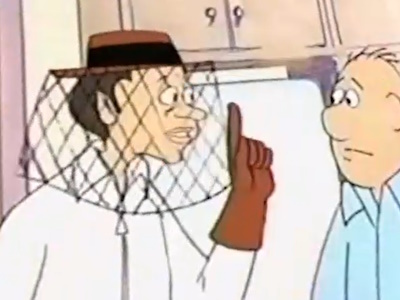
Beekeeper Review: Charles “Bumbles” Johnson

What’s difficult about this Beekeeper Review is that even though he appears in the Wait Till Your Father Gets Home episode that is entitled “The Beekeeper” we never actually get to see Bumbles do any Beekeeping.

The Boyles, the show’s protagonist family, have bees in their house. They check the phone book and see a big ad: “Charles Bumbles Johnson: If you’ve got bees give me a buzz – 851-6181”. Bumbles Johnson, voiced by Don Knotts, comes in exuding confidence, using his radio to stay in contact with his “Bumble Base” headquarters. He seems to have a supernatural ability to smell bees (“You can tell a bee man by his nostrils”) and shows no fear of being stung (“When you’re in bees, you learn to leave fear behind”). He seems like an ideal beekeeper, except that the comedic conceit of the episode is that he’s not good at his job and he’s kind of a jerk on top of it.

His attempts to get rid of the bees are unsuccessful. He causes chaos and destruction in the household. He flirts with the women and tells (presumably fictional) stories in which he name-drops celebrities he has supposedly worked for (“Bumbles Johnson, Sprayer to the Stars”). Eventually he insists that the only way to beat the bees is if he moves in with the family full time, naturally making of a nuisance of himself while he’s there. He eats all their food and tries to do non-Beekeeping-related tasks around the house, which he does badly as he does his attempted bee removal.

It’s a perfectly normal thing for a beekeeper to be called in to help with. So far so good. But he doesn’t do it. Also, we’re never shown that he has a hive or anything. He does state his intent to take care of the bees without killing them, but that is the only check in the positive column that Bumbles earns. It’s not enough.

One Honeycomb out of Five. It pains me to add another low-scoring review that bring the Average Beekeeper Rating down, but if I’m to remain the world’s foremost reviewer of fictional beekeepers, then I need to commit to the truth, not to raising the ABR.

Beekeeper Review: The Savage Family

“I repaired old hives, constructed new ones. Not standard hives, not in this family. We had our own design. The drawings hung on the wall of the dining room– framed. It was Emma who had done it. She had found the drawings in a clothes chest in the attic, where they lay because everyone in my family knew the dimensions by heart anyway. The chest, a real going-to-America trunk, could easily have been sold to an antique shop for a nice lump of cash. But it was nice to have it up there, I thought. Reminded me of where I came from. The chest had traveled across the pond from Europe, when the fist person in my family put her feet on American soil. One solitary woman. Everything stemmed from her, from this chest, from the drawings.

The Savage family are among the lead characters in the novel The History of Bees by Maja Lunde and a bunch of them keep bees. Here’s some of the relevant folk:

  • William: A man living in England in the mid-1800s, William is not a Beekeeper by trade, but does keep bees. He’s not in the game to harvest honey, his interests are in scientific research and in attempting to create a perfect hive for bees to live in. He’s also riddled with personal problems, including severe depression and general obliviousness. He sees the ultimate goal of Beekeeping as “taming” bees.
  • Charlotte: One of William’s many children, but the only one who takes an interest the bees. She helps him design the “Savage’s Standard Hive” design that will be custom-built by the lineage for the rest of their time in apiary pursuits. She’s basically a living saint even before she saves the hive design plans from her despondent father and brings it with her to America.
  • George: A man living in America in the “present” (the early 2000s), George has a fairly successful operation with hundreds of hives and a couple of paid workers alongside him. But as he gets older and the industry is threatened by Colony Collapse Disorder, the weight of things gets to him and he grows bitter that his son doesn’t want to follow in his footsteps.
  • Tom: George’s son, who is a skilled Beekeeper helping around the family’s farm, but who goes off to university and wants to be a writer. It’s only the significance of the CCD threat that finally pulls him back into the family business, and though the struggle to keep the bees around is in vain, he does manage to write a book about Beekeeping that will be important to the future.

George is the one whose actual Beekeeping gets the most focus, and he’s also the least sympathetic of the batch, though his crankiness is, if nothing else, understandable. He’s a grumpy old man who hates change and is sexist and wants to control his son’s life. George made me realize something about Beekeeper Rage that I had not really caught before, though it is kind of obvious in hindsight: Beekeeper Rage stems from wanting to control the world around you, but failing. I’ve said before that keeping bees is an attempt to create a community that all works together. Wouldn’t it be nice if all of society looked after one another as a good Beekeeper looking after their bees? But it doesn’t always work that way and that is frustrating. But it’s “beekeeping” not “beecontrolling” and in this book we see a lot of parents who want to control their children. I have in the past, and am going to again here, marked up a Beekeeper’s rating if they come from a long tradition of Beekeeping. It’s cool. But that lineage it doesn’t have to be familial, especially if you are forcing the children into it. Instead, maybe do an apprentice situation with someone who is actually interested instead of foisting it on the kids. Support one another, don’t control them.

Reading the novel, I hadn’t expected I would be rating the family very highly. They don’t have any supernatural powers or solve murders or any of the stuff Beekeepers are supposed to do. That said, William and Charlotte do science and Tom is a skilled writer, if not as prolific as he might have been. But George is such a stick-in-the-mud Beekeeper, even though he invents a myth about bees one time to entertain Tom, he otherwise drags down the whole group with both his temper and his attempts to keep his son out of academia. But, importantly, the novel’s story is also about the world in the year 2098, long after the bees have seemingly all died and the world is basically an ongoing ecological post-apocalypse. In those bad times, when wild bees are finally found again, it’s Tom’s book that teaches people how to not kill the bees all over again and the family’s hive design comes back into use. Basically, though none of them live to see it, the Savage family save humanity. That’s gotta earn a decent rank even for a family who would otherwise be mere “normal” Beekeepers.

Four Honeycombs out of Five.

(There are other Beekeepers spread throughout the book, most notably Gareth Green, a childhood friend of George’s who gets into the industry and is more successful than George, who sees him as a jerk. He also loses most of his business to CCD. None of these ones are worth a full review because they’re just normal apiarists given little to no focus, but I note they exist for completeness sake.)

Checking in on 75 Beekeepers

I just hit another multiple of 25 for my Fictional Beekeeper Reviews, so obviously I have to think about that. Last time I calculated that the average rating was 2.68 out of 5. Now, let’s see how things have changed in the years since that. The new average is:

2.77 out of 5.

Once again, it’s a pretty minimal amount of growth. I suppose if I actually sought out particularly powerful examples of apiarists I could get that up, but I do like to just review what feels right at the moment.

I should add that over the last couple years of reviews, I’ve really been thinking that this would have worked better if I’d been rating out of 6 this whole time. When I look at the dozens of reviews that have resulted in a 3 rating, I feel like there is a real “high 3 and low 3” divide that I can sense. Changing the rating system retroactively would be a lot of work, though. So I’m just not gonna. I will live with the knowledge that 3 is a wide field.

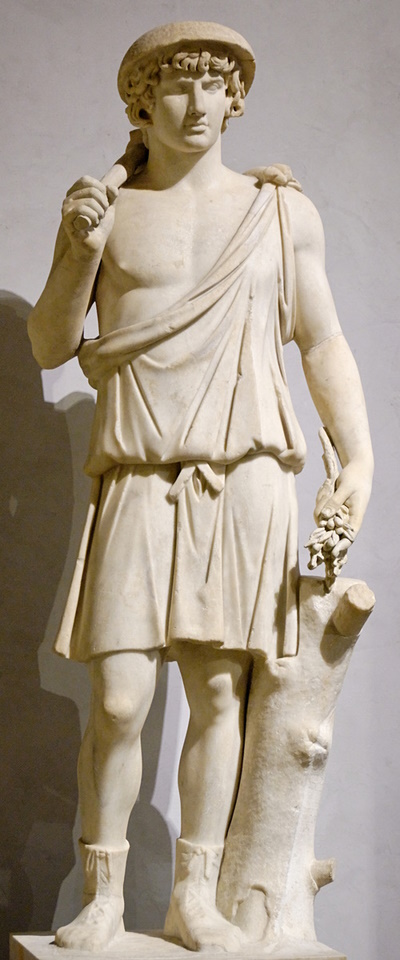
Beekeeper Review: Aristaeus

“That man invented the riddled hive with its rows of cells, and made a settled place for the labours of the wandering bees, which flit from flower to flower over the meadows and flutter on clusters of fine-fruiting plants, sucking dew from the top with the tips of their lips. He covered every limb from toenails to hair with a closewoven wrap of linen, to defend him from the formidable stings of the battling bees, and with the cunning trick of smothering smoke he tamed their malice. He shook in the air a torch to threaten the hive-loving bee, and lifting a pair of metal plates, he clapt the two together with rattling hands over the brood in the skep, while they buzzed and humblebumbled in ceaseless din; then cutting off the covering of wax with its manypointed cells, he emptied from the comb its gleaming treasure of honeydripping increase.” –Nonnus, Dionysiaca 5. 212

Aristaeus is a pretty big deal as far as apiarists are concerned, what with being none other than the Greek God of Beekeeping. As I mentioned in the Friar Tuck review, being a legendary figure elevates a fictional character to another level, and the Greek Gods start at that level. Aristaeus may not have as many stories as Heracles or Odysseus, but you can be sure that there are many stories about Aristaeus that go together or contradict. Even for such a relatively minor figure of myth, I can’t cover them all. But we can look at the basics.

Aristaeus is the son of Apollo, the god, and Cyrene, a nymph or mortal princess depending what tale you’re listening to. In any case, Aristaeus may have been born mortal, but was elevated to godhood either because of his family or because of his skill making honey. What we do know is that he learned to keep bees alongside a lot of other skills such as herblore and cheesemaking, because even the best Beekeepers know that it pays to expand one’s knowledge base. But the thing about Aristaeus is that he shared his knowledge with humans. He travelled the world educating mortals and teaching them things that might help them get by. This sort of Promethean kindness goes a long way with me.

But there are things I don’t care for when it comes to our man here. I’ve read several accounts that describe him “enslaving” the bees, and I don’t like that, so I have to chalk it up to a translation thing. More significant is that, in some tellings, he had a role in the death Eurydice. Apparently he was enamoured by her and “chased her” which led to her running into a snake pit and getting bitten. I don’t like the idea of anybody actually physically chasing someone like that because it makes you wonder what he intended to do if he caught her. He may not have been intentionally responsible for her death, but geez. We do have stories that follow up on this event. The gods decide to punish Aristaeus for his role in her death and they kill off all his bees. To get them back he has to perform a lot of sacrifices and do rituals to make it up to Eurydice and Orpheus. He does all this and is apparently forgiven because he gets his bees back. As it is presented, he does this for his bees rather than because he actually feels bad about what he’s done. But that’s the thing about legendary figures, we don’t get much of their interiority unless someone rights that story. Anyway, none of this comes up in Hadestown, so I don’t even really need to consider canonical if I don’t want to.

There’s more to the guy. I’ve seen at least one account of him solving a murder, which is a big Beekeeping plus for me. He eventually marries a princess named AutonoĆ« and from what I can see their marriage is above average for Greek gods, if we ignore what happened to one of his children. Oh, and his name literally means “The Best”.

Five Honeycombs out of Five. He’s a literal God of Beekeeping. I feel like I couldn’t go any lower than this.

Beekeeper Review: Delia Gunning

Delia Gunning is a Beekeeper who appeared in a Johnathan Creek mystery. I’m on the record of liking it when Beekeepers use their bee-related skills to get involved in investigating mysteries and whatnot. Sadly, that’s not what happens here.

Delia is the editor of a small town’s daily newspaper who keeps bees on the side. She’s got at least three hives and makes enough honey that she can give it away as gifts. This all speaks well of her beekeeping success, but it all comes crashing down when she falls in love with the wrong guy, a guy who is a magician! And also he’s a murderer.

To abet this murderer, Delia arranges to have the victim apparently caught on video alive after going missing, so nobody thinks she’s really been killed. This is done by filming the footage before the murder. She prints up a false front page to a newspaper, has that paper visible in the background on the video, and then makes sure that news comes true on the day after the killing. Thus, a headline about a swarm of bees disrupting a city council meeting comes true when she releases some bees at that meeting on the day in question. Sheer genius in its simplicity. Sure, some of it might have been the magician’s idea, but Delia is the one who pulled it off and, given her skills both journalist and apiarist, I’m inclined to give her credit.

But it ends poorly for Delia anyway, when the killer turns on her, because she is the only one who can turn him in. He pushes her down some stairs and attempts to bludgeon her to death, only stopping because the show’s titular investigator arrives in time.

Two Honeycombs out of Five. Kind of clever and good at lateral thinking perhaps, but also led astray by love of a bad boy.