Beekeeper Review: President Kring

We’ve got Beekeeper from a Star Trek comic book today. An alien beekeeper! Potentially the first keeper of alien bees I’ve reviewed. Fantasy world bees would technically be different from Earth bees, but they are treated the same in their stories. These are actual alien bees. Anyway, here’ goes:
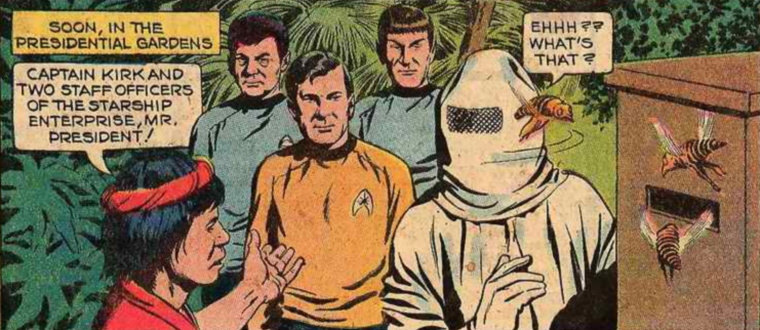
The planet Njura is the largest planet in its star system and is home to the Njuran peoples. Long ago the Njurans established colonies on the other four worlds of their system and, for nearly a thousand years, the colony worlds were ruled by Emperors based on Njura. The last of those Emperors was Kring. Kring ruled during a period of bloody rebellion in the colonies and, indeed, he was overthrown. With the colonies now free, Kring was no longer the Emperor, but was elected President of Njura in an actual democratic election.

During the peaceful era of President Kring the Njurans began talks with the United Federation of Planets and accepted a visit from the USS Enterprise. When Kirk, Spock, and McCoy pay a visit, Kring proudly showed off his apiary, where he keeps the Njuran equivalent of bees, who produce a substance called varta, which is their version of honey. Varta is pink, but is still used in cake recipes and to sweeten tea and presumably other ways similar to our use of honey. But Kring isn’t just content to harvest varta. He actively breeds his bees to create new types. It’s clear he is very much into beekeeping, which is strange given how much it doesn’t come up at all in the rest of the story.
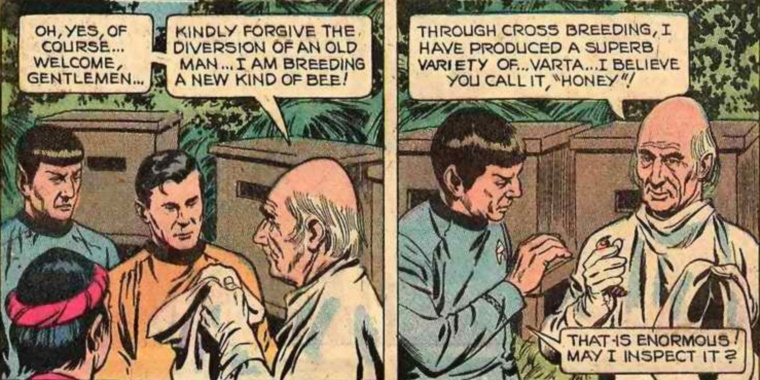
During the Federation’s visit, Kring threw a parade to show off all the agricultural ships and stuff he’d be giving to the colonies. Except, Spock figured out, it was all actually disguised military stuff. Kring was attempting a reconquest of the colonies and he was doing right in front of everyone. Oddly, after Kring is exposed, Kirk just assumed he had “learned his lesson” and the Federation team lied to the Njurans, creating a fictional villain and claiming that Kring had actually saved the day. After that, Kring earned the title “Keeper of the Peace”. It’s a weird little story.

Review time: Kring is objectively good at his apiarist craft, and he’s got access to technology perhaps not as advanced as the Federations, but better than we’ve got. He must have something going for him given that even after his defeat during the rebellion he is made President and rules in a time of peace (and given that Kirk was willing to cover for him). But that attempt to recapture the colonies really hurts his score, no matter how quickly he accepts his failure. At best I could say this was a case of succumbing to Beekeeper Rage. At worst, Kring is a straight-up supervillain. I wish I could rate him higher, but I cannot:

Three Honeycombs out of Five.

Beekeeper Review: Sam from Spy vs. Spy

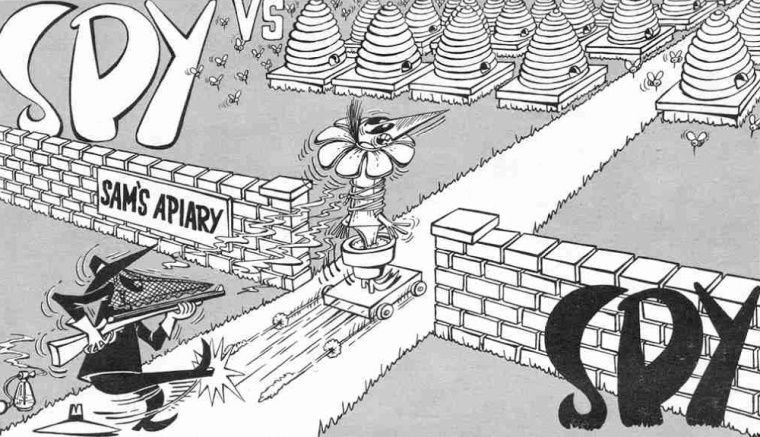
We never see Sam. We’re not told anything about Sam. This single panel from the title section of a Spy vs. Spy strip is all we ever see of Sam’s Apiary. But I have to be thorough in my reviews, so it’s got to be done.

First we need to ask: Does Sam even exist? The titular spies spend a lot of time and effort setting up traps for each other and establishing a fake apiary would certainly be within their typical hijinks. But this scenario doesn’t seem to involve any such trickery. The Black Spy has simply tied up his enemy, make him appear to be a flower, and pushed him in among the hives. I think this was an existing honey farm and that Sam is indeed real.

Sam’s got to be pretty good. They’ve got dozens of hives on the go and the bees seem to be healthy. And they’ve achieved this level of success in a world where the Black and White armies are causing damage all the time every day forever. That’s impressive. But we just don’t know enough to rank Sam as anything more than an average Beekeeper.

Two Honeycombs out of Five.

Checking in on 50 Beekeepers

I should take a moment to note that I have reviewed fifty Fictional Beekeepers for this website so far. Let’s check in on them. When I was at 25, the average ranking was a mere 2.52 out of 5. I’ve checked the numbers and our average at 50 is:

2.68 out of 5.

Well. That’s not quite the level of improvement I was hoping for. Still a lot of work ahead for my quest of apiarist boosting.

It’s worth remembering that 2 out of 5 is the range that includes what a decent real-world beekeeper would achieve, so it isn’t anything to be ashamed of. And that is also the range where I’d place superhuman beekeepers who turn to villainy.

But I know I can improve that grade. I’m on the job.

Beekeeper Review: Swarm

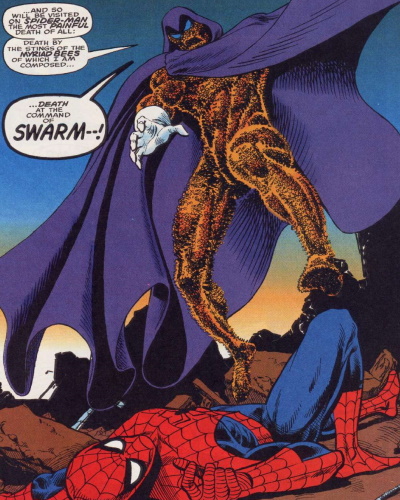
Today’s fictional beekeeper is the Marvel Comics supervillain known as Swarm. If you’ve heard of him at all, you probably know the deal: he’s a Nazi made of bees.

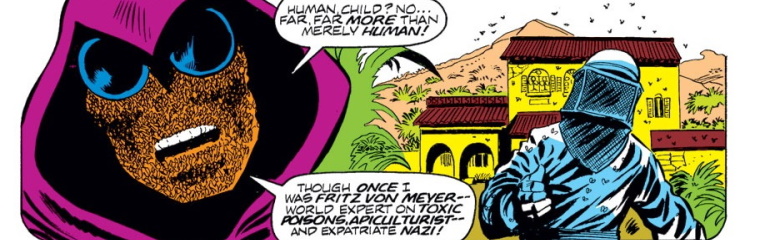
Swarm was once a human scientist and beekeeper named Fritz von Meyer. Fritz’s time during the Second World War has not been explored much, though he’s been described as one of Hitler’s top scientists and we know he was an expert in toxins and poisons. Given that, I’d expect he did some real real bad things. When the Nazis lost, he fled to South America and lived in hiding there for years.

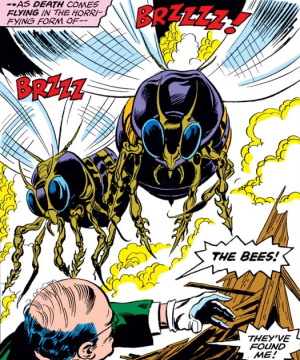
It was in South America that Fritz came to devote more time to melittology, opting to study the breeding patterns of killer bees (perhaps already he saw bees as a way to get his revenge). During this period he discovered a colony of bees that had been strangely mutated by cosmic radiation, making them stronger, more intelligent, more curious, and utterly peaceful and without fear. Fritz saw this and immediately thought “Hey maybe I can make them evil!” so he made a sci-fi ray gun that was supposed to help him control these killer bees and reactivate their violent nature. As soon as he fired on them, the bees devoured Fritz down to the bone, but his consciousness remained alive, now part of the hivemind of the bees. He could even create a physical form for his mind by having the bees swarm around his skeleton. Taking on the role of “Lord of the Killer Bees” Swarm is began his career as a supervillain and began trying to conquer the world.

Indeed this fusion of beekeeper and bees has resulted in one heckuva powerful supervillain. Being a man-made-of-bees, Swarm can fly and break into disparate parts, and looks great in a cloak. They can see simultaneously from the eyes of any and all of the bees in the hivemind, which has at times numbered millions of bees, enough to cover Los Angeles. They can eat their way through various materials, including synthetic webbing and some armours. They have complete access to Fritz’s mad science intellect as well, creating such things as giant invulnerable mutant queens, massive mechanical drones, and duplicates of enemy heroes made from bees. In one instance, after a defeat that left Fritz’s skeleton separated from the bees, a dormant queen was hidden inside his skull that, when bathed in radiation, awakened and gave birth to a new swarm’s worth of bees at incredible speeds.

Of course, as impressive as that list is, Swarm is not without weaknesses. Threats to the individual bees are just what they would be to any bees. Fire, water, electricity, all of these and more have felled the bees. Regular insect repellent has proven useful on several occasions. But Swarm itself is not just individual bees, it is the hivemind in full. That’s harder to defeat, but heroes have managed it on numerous occasions. There are vibrations that disrupt the mental cohesion among the bees, but I’m going to come out and say it: Swarm’s biggest weakness is that Swarm is a bad beekeeper.

Swarm’s bees are explicitly “killer bees” and we’ve never once seen the guy making honey. Fritz, and therefore the hivemind, doesn’t care a whit for the wellness of the bees beyond their use as a tool for world conquest. Not once have I seen Swarm, you know, making honey or anything. This whole colony is too caught up in that supervillain life to be good at being bees. It doesn’t have to be this way. Beekeepers are supposed to improve the existence of the hive, but Fritz has not done so.

It’s interesting to look at the arc that Swarm has undergone through their publication history, which I’m sure is unintentional since the character has been thoroughly stickerbooked. When fresh on the scene, Swarm was a powerful world-level threat that took a lot to beat. After several defeats, they started identifying as a pluralized being, no longer explicitly as Fritz von Meyer. This version of Swarm decided to opt out of the supervillain game, content to just wait until humanity offed itself through its various follies. This era of Swarm didn’t seek out fights, but would retaliate if someone accidentally hurt them. But that era didn’t last and Swarm has fallen to more petty supervillainy, and with it the singly-identifying again. He’s now more likely to join a team of supervillains (though at least he’s been the leader of such groups) and pull off crimes like robbing banks. Swarm has identity issues and vacillates between a single being who is a jerk of a supervillain, and a grand hive who hates humanity and responds mercilessly to any threat. Neither is great, and a solid beekeeper would have been able to keep the bees on a more constructive track.

Four Honeycombs out of Five.

As you ponder this rating, keep in mind that I’ve always given evil Beekeepers a lower rating than good Beekeepers. Swarm rates this highly even though he’s quite bad because he’s powerful and supernatural and does good for bee-theming and all that, but he loses that one point that most beekeepers can get just for beekeeping. It’s a shame.

Beekeeper Review: SCP-1256-1

The code “SCP-1256-1” is used by the SCP Foundation to refer to anybody who comes under the influence of a certain strange pamphlet with mind-altering effects, but I am specifically reviewing the family on whose property the mysterious pamphlet was first discovered. We don’t know much about them, but of course that will not stop me. I’ve reviewed more obscure beekeepers than this.

This family of five ran a bee-farm in New South Wales, though I can’t say for sure how successful it was. What we do know is that at some point they came into the possession of a pamphlet titled “Bees – Smarter Than You Think” and at least one member of the family (the eldest daughter) read it pamphlet and fell under its influence.

For whatever reason, this pamphlet makes the reader obsessed with helping bees. Unfortunately this does not make for better beekeepers, because it does it wrong. The afflicted person loses any sense of what actually helps the hive and can actually hurt the hive, to the point that the bees will be fighting against the person who is obsessively trying to help them. In the case of this family, it ended with the daughter murdering the rest of her family. In the long run, this did not help the farm.

This family is (or I should say, was) a beekeeping group in proximity to the supernatural. Often that can be good for these reviews. It did not work out so well in this case, though. They don’t rate so highly.

2 Honeycombs out of Five.

It’s worth noting that the SCP Foundation has devoted a team to containing the pamphlet when it turns up, called Mobile Task Force Zeta-4 but nicknamed the ‘Beekeepers’. But they aren’t actually beekeepers. They’re pamphlet killers whose target pamphlet happens to be about bees.