
This is a work in progress.
Gurx orbits a star that the Strondovarians call Ahan.
I estimate that the surface gravity of Gurx is somewhere in the range of 85 to 90 percent of Earth’s gravity.
A map of Gurx as provided in this post.
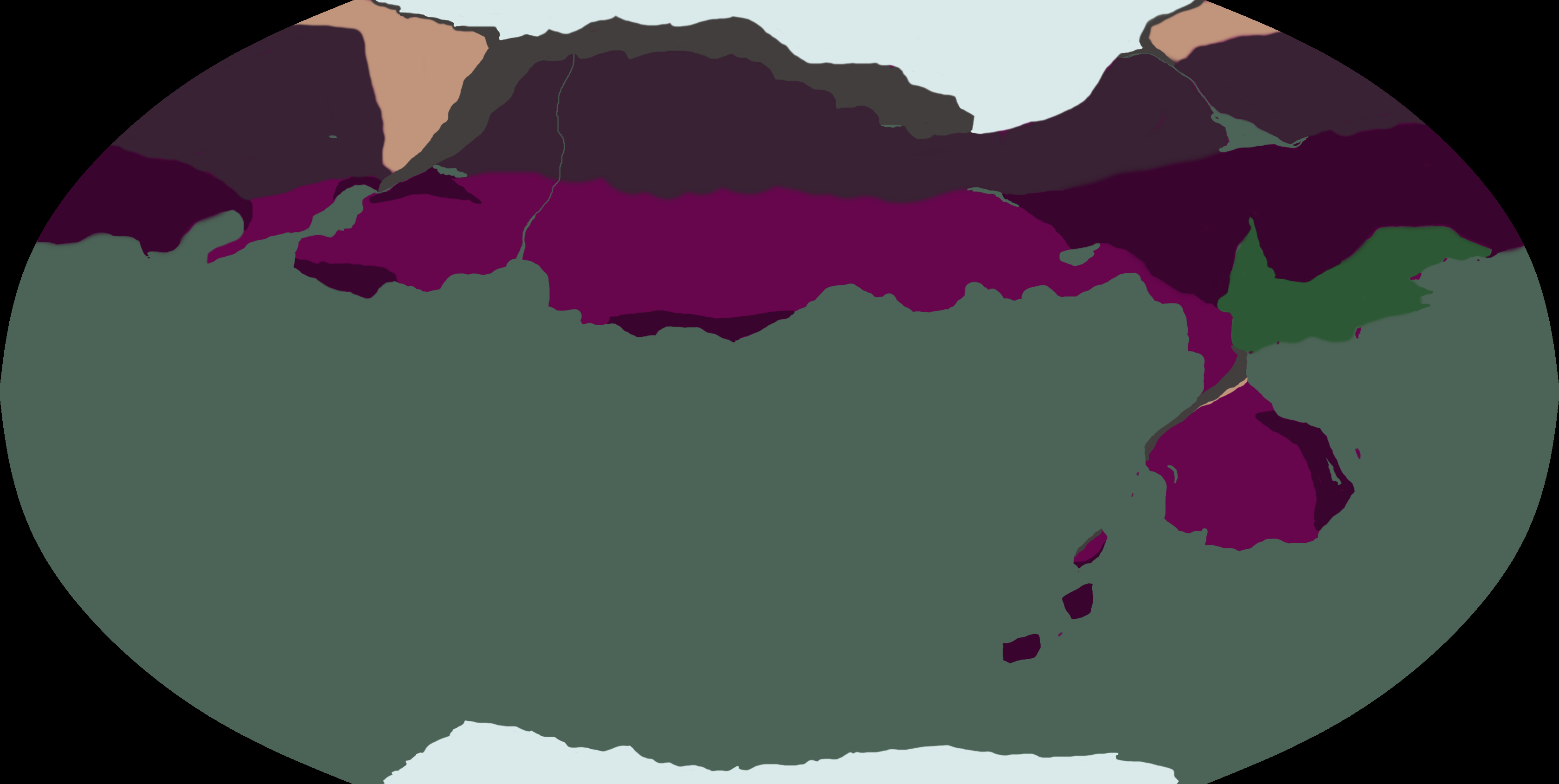
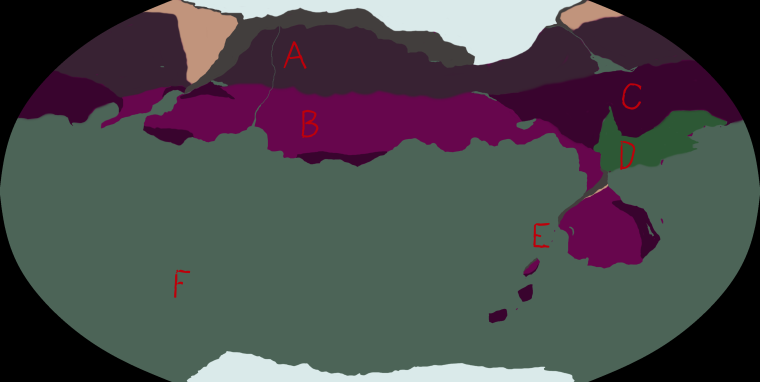
- A: The region depicted here in a kind of greyish purple is the Gurxian equivalent of a tundra, called the “Evboviv” in Strondo language. Cool and dry compared to the more southerly regions, the Evboviv of Gurx is made up of hilly areas, lots of rivers and lakes, and grasslike plants that grow dozens of metres tall in some areas. To the north of the Evboviv you’ll find volcanic mountain ranges, chilly deserts, and the polar ice cap. Strondovarians only sparsely populate this region, but a lot of their spaceports are located in cities around here.
- B: The brighter purple on the map is the rocky grasslands, which the Strondos know as the “Koneabb” and it is where most of Strondo population of Gurx lives. Though trees and forests can spring up here, generally the ground doesn’t support the large plants of Gurx very well, so only smaller grass-like plants can thrive. This makes a lot of room for Strondo development.
- C: The dark purple on this map is the dense forest region the Strondos call the “Yaouphar” and encompasses dryer forests of the north and the humid forests in the equatorial regions. Strondos have not always treated the Yaouphar with respect, but since they’ve begun populating other planets, few Gurxian Strondos have found it worth the effort to live there. Nature has reclaimed many of the former Strondo dwellings there and the Yaouphar are once again thick and teeming with diverse kinds of life, plants and animals, large and small.
- D: Slime is very common in the waters of Gurx, but the green on this map represents a region of ocean on which slime floats in a mass so thick and permanent on the surface and a whole ecology has grown on it. We might call these the “slimelands” but to the Strondos they are the “Chooeviv”. There are small Strondo settlements on the Chooeviv, mostly farming communities, but like the Yaouphar the population has decreased since the days before Strondos reached other worlds.
- E: The peninsula and islands in the South are the result of tectonic activity. These islands are so separated from the rest of the Gurxian landmass that animals and plants here had significant evolutionary differences from the rest of the world.
- F: And of course there is the ocean, or the “Agedda” as the Strondos call it. It makes up most of the surface of the planet and, while it doesn’t reach the depths that Earth’s oceans do, it is full of life as well.
