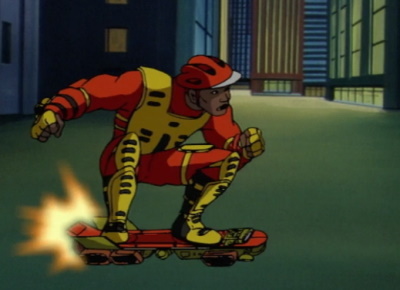
Rocket Racer of Earth-20051

I mentioned last time that Fred Van Lente had written an “other-continuity” appearance of Rocket Racer not applicable to the mainstream Bob Farrell. Well, let’s delve Into The Rocketverse and explore that:

This was in a book called Marvel Adventures Spider-Man #21. You know how mainstream superhero comics are a poisoned cesspool of non-stop drastic changes to the status quo trying to trick the audience into thinking stories are “important” because apparently the bulk of readers of mainstream superhero comics only value stories for how “important” they are? Well, Marvel Adventures Spider-Man was mercifully not that. It was just a book that sought to tell simple Spider-Man stories and, from what I’ve seen, it did them well. Naturally it’s long dead now.
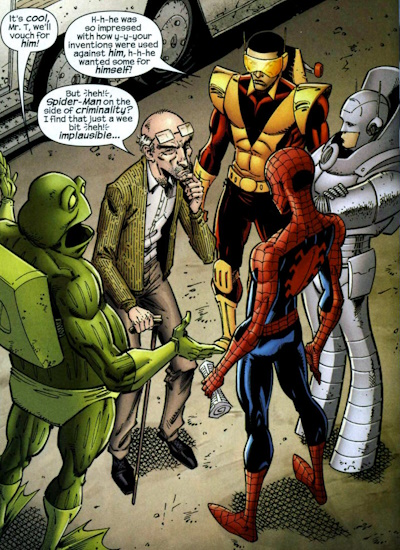
This story begins with Spider-Man chasing the Rocket Racer who has a big bag of cash stolen from a bank (classic!). This version of Bob stutters with almost every other word and he lobs insults at Spider-Man implying that the vigilante is dumb, showing that this Bob very much values intellect. Bob escapes with relative ease, but Spidey finds one of his rockets hasn’t exploded and it has a “T” logo on it.

Spider-Man then has to deal with two other supervillains, Frog Man (Eugene) and Stilt-Man (Wilbur), only to discover that the three are actually working together. They are just nerdy guys who “met online at a message board for connoisseurs of the mechanical arts” and from there they met the Tinkerer, the guy who provides supervillains with technology. The Tinkerer offered the three guys super-suits for free, no strings attached, because what the Tinkerer actually wanted was to show off how good his tech was to real supervillains. When these three loser villains fail to defeat Spider-Man on their own, Tinkerer remote controls them to attack more violently, against their protestations. The hero still wins, of course, but we see that these guys are crooks, but don’t want to be murderers.

This version of Bob clearly loves technology, but it seems like all credit for his devices goes to Tinkerer here, which clearly makes him less of a self-made Rocket Racer. The regular version of Bob did have his tech improved by the Tinkerer, but only after designing it himself and beginning his Rocket Racer career. Like Van Lente’s Supervillain Team-Up story, this story leans into the “nerd” take on Bob. He’s got a Star Trek shirt and a Godzilla poster and the like. I don’t mind this take, save for the fact I don’t think the mainstream Bob has the disposable income to collect things like that.

As for Wilbur and Eugene: Bob-616 has only minor connections to either of those characters. He attended the funeral/wake for his universe’s Wilbur Day, but more to be with his friends who were closer. And he may have met his universe’s Eugene, but only in passing as far as we’ve been told. For the sake of this story, Bob is roughly the same nebulous age that he always is, but Stilt-Man is, if anything, aged down and Frog Man aged up, so they are all now in the same cohort. For the record, in the Marvel Universe proper, Eugene is not a tech-guy. His Frog-Man suit was built by his father and he’s had to rely on others to repair it. Also, regular Eugene has never been a criminal.

The Animated Adventures of Rocket Racer

There was an episode of the ’90s Spider-Man cartoon that had Robert Farrell in it. They never actually call him “the Rocket Racer” in the episode, but he does all the usual Rocket Racer stuff. It’s got to be the most prominent appearance of the character outside of the comics so far, and it’s likely to remain that way for a long time.

In the fifth episode of the third season, titled “Rocket Racer” we meet Robert Farrell, voiced by Billy ‘Pop’ Atmore.

Watching the episode, I find that we get a lot of the things I want to see in a Rocket Racer story. There’s subtle commentary on race and how ex-criminals aren’t given a fair shot at finding their way back into society. We’re shown Bob struggling to help out his sick mother, whose illness is never identified. We’re shown that the neighbourhood where Bob lives is on his side (a pharmacist gives him a discount on medicine). Bob shows no signs of romantic interest in anyone. We even get the Big Wheel making an appearance. All in all, this is about as faithful an appearance to the comics version as possible. So here’s where I pick out what is different about Rocket Racer here and his usual portrayal in the Marvel Universe.

  • Bob is young here. I’ve mentioned this one before, but usually Bob is depicted as being at least as old as Spider-Man, but in this episode he is a teenager who is actually a student being tutored by Peter Parker. I don’t mind that he’s aged down for this (as I’ve said, you’d expect a skateboard-themed character to be young), but I don’t like that he knows Peter Parker. That makes the world feel very small.
  • Bob’s story is backwards. In the comics, Bob was an upstanding and smart young child who had to resort to crime because he couldn’t afford to take care of his family when his mother got sick. In the cartoon, Bob was a criminal child who turned his life around to help his mother when she got sick. There’s a place for each kind of story, sure, but I prefer the original, because it casts the broken aspects of society as the impetus.
  • Bob’s family doesn’t exist here. In this cartoon Mrs. Farrell (never named Emma, but we can assume) is shown to be a single mother, but instead of having seven children, she seems to only have Bob. I do feel that Bob’s siblings represent untapped potential for Rocket Racer stories, but this isn’t a Rocket Racer story. This is a Spider-Man show that only goes to the Rocket Racer well one time, so it doesn’t need all those other kids around to complicate things. It is understandable to have excised them. (Also, Mrs. Farrell is depicted as much thinner and more conventionally attractive than her comics counterpart. That I don’t like. Let’s have more representation of large people, please. But I guess having six fewer children made a difference.)
  • Mrs. Farrell owns a grocery store. We’re never told what Mrs. Farrell did for work in the comics, but in this cartoon she owns Farrell’s Grocery. Maybe the comics version has this store too. Maybe it’s manned by Bob’s adult siblings we never see. We simply don’t have the information.
  • The Big Wheel’s story is also backwards. In the comics, Jackson Weele was an embezzling businessman who was conned by Bob when the Rocket Racer did crimes on corporate types. That caused Jackson to create the Big Wheel persona for revenge. In the cartoon, the Big Wheel is an existing criminal mastermind with a gang of henchmen in power-suits called the Rocket Raiders. I’d guess maybe this was changed to make Bob a more sympathetic character, since blackmailing someone so hard that they become a supervillain isn’t a great look if you want the kid to be a poor wretch who deserves better, right?
  • Bob steals equipment from the Rocket Raiders to create his own Rocket Racer equipment. In the comics, Bob gets his equipment from junkyards and the Tinkerer. This is a very minor change, given that we’re still shown Bob assembling the equipment himself and Peter admits that Bob knows a lot about gyroscopic science or whatever it is. Sure, it seems like it’d be less impressive to build a rocket skateboard from pre-made equipment than from scratch, but it’s only really done to drive the conflict here. I’ll allow it.

So that’s my report on the Spider-Man Animated Series episode Rocket Racer. Let’s see what the people on the Internet have to say about it. “This episode and The Spot are considered by most fans to be the two worst episodes of Spider-Man: The Animated Series.” Ah. Well. At least it’s a tie, and not dead last.