Phone Guys: New Toothpaste

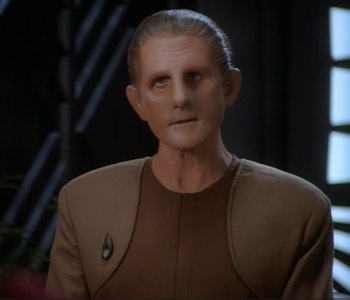
When I watched Deep Space Nine as a child, I liked Odo, but I thought of him as a cranky old man. It was only later that I realized that this was incorrect. Odo was young. Cranky, yes, but young.
If we get an exact estimate of his age in the show, I missed it, but I did notice than in the later seasons he mentioned his youth being “thirty years ago” or something close to it. So, at the beginning of the show he was the equivalent of a human in his twenties. And that means while he was on Terok Nor, he was basically a teenage who had been recruited to serve a fascist regime. He never spent any time as a child, he presumably started looking like a Bajoranoid adult as soon as he started looking like a person at all. It’s no wonder he’s grumpy.
I also began wondering on this watch if Odo’s inability to emulate other faces perfectly wasn’t a bit of a psychological thing rather than a skill issue. In his formative years, sure, that imperfect attempt to emulate a Bajoran appearance he couldn’t get it right, but in time that “imperfect” face became his face. Odo is someone who felt very comfortable within rigid rules and codes, so having a mental “rule” about his self-image surely felt like something he could not easily switch on and off. Pretending to be a serving tray, that Odo can do. Pretending to be a person other than Odo? That could lead him down lines of thought he didn’t want to deal with.
Naturally I can’t let a post go by without talking about aliens in Star Trek and Odo is, of course, one of very few main characters in the franchise who are not a member of a humanoid alien species. The fact he gets to look exactly like one surely helps this to have happened, but he’s really goo. It was always disappointing to me that when we saw other members of his species, they defaulted to a look that resembled his. I guess it was done for ease of the viewers (and makeup designers), so we’d mentally connect them to him. I dunno, maybe if they’d looked different it could have played into his distance from them. Would he have wanted to make himself look more like them? Would that have caused him self-image problems? I guess we’ll never know. (When we saw some other Changelings on Picard’s show, they defaulted to a different form, I admit, but Odo was long gone by then.)
This is the train one.
We get Daily Planet headlines about the biggest ever shipment of gold being sent by train and we know, that’s gonna have some trouble. The byline on the article is Lois’s, which is nice considering in this era she was often depicted as being stuck doing “women’s stories” and such, and she even gets to ride the train along the shipment to keep the story going. A bunch of exactly-the-same-guy looking security guards load the gold onto the train and we’re off.
Obviously this is a story about an attempted train robbery. The nondescript masked robbers have a cool modified car, which is the only really notable thing about them. Two of them hop on board, though their hijacking attempt doesn’t go great. Though they are able to get rid of the security guards and knock the engineer off the train, they only do so by falling off themselves. Now we have a train with all that gold and the only person on board to protect it is Lois Lane.
This cartoon is a good showing for Lois. Is she in a woman in peril? Yeah, sure, but she’s there for her job and she doesn’t go quietly. In this one she picks up a gun and fires back at the cool car. The car is bulletproof, but hey, Lois tries.
Back at the office, Clark hears about the situation so he gets into his Superman outfit (just hiding behind some boxes to do it today), and we get to see who really is more powerful than a locomotive. The remaining criminals use their cool car to Wacky Races the train, in that they keep getting ahead of it and setting traps and whatnot. Superman responds by doing super things to save the train. All good stuff. A great bit is when the train is falling and he catches it and jumps back up with it back onto the tracks, making sure to leap swiftly from the front to the back as he does it to line it up right. And the bit where Superman struggles ever so slightly to pull against the train’s downhill momentum puts me in a mind of the fight where he punches the lasers in the Mad Scientist. I like seeing Superman have to put some effort in. I’m not one of those who think the character needs to be depowered to be interesting, but I do think he should look like he’s trying while he’s doing all those powerful things.
In the end, Clark brings the gold to its destination by himself, so it can be used by the military-industrial complex or whatever, and we’re given another news article by Lois saying that he went back to catch those criminals and then disappeared. We’re given a little “back at the Planet” scene for an ending, but it’s not a great one. Still, Clark knowingly looks at the camera and, while he may not wink, it’s getting closer.
I am fond of this one, though largely for the cool car. If you’d asked me at the start of this rewatch, when Clark excused himself at the beginning, I thought he was slipping off so that he could Superman up to watch the train. Instead, since we next see him at the office, I guess he really was just working on a different story. I like that better somehow.
“But I had never met Sir John, had never visited Tremoth Hall, till the time of those happenings which formed the final tragedy. My father had taken me from England to Canada when I was a small infant; he had prospered in Manitoba as an apiarist; and after his death the bee ranch had kept me too busy for years to execute a long-cherished dream of visiting my natal land and exploring its rural by-ways.”
Today’s Beekeepers are from a short story from 1933 called “The Unnamed Offspring” by Clark Ashton Smith and it is part of the “Cthulhu Mythos” of stories, which means it shares a lineage with the unnamed Greek Beekeeper I have reviewed before. In that story the Beekeeper was offhandedly mentioned and never showed up. In this one of the Beekeepers is the protagonist, though his beekeeping is only offhandedly mentioned. Well, still better than nothing.
Henry Chaldane is our protagonist. His father, Arthur Chaldane, was the one who originally “prospered in Manitoba as an apiarist” but his father is dead by the time our story begins. Henry took over the “bee ranch” after that and, while it kept him busy for years, he eventually got to a point where either he had enough help running the place he could take some time off, or he just sold it. In either case, Henry is not actively keeping bees at this time, but it is theoretically possible that he has people doing it for him back in Canada while he travels. We know that Arthur was good at beekeeping and Henry seems to have followed in his footsteps, so that’s all good.
But what of the extras of being a Beekeeper? The Chaldanes have no supernatural abilities. We only spend time with Henry and he seems nice enough. He rides a motorcycle, which is unsafe but undeniably cool. When thrust into a horror story scenario, he understands what is going on around him almost immediately. And he’s not necessarily combat-focused by nature, but when given a gun and asked to help fight off a monstrous Ghoul, he does his best. His best fails, but it’s a brave kind of failure.

Two Honeycombs out of Five. I’d love to be able to give him more, but we’re just not given enough information to work with.
Latest SecGov Page:
